


Classes Still Create Hoosier Hysteria
July 27, 2017
By Rob Kaminski
MHSAA benchmarks editor
This is the fourth part in a series on MHSAA tournament classification, past and present, that will be published over the next two weeks. This series originally ran in this spring's edition of MHSAA benchmarks.
Twenty years ago, Bloomington North High School won the Indiana High School Athletic Association boys basketball championship, defeating Delta 75-54 at the RCA Dome in Indianapolis.
The date, March 22, 1997, is at the same time revered and disdained by traditionalists in the state who saw it as the last schoolboy championship game the state would ever host.
That’s how devout the game of basketball, particularly interscholastic basketball, had become in the Hoosier state during the 87 years a state champion – one state champion, to be precise – was crowned.
Following that 1997 season, the IHSAA moved to a four-class system for its roundball tournaments, like so many of its state association counterparts had done years earlier.
It would be shocking to find more than a small percentage of current high school basketball players around the country unfamiliar with the iconic movie Hoosiers, even though the film is now more than 30 years old.
And, the storyline for that blockbuster unfolded more than 30 years prior to its release, when small-town, undermanned Milan High School defeated Muncie Central High School 32-30 in the 1954 IHSAA title game.
Perhaps it’s because of the David vs Goliath notion, or the fame of the movie that replaced Milan with the fictional Hickory and real-life star Bobby Plump with Hollywood hero Jimmy Chitwood, or the simple fact that Indiana had something other states didn’t.
Whatever the reason, plenty of opposition remains to this day to basketball classification in the state.
The fact is, the small rural schools were regularly being beaten handily by the much larger suburban and city schools as the tournament progressed each season.
Small schools also were closing at a rapid rate following the state’s School Reorganization Act in 1959, as students converged on larger, centralized county schools. From 1960 to 2000, the number of schools entering the tournament dropped from 694 to 381, and in 1997 a total of 382 schools and 4,584 athletes began competition at the Sectional level (the first level of the IHSAA Basketball Tournament).
It was at the entry level of the tournament where school administrators felt the pain of the new class system, but not necessarily for the same nostalgic reasons as the fans who either attended or boycotted the tournament.
At the Sectional round of the tournament, the IHSAA was culling just 2 percent of the revenue, with the participating schools splitting the balance. So, when Sectional attendance dropped by 14 percent in that first year of class basketball, many schools realized a financial loss. It was money they had grown to count on in prior years to help fund various aspects of the department.
Schools cumulatively received more than $900,000 from Sectional competition in 1998, but that total was down from more than $1 million in the last year of the single-class tournament.
Yet, the current format provides a great deal more opportunity and realistic chances at championship runs for schools of all enrollments.
To date, 60 additional teams have championship or runner-up trophies on display in school trophy cases around Indiana.
That was the mission in front of then-IHSAA commissioner Bob Gardner (now National Federation executive director) once the board made its decision: to give thousands more student-athletes the opportunity for once-in-a-lifetime experiences.
As any statistician knows, figures can be manipulated to tell any side of a story. Declining attendance in year one of class basketball is such a number.
The truth is tournament attendance had been on a steady downward spiral since its peak of just over 1.5 million in 1962. By the last single-class event in 1997, the total attendance was half that.
The challenge then and today, as it is for all state associations, is to find that delicate balance for those holding onto tradition, those holding onto trophies, and the number of trophies to hand out.
Editor’s Note: Stories from the Fort Wayne Journal Gazette in 1998 and from a 2007 issue of Indianapolis Monthly provided facts in this article.
History Made in D1 as Senior Champs Strike
By
Perry A. Farrell
Special for MHSAA.com
March 27, 2021
ALLEN PARK – Reigning Division 1 singles champ Izaac Goergen almost met his fate in the ninth frame of his second game in the boys semifinal Saturday at Thunderbowl Lanes.
A 3-7-9 split paved the way for Holt’s David Schaberg to reach the final. Goergren’s 233 could have been beaten if Schaberg struck out. But Schaberg left a seven-pin on his first shot in the 10th and his 245 game left him three pins short of advancing, 467-464.
“I threw three good shots in the 10th and I wanted to make him earn it if he beat me,’’ said Goergen. “I did that and was lucky enough to advance.’’
Schaberg, meanwhile, was stunned: “I wanted to stay aggressive. I thought it was down. In that situation, you have to stay aggressive.’’
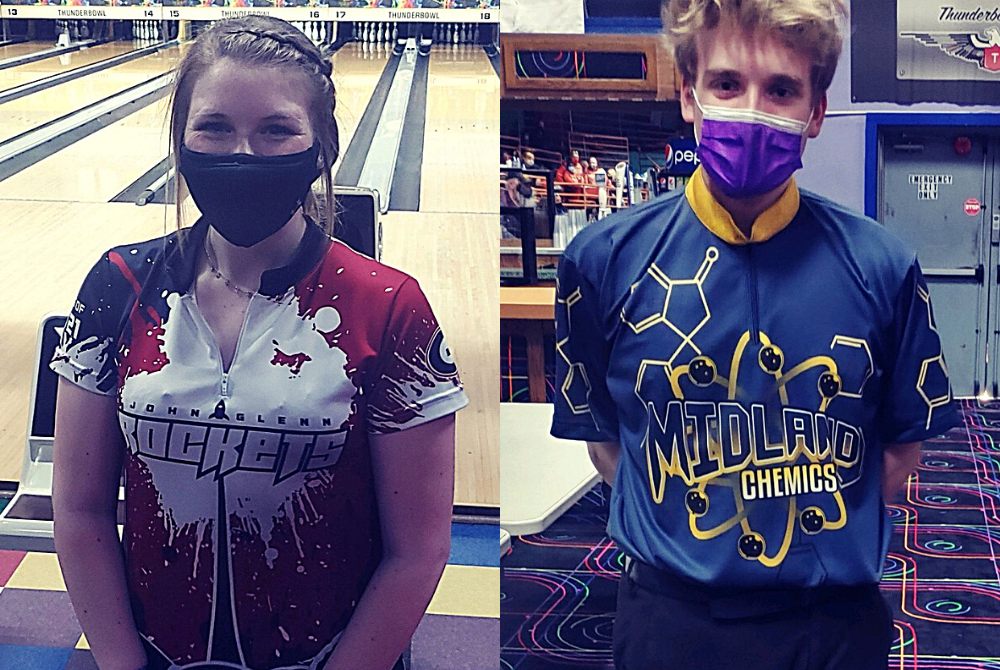
Goergen emerged with an opportunity to make MHSAA Finals history – and took advantage. The Midland senior faced junior Ian Cain from Livonia Franklin in the championship and became the first Division 1 bowler (and second across all divisions) to repeat in singles, claiming his second straight title, 463-384.
“This means everything to me,’’ said Goergen. “With the pandemic and how the season went, there were things going on that weren’t in my favor.’’
In the girls division, Westland John Glenn senior Anna Maxwell, who shot a 278 in the semifinal, knocked off the top seed on her way to the final. There she faced South Lyon’s Ava Crumley, who had stopped second-seed Melanie Straub of New Baltimore Anchor Bay to advance.
Maxwell came out firing in the championship, throwing the first 10 shots for strikes to shoot a 289 and build a 54-pin lead on her way to the title, 470-389.
“The big lead gave me some room,’’ said Maxwell. “(Crumley) is a friend, so even if she won I would’ve been fine.
“This means so much considering what we have been through.’’
Cain advanced to the championship by knocking off Nick Johnson of Swartz Creek 377-331.
Goergen was the top qualifier at 1,361, 10 pins higher than Northville’s Brandon Leavitt, whose 279 in the sixth game shot him up to second in the qualifying block.
Jacob Vernier of Wyandotte Roosevelt was the final qualifier at 1,210, one pin better than Gabe Johnson of Plymouth and three more than Patrick McLetchie of Clarkston.
Despite a split in the 10th frame of his second game, Goergen advanced to the quarterfinal with a 383-371 victory over Vernier.
The toughest match pitted Franklin teammates Cain and Kenneth Kloth Jr. Cain advanced to the quarterfinal with a 399-368 win to face junior Brandon Leavitt of Northville in a semifinal.
“It was tough, especially with him being a senior,’’ said Cain. “I just concentrated on my game. The lanes are really tough.’’
Schaberg moved into the semifinal by eliminating sophomore Jermiah Swain of Hudsonville 445-308.
Nick Johnson of Swartz Creek shot 254 in his second quarterfinal game and beat Andrew Martin of Utica Ford 489-434.
Goergen reached the semifinals by eliminating Shane Legeret of Macomb Dakota 388-335.
Grace Meyer of Oxford was the top girls qualifier at 1,271, 17 pins better than sophomore Straub.
Meyer eventually met her match and fell to Maxwell in the quarterfinal, 411-282.
Meyer had eliminated Sarah Lyeria of Lapeer, 432-351, to get to Maxwell, while Straub moved past Alexis Thompson of Grand Haven, 466-365.
Belleville, the team runner-up on Friday, had two singles advance to the quarterfinal. Junior Sydney Allison eliminated Carrington Beamon of Farmington, 426-308, while teammate Asia Wells beat Kaitlyn McGovern of Midland, 352-345.
Straub, who hadn’t bowled a game under 210, beat Wells, 441-393, to advance to the semifinal to face Crumley, who had defeated Morgan Smith of Zeeland East 415-335. Allison, meanwhile, was stopped by Monroe’s Nataleigh Eagle, 368-319, in the other quarterfinal.