


Classes Still Create Hoosier Hysteria
July 27, 2017
By Rob Kaminski
MHSAA benchmarks editor
This is the fourth part in a series on MHSAA tournament classification, past and present, that will be published over the next two weeks. This series originally ran in this spring's edition of MHSAA benchmarks.
Twenty years ago, Bloomington North High School won the Indiana High School Athletic Association boys basketball championship, defeating Delta 75-54 at the RCA Dome in Indianapolis.
The date, March 22, 1997, is at the same time revered and disdained by traditionalists in the state who saw it as the last schoolboy championship game the state would ever host.
That’s how devout the game of basketball, particularly interscholastic basketball, had become in the Hoosier state during the 87 years a state champion – one state champion, to be precise – was crowned.
Following that 1997 season, the IHSAA moved to a four-class system for its roundball tournaments, like so many of its state association counterparts had done years earlier.
It would be shocking to find more than a small percentage of current high school basketball players around the country unfamiliar with the iconic movie Hoosiers, even though the film is now more than 30 years old.
And, the storyline for that blockbuster unfolded more than 30 years prior to its release, when small-town, undermanned Milan High School defeated Muncie Central High School 32-30 in the 1954 IHSAA title game.
Perhaps it’s because of the David vs Goliath notion, or the fame of the movie that replaced Milan with the fictional Hickory and real-life star Bobby Plump with Hollywood hero Jimmy Chitwood, or the simple fact that Indiana had something other states didn’t.
Whatever the reason, plenty of opposition remains to this day to basketball classification in the state.
The fact is, the small rural schools were regularly being beaten handily by the much larger suburban and city schools as the tournament progressed each season.
Small schools also were closing at a rapid rate following the state’s School Reorganization Act in 1959, as students converged on larger, centralized county schools. From 1960 to 2000, the number of schools entering the tournament dropped from 694 to 381, and in 1997 a total of 382 schools and 4,584 athletes began competition at the Sectional level (the first level of the IHSAA Basketball Tournament).
It was at the entry level of the tournament where school administrators felt the pain of the new class system, but not necessarily for the same nostalgic reasons as the fans who either attended or boycotted the tournament.
At the Sectional round of the tournament, the IHSAA was culling just 2 percent of the revenue, with the participating schools splitting the balance. So, when Sectional attendance dropped by 14 percent in that first year of class basketball, many schools realized a financial loss. It was money they had grown to count on in prior years to help fund various aspects of the department.
Schools cumulatively received more than $900,000 from Sectional competition in 1998, but that total was down from more than $1 million in the last year of the single-class tournament.
Yet, the current format provides a great deal more opportunity and realistic chances at championship runs for schools of all enrollments.
To date, 60 additional teams have championship or runner-up trophies on display in school trophy cases around Indiana.
That was the mission in front of then-IHSAA commissioner Bob Gardner (now National Federation executive director) once the board made its decision: to give thousands more student-athletes the opportunity for once-in-a-lifetime experiences.
As any statistician knows, figures can be manipulated to tell any side of a story. Declining attendance in year one of class basketball is such a number.
The truth is tournament attendance had been on a steady downward spiral since its peak of just over 1.5 million in 1962. By the last single-class event in 1997, the total attendance was half that.
The challenge then and today, as it is for all state associations, is to find that delicate balance for those holding onto tradition, those holding onto trophies, and the number of trophies to hand out.
Editor’s Note: Stories from the Fort Wayne Journal Gazette in 1998 and from a 2007 issue of Indianapolis Monthly provided facts in this article.
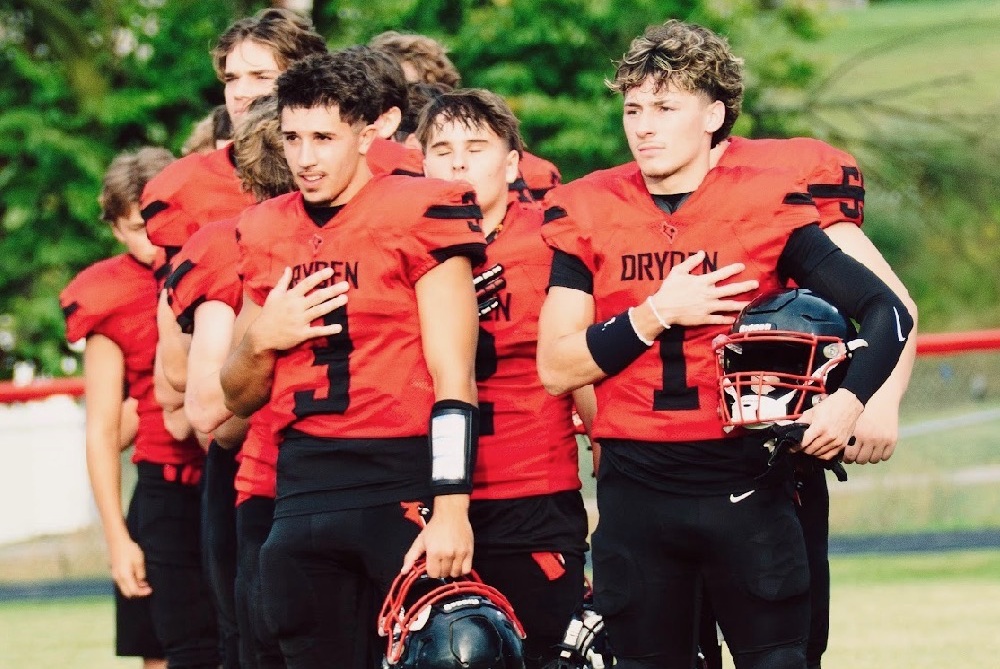
Rejuvenated Dryden Football Hungry for More After Undefeated Start, Signature Win
By
Paul Costanzo
Special for MHSAA.com
October 1, 2026
Santiago Perales and his Dryden football teammates aren’t patting themselves on the back for anything.
 The Cardinals are 5-0 and just knocked off the Thumb’s 8-player giant, Deckerville. It’s the start of a season anyone would be celebrating, but especially a program that just restarted in 2023 after a four-year hiatus.
But looking back on how far they’ve come only makes Perales more resolute in making sure he and his senior classmates don’t lose the edge that helped them get here.
“For me, it kind of still feels the same,” Perales said. “I still feel like we’re the underdogs. The job’s not done. We have to keep working. We have to motivate the younger players to keep working hard. Everyone on the team still has more work to put in. We have to keep our heads down and keep working.”
Perales is one of six Dryden seniors who has been there since Year 1 of the return, enduring the ups and downs of a program starting from scratch.
He, Gianni Coscione, Luke Taylor, Tyler Roberts, Logan Korth and Collin Tyrkus are all in their fourth years with the program and at the heart of the unbeaten start.
“It’s pretty amazing, honestly, watching them grow from freshmen,” said Dryden coach Hunter Gall, who is also in his fourth year leading the program. “They weren’t that confident in that first year, and even the second year. But I think, honestly, it’s been good for us. They’re still super hungry even though we’re 5-0, because they’re not used to it and they don’t want that feeling to go away. But it’s been interesting to watch these freshmen who barely spoke the first year turn into huge leaders on our team. Now we’re watching them teach the underclassmen everything they learned.”
Gall, a 2018 graduate of Dryden, was part of the 2017 team, which was the last to complete a season before 2023.
The following year, the Cardinals played through September before low numbers and injuries forced them to forfeit their final three games. In 2019, they never started, and eventually players from Dryden who were interested in playing football could join Imlay City as part of a co-op.
That included at the middle school level, where Perales, Coscione and some others were playing, and succeeding.
While the co-op provided opportunity, Gall and others wanted to bring back the identity and community excitement that came with having a team representing the school.
A petition was circulated and enthusiastically moved through the process to start things back up again for the 2023 season, with Gall in charge along with his classmate and assistant coach Sam Peyerk.
The Cardinals actually won their first game back, defeating Carsonville-Port Sanilac 52-12, but they would finish the season 2-7, dropping seven in a row before defeating Akron-Fairgrove in Week 9.
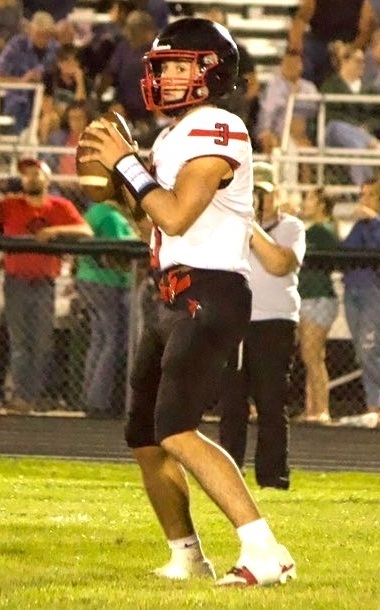
“The biggest challenge, honestly, was just teaching the game of football to a bunch of kids who had virtually never played,” Gall said. “Just basic football terms. Teaching sophomores, juniors and seniors how to get into a three-point stance is not a typical issue for most football programs. Almost half our starting lineup was freshmen, and everyone else, they were older, but they had the experience of freshmen. The biggest hurdle was just keeping them confident and keeping them from hanging their heads.”
Fortunately for Gall, his players bought in and even had a belief that very bright days could be ahead.
“I really did know that, eventually, after us putting in the hard work, we’d get to this point,” said Coscione, who is now in his fourth year as starting quarterback for the Cardinals. “Our whole team believed it. I’m not gonna lie, it was pretty hard to believe, but we all (toughed) it out together, stayed together as a team and put in the work. You can’t just start up a new program and expect to be undefeated. We all knew we had to go through those ups and downs of it sucking really bad. (Gall and Peyerk), all the coaches definitely motivated us and got us through that.”
Not all players who had to suffer through the building years were able to enjoy the fruits of the program’s labor, however, and they knew it. That, Coscione said, made their hard work even more impressive. That includes Gall’s younger brother Owen and Coscione’s older brother Sonny, who both graduated in 2025 and were part of the 2023 and 2024 teams.
“(Sonny) is so proud of not just me, but everyone,” Gianni Coscione said. “Even though he’s not out there playing with us, he knows that us being out there and doing what we are today, it wouldn’t be possible without him and the other upperclassmen that we learned from. Without them, all of this probably wouldn’t be possible. I think that shows a big part in how they’re great people. They knew they weren’t going to be part of the greatness, but they were going to be a part of the rollercoaster.”
Dryden won four games in 2024 and five in 2025, barely missing the 8-player playoffs. With just one senior graduated from the 2025 team, expectations were high surrounding this year’s group.
“The first two years, I would have said no, that I didn’t think this was going to happen,” Taylor said. “We were never going to be able to keep up with these kids at the bigger schools. But as a junior we were able to stick with them, and we knew if we locked in over the offseason (the current success was possible). A lot of us got in the gym over the summer, and we really wanted to get in and go far in the playoffs.”
Starting 4-0 was certainly a sign that it was all coming together, but it was the win against Deckerville that has added a new layer of belief in the team, at least in the community. The Eagles were the 2024 Division 1 8-Player Finals champion and advanced to the Semifinals a year ago. They’ve won two Finals titles and have two other runner-up finishes since moving to 8-player in 2012.
“It was a huge win,” Gall said. “Probably one of the biggest wins that we’ve had in program history so far. My high school coach, who was also on the 2008 Dryden team that went undefeated, he’s on my staff, and he said that even including the 2008 season, that was the biggest win of his career. Definitely, by far, it’s the biggest win of mine.”
The players acknowledge how big that win was, especially after suffering through a 2023 game against the Eagles during which they were shutout and gained just 25 yards of total offense.
But last weekend’s success hasn’t changed their goal moving ahead, which is to beat Byron, their Week 6 opponent.
“It definitely feels good, and we know that we deserved it because we put in a lot of work throughout the years,” Perales said. “But we’re not satisfied with our record right now. We want to go undefeated every week, and we know we still have to keep our heads down and keep working toward what we want.”
 Paul Costanzo served as a sportswriter at The Port Huron Times Herald from 2006-15, including three years as lead sportswriter, and prior to that as sports editor at the Hillsdale Daily News from 2005-06. He can be reached at [email protected] with story ideas for Genesee, Lapeer, St. Clair, Sanilac, Huron, Tuscola, Saginaw, Bay, Arenac, Midland and Gladwin counties.
PHOTOS (Top) From left, Gianni Coscione and Santiago Perales stand with their team for the national anthem. (Middle) Coscione eyes his target before throwing a pass. (Top photo courtesy of the Dryden football program. Action photo of Coscione by Dane Pelkowski.)