


Classes Still Create Hoosier Hysteria
July 27, 2017
By Rob Kaminski
MHSAA benchmarks editor
This is the fourth part in a series on MHSAA tournament classification, past and present, that will be published over the next two weeks. This series originally ran in this spring's edition of MHSAA benchmarks.
Twenty years ago, Bloomington North High School won the Indiana High School Athletic Association boys basketball championship, defeating Delta 75-54 at the RCA Dome in Indianapolis.
The date, March 22, 1997, is at the same time revered and disdained by traditionalists in the state who saw it as the last schoolboy championship game the state would ever host.
That’s how devout the game of basketball, particularly interscholastic basketball, had become in the Hoosier state during the 87 years a state champion – one state champion, to be precise – was crowned.
Following that 1997 season, the IHSAA moved to a four-class system for its roundball tournaments, like so many of its state association counterparts had done years earlier.
It would be shocking to find more than a small percentage of current high school basketball players around the country unfamiliar with the iconic movie Hoosiers, even though the film is now more than 30 years old.
And, the storyline for that blockbuster unfolded more than 30 years prior to its release, when small-town, undermanned Milan High School defeated Muncie Central High School 32-30 in the 1954 IHSAA title game.
Perhaps it’s because of the David vs Goliath notion, or the fame of the movie that replaced Milan with the fictional Hickory and real-life star Bobby Plump with Hollywood hero Jimmy Chitwood, or the simple fact that Indiana had something other states didn’t.
Whatever the reason, plenty of opposition remains to this day to basketball classification in the state.
The fact is, the small rural schools were regularly being beaten handily by the much larger suburban and city schools as the tournament progressed each season.
Small schools also were closing at a rapid rate following the state’s School Reorganization Act in 1959, as students converged on larger, centralized county schools. From 1960 to 2000, the number of schools entering the tournament dropped from 694 to 381, and in 1997 a total of 382 schools and 4,584 athletes began competition at the Sectional level (the first level of the IHSAA Basketball Tournament).
It was at the entry level of the tournament where school administrators felt the pain of the new class system, but not necessarily for the same nostalgic reasons as the fans who either attended or boycotted the tournament.
At the Sectional round of the tournament, the IHSAA was culling just 2 percent of the revenue, with the participating schools splitting the balance. So, when Sectional attendance dropped by 14 percent in that first year of class basketball, many schools realized a financial loss. It was money they had grown to count on in prior years to help fund various aspects of the department.
Schools cumulatively received more than $900,000 from Sectional competition in 1998, but that total was down from more than $1 million in the last year of the single-class tournament.
Yet, the current format provides a great deal more opportunity and realistic chances at championship runs for schools of all enrollments.
To date, 60 additional teams have championship or runner-up trophies on display in school trophy cases around Indiana.
That was the mission in front of then-IHSAA commissioner Bob Gardner (now National Federation executive director) once the board made its decision: to give thousands more student-athletes the opportunity for once-in-a-lifetime experiences.
As any statistician knows, figures can be manipulated to tell any side of a story. Declining attendance in year one of class basketball is such a number.
The truth is tournament attendance had been on a steady downward spiral since its peak of just over 1.5 million in 1962. By the last single-class event in 1997, the total attendance was half that.
The challenge then and today, as it is for all state associations, is to find that delicate balance for those holding onto tradition, those holding onto trophies, and the number of trophies to hand out.
Editor’s Note: Stories from the Fort Wayne Journal Gazette in 1998 and from a 2007 issue of Indianapolis Monthly provided facts in this article.
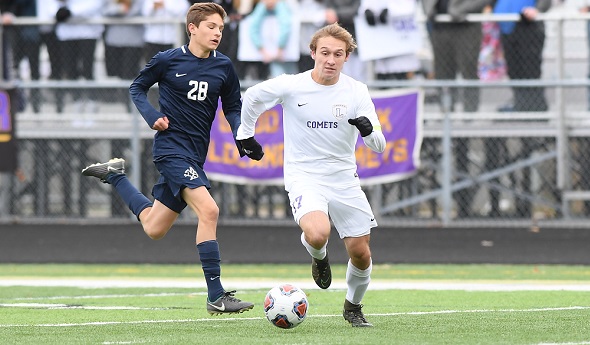
Lund Leads Leland Scoring Charge
April 23, 2019
By Geoff Kimmerly
Second Half editor
Leland’s run to the Division 4 championship this past fall came in part thanks to one of the highest-scoring offenses of all-time.
The Comets scored 157 goals – third-most all-time. Senior Cobe Lund capped his career with 42 goals and 63 points. He played two seasons at Leland after two at Traverse City West and also made career scoring lists with 139 points and 49 assists over four seasons.
Defense played a key part in Leland’s success, of course – sophomore keeper Gavin Miller made the shutouts list with 16 in the fall, and the team had 17 total.
See below for more recent record book updates in boys soccer, ice hockey, girls lacrosse and volleyball. Click on the headings to see those record books in full.
Ice Hockey
Bay City John Glenn senior Cole Parks scored an incredible three goals over 17 seconds against Grand Blanc on Nov. 28, breaking the previous record for fastest three goals by six seconds. Parks played for the Bay Area Thunder, a co-op program with athletes from six schools. He scored with 5:19, 5:10 and 5:02 left in the first period. The three goals also count as the second-fastest three scored by one team, and a fourth goal scored 1:20 before Parks’ hat trick by Justin Raymond gave the Thunder four goals in 1:37 – third on the list for four goals scored over the shortest amount of time.
Nolan Lockhart also joined the fastest three goals list with three for Lowell/Caledonia over 30 seconds against Chelsea on Jan. 7. The senior scored his at 2:41, 2:22 and 2:11 of the second period of a 4-3 overtime win. His string was the third fastest for three scores.
Novi as a team broke the record for fastest four goals, netting them over 1:07 in a win over Canton on Jan. 29. Evan Chippa started the run with 5:10 left in the first period, with Ryan Pinho scoring 10 seconds later, Tanish Nichanametla scoring at 4:28 and Isaac Gibbs finishing the streak at 4:03. The first three goals, over 42 seconds, made the record book list in that category.
Girls Lacrosse
DeWitt’s Alexa Beyer earned her first two record book entries last spring as a sophomore, for seven goals in a game against East Lansing and 53 for the season. Teammate Sarai Canales, then a junior, was added for five assists in a game against Huron Valley United, and then-senior goalie Julianna Harrison was added for 198 saves – the fifth most in MHSAA history. Beyer has committed to play collegiately at St. Bonaventure University.
Boys Soccer
Ithaca keeper Riley Vernon had 306 saves over 18 games in the fall, 14th most for a single season. He had a high of 31 on Oct. 3 against Alma.
Berkley finished 19-4-3 this past fall, making the MHSAA team shutouts list with 15 over those 26 games. Senior keeper Spencer Meade was added for 13 of those 15 shutouts. Berkley also was added for its 5-5 tie with Rochester Hills Stoney Creek, which tied for the third highest-scoring tie in MHSAA history.
Dowagiac’s Cristian Wilson joined the single-game scoring list with six goals in his team’s 7-0 win over Parchment on Aug. 30. Wilson is a junior.
Brett Robinson finished his successful four-year career in net in 2017, leaving Marysville on career MHSAA lists with 645 saves and 37 shutouts over 93 games. He had 13 shutouts his senior season. Robinson plays now at Ashland University.
Volleyball
Kaitlyn Bricker finished her sophomore season in 2017 with a pair of record book entries for sharp serving. Now a junior, Bricker had 13 aces during a three-set Oct. 10 match against Mancelona and finished the season with 127 aces total.
PHOTO: Leland’s Cobe Lund (17) pushes the ball upfield during his team’s Division 4 Final win over Ann Arbor Greenhills last fall.