


Classes Still Create Hoosier Hysteria
July 27, 2017
By Rob Kaminski
MHSAA benchmarks editor
This is the fourth part in a series on MHSAA tournament classification, past and present, that will be published over the next two weeks. This series originally ran in this spring's edition of MHSAA benchmarks.
Twenty years ago, Bloomington North High School won the Indiana High School Athletic Association boys basketball championship, defeating Delta 75-54 at the RCA Dome in Indianapolis.
The date, March 22, 1997, is at the same time revered and disdained by traditionalists in the state who saw it as the last schoolboy championship game the state would ever host.
That’s how devout the game of basketball, particularly interscholastic basketball, had become in the Hoosier state during the 87 years a state champion – one state champion, to be precise – was crowned.
Following that 1997 season, the IHSAA moved to a four-class system for its roundball tournaments, like so many of its state association counterparts had done years earlier.
It would be shocking to find more than a small percentage of current high school basketball players around the country unfamiliar with the iconic movie Hoosiers, even though the film is now more than 30 years old.
And, the storyline for that blockbuster unfolded more than 30 years prior to its release, when small-town, undermanned Milan High School defeated Muncie Central High School 32-30 in the 1954 IHSAA title game.
Perhaps it’s because of the David vs Goliath notion, or the fame of the movie that replaced Milan with the fictional Hickory and real-life star Bobby Plump with Hollywood hero Jimmy Chitwood, or the simple fact that Indiana had something other states didn’t.
Whatever the reason, plenty of opposition remains to this day to basketball classification in the state.
The fact is, the small rural schools were regularly being beaten handily by the much larger suburban and city schools as the tournament progressed each season.
Small schools also were closing at a rapid rate following the state’s School Reorganization Act in 1959, as students converged on larger, centralized county schools. From 1960 to 2000, the number of schools entering the tournament dropped from 694 to 381, and in 1997 a total of 382 schools and 4,584 athletes began competition at the Sectional level (the first level of the IHSAA Basketball Tournament).
It was at the entry level of the tournament where school administrators felt the pain of the new class system, but not necessarily for the same nostalgic reasons as the fans who either attended or boycotted the tournament.
At the Sectional round of the tournament, the IHSAA was culling just 2 percent of the revenue, with the participating schools splitting the balance. So, when Sectional attendance dropped by 14 percent in that first year of class basketball, many schools realized a financial loss. It was money they had grown to count on in prior years to help fund various aspects of the department.
Schools cumulatively received more than $900,000 from Sectional competition in 1998, but that total was down from more than $1 million in the last year of the single-class tournament.
Yet, the current format provides a great deal more opportunity and realistic chances at championship runs for schools of all enrollments.
To date, 60 additional teams have championship or runner-up trophies on display in school trophy cases around Indiana.
That was the mission in front of then-IHSAA commissioner Bob Gardner (now National Federation executive director) once the board made its decision: to give thousands more student-athletes the opportunity for once-in-a-lifetime experiences.
As any statistician knows, figures can be manipulated to tell any side of a story. Declining attendance in year one of class basketball is such a number.
The truth is tournament attendance had been on a steady downward spiral since its peak of just over 1.5 million in 1962. By the last single-class event in 1997, the total attendance was half that.
The challenge then and today, as it is for all state associations, is to find that delicate balance for those holding onto tradition, those holding onto trophies, and the number of trophies to hand out.
Editor’s Note: Stories from the Fort Wayne Journal Gazette in 1998 and from a 2007 issue of Indianapolis Monthly provided facts in this article.
The Official View: Night with the Crew
By
Brent Rice
MHSAA Assistant Director
October 1, 2018
By Brent Rice
MHSAA Assistant Director
In this week’s edition we discuss the power of our words and delivering them proactively, examine a football rule regarding rushing the punter and take a look at an “It’s Your Call” at the volleyball net.
It’s Official!
The Words We Use: Officials face criticisms regularly for their rule enforcement, judgment decisions and even positioning. As we know, these criticisms will be tossed about whether you get plays and rulings correct or not, so there is very little we can control in this area. One area we can control the criticisms we receive is the way we speak to others.
I’ve heard people say, “I’ll give them respect when they earn it.” If that’s your line of thinking, maybe you should consider giving respect simply because it’s the right thing to do. The way you communicate as an official to coaches, players and administrators reflects on you professionally, and often is a determining factor on how these parties view you in carrying out the rest of your responsibilities. If they think you’re a bad person, they often don’t give you the benefit of the doubt in close-call situations.
There are a number of books written on the art of diffusing situations through the words you use. One that immediately comes to mind is “Verbal Judo” by George Thompson. It is rather succinct and definitely worth the read. It provides much more detail on the philosophy of word usage, but let me provide you with a couple of seemingly innocuous phrases that can draw the ire of a coach and should be avoided:
“Well, that’s the rule” – Rules citation is very important when providing explanations, but simply stating that the rule says so sounds flippant and is looked at as a cop-out. Instead, start with “By rule,” then use rulebook terminology to describe the situation and ruling.
“Calm down” – While this is much better than the cringe worthy “Shut up” or “Hush” we hear being used from time to time, it still can provoke a primal urge to respond and can actually have the opposite effect of what is intended. Instead, try getting the results you desire by having them talk it through. Try statements like “All right, I’m listening to you,” or “Okay, explain to me what you’re asking.” And when using a phrase like “calm down,” trying adding an “if” statement along with it. For instance, “I’ll explain to you what I have if you calm down.”
Rule of the Week
FOOTBALL Team R loads up the box with rushers to put pressure on K’s punt deep in its own zone. As K1 punts, R1, coming from the center of the line, just gets fingers on the ball and partially blocks it. R2, from the edge, then firmly contacts the kicker’s plant leg and sends him to the ground.
Ruling: This is not a foul (in itself). The rulebook does not provide that only the player who touches the kick is excused from contacting the kicker. This exception to the rule refers only to when “the defense touches the kick.” (9-4-5-b) Of course, this does not give carte blanche to defensive players to go out of their way to unnecessarily rough the kicker just because the ball is touched.
It’s Your Call
VOLLEYBALL The clip from this week picks up after an extended volley. As Team S plays the ball over the net for its third hit, a front row member of Team R makes a play on the ball. The questions is, are the two contacts by the front row R player legal? Why or why not?
Last Week’s IYC Ruling: The basic spot on the play is the end of the run. Using the all-but-one principle, this foul would be penalized from the spot of the foul (A’s 35). If the defense accepts the penalty, it would be A’s ball, 3rd-and-27 on A’s 20. If the defense declines, it would be 4th-and-8 on A’s 39. This is definitely an instance that you want to run the options by B’s coach before enforcing the penalty. (Click to see the video from last week.)
Official View
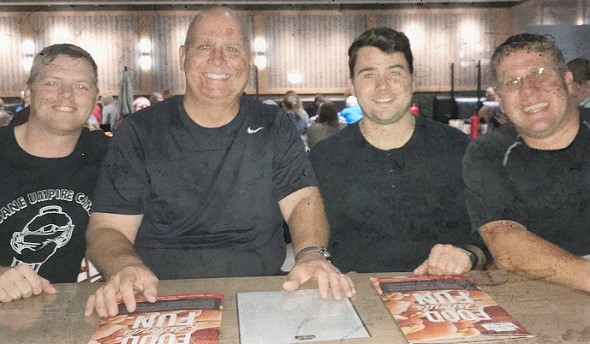
After a long, hard-fought Friday night contest between Rockford and Greenville, crew members (left to right) Dale Feutz, Brian Donovan, Sam Boland, and Luke Griemsman stop in at a local Rockford eatery to discuss the night’s game over a meal.