


Classes Still Create Hoosier Hysteria
July 27, 2017
By Rob Kaminski
MHSAA benchmarks editor
This is the fourth part in a series on MHSAA tournament classification, past and present, that will be published over the next two weeks. This series originally ran in this spring's edition of MHSAA benchmarks.
Twenty years ago, Bloomington North High School won the Indiana High School Athletic Association boys basketball championship, defeating Delta 75-54 at the RCA Dome in Indianapolis.
The date, March 22, 1997, is at the same time revered and disdained by traditionalists in the state who saw it as the last schoolboy championship game the state would ever host.
That’s how devout the game of basketball, particularly interscholastic basketball, had become in the Hoosier state during the 87 years a state champion – one state champion, to be precise – was crowned.
Following that 1997 season, the IHSAA moved to a four-class system for its roundball tournaments, like so many of its state association counterparts had done years earlier.
It would be shocking to find more than a small percentage of current high school basketball players around the country unfamiliar with the iconic movie Hoosiers, even though the film is now more than 30 years old.
And, the storyline for that blockbuster unfolded more than 30 years prior to its release, when small-town, undermanned Milan High School defeated Muncie Central High School 32-30 in the 1954 IHSAA title game.
Perhaps it’s because of the David vs Goliath notion, or the fame of the movie that replaced Milan with the fictional Hickory and real-life star Bobby Plump with Hollywood hero Jimmy Chitwood, or the simple fact that Indiana had something other states didn’t.
Whatever the reason, plenty of opposition remains to this day to basketball classification in the state.
The fact is, the small rural schools were regularly being beaten handily by the much larger suburban and city schools as the tournament progressed each season.
Small schools also were closing at a rapid rate following the state’s School Reorganization Act in 1959, as students converged on larger, centralized county schools. From 1960 to 2000, the number of schools entering the tournament dropped from 694 to 381, and in 1997 a total of 382 schools and 4,584 athletes began competition at the Sectional level (the first level of the IHSAA Basketball Tournament).
It was at the entry level of the tournament where school administrators felt the pain of the new class system, but not necessarily for the same nostalgic reasons as the fans who either attended or boycotted the tournament.
At the Sectional round of the tournament, the IHSAA was culling just 2 percent of the revenue, with the participating schools splitting the balance. So, when Sectional attendance dropped by 14 percent in that first year of class basketball, many schools realized a financial loss. It was money they had grown to count on in prior years to help fund various aspects of the department.
Schools cumulatively received more than $900,000 from Sectional competition in 1998, but that total was down from more than $1 million in the last year of the single-class tournament.
Yet, the current format provides a great deal more opportunity and realistic chances at championship runs for schools of all enrollments.
To date, 60 additional teams have championship or runner-up trophies on display in school trophy cases around Indiana.
That was the mission in front of then-IHSAA commissioner Bob Gardner (now National Federation executive director) once the board made its decision: to give thousands more student-athletes the opportunity for once-in-a-lifetime experiences.
As any statistician knows, figures can be manipulated to tell any side of a story. Declining attendance in year one of class basketball is such a number.
The truth is tournament attendance had been on a steady downward spiral since its peak of just over 1.5 million in 1962. By the last single-class event in 1997, the total attendance was half that.
The challenge then and today, as it is for all state associations, is to find that delicate balance for those holding onto tradition, those holding onto trophies, and the number of trophies to hand out.
Editor’s Note: Stories from the Fort Wayne Journal Gazette in 1998 and from a 2007 issue of Indianapolis Monthly provided facts in this article.

Scoring & Sharing, Visser Eyes Eagles' Rise
October 1, 2018
By Dean Holzwarth
Special for Second Half
GRAND RAPIDS – Grand Rapids Christian senior Tommy Visser had a difficult time deciding which aspect of soccer he enjoys the most – scoring goals or distributing.
 The question wasn’t easy considering he does both equally well.
“Obviously scoring goals is a ton of fun, but at the same time setting other people up and seeing their reactions when they score or leading up to it is fun,” Visser said. “I think they are pretty equal. Assisting and scoring is a lot of fun.”
Midway through the season, Visser is already in double figures in both goals (11) and assists (15) while helping lead the Eagles to an 11-1 start and No. 2 state ranking in Division 2.
Grand Rapids Christian’s only loss is to top-ranked Forest Hills Northern.
Visser, a four-year varsity player and returning all-state first teamer, is one of the most highly regarded in the state and the catalyst of a veteran Eagles squad that boasts 14 seniors.
“He definitely meets all the hype,” Eagles coach Bruce Pobocik said. “He’s one of the most athletic soccer players I’ve had the privilege to coach, and he’s just a very committed competitor. He has just worked his tail off year after year to become one of the most skilled players, hands down, in the state.”
Visser, who recorded 17 goals and 15 assists as a junior, possesses qualities that set him apart from other players.
Vision, quickness, unselfishness and playmaking abilities are just a few of the attributes that have opposing coaches scrambling to find ways to contain him.
“I’ve had him since his sophomore year, and each year he has continued to get faster, stronger, more technical and more creative with his abilities,” Pobocik said. “He’s our captain, and really is the glue that connects the defense and offense. All play goes through his feet, and he’s a two-touch player who makes the guys around him better.”
Visser is constantly marked by other teams, but he takes it in stride while finding opportunities for his teammates.
“I just continue playing and not worry about it too much,” Visser said. “I have to change up my runs and move positioning, but I think it’s been good because it’s helped me grow as a soccer player. It gives more space and time for my teammates. They have more time to get the ball and attack.”
Pobocik points to Visser’s affinity for spreading the wealth as a reason why he is so hard to stop.
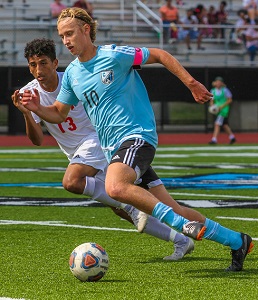 “He looks to connect with his teammates and put them in positions to be successful,” Pobocik said. “And I think that’s why he’s so dangerous. He’s not a player that is going to try and take everyone every time. When he’s double teamed, he’s going to make you pay by putting others in dangerous spots.”
Visser was a highly-recruited college prospect and attracted the attention of several Division I programs.
He received scholarship offers from Michigan State and Western Michigan University, and also considered Calvin College before committing to Butler University.
“For me, Butler was a great fit because it’s a combination of strong academics and a strong soccer program with a coaching staff that I liked,” Visser said.
Visser isn’t thinking about his college future just yet – he’s focused on helping the Eagles make a deeper run in the MHSAA tournament.
Last season, Grand Rapids Christian lost to eventual champion Holland in a Division 2 Regional Final.
“Last year really motivated us to not be satisfied,” Visser said. “We want to go big, and I think it really pushes us to continue working hard each practice and try to get better throughout the season.
“We all get along great and have played together for a while. We have a lot of different players that can impact the game, and all parts of our game are solid.”
While the offense is generated through Visser, the Eagles also have a stout defense behind a superb backline and two capable goalies in senior Daniel Wonder and junior Grayson Parks.
“We knew what we had coming back, and we had big hopes,” Pobocik said. “So far they’re exceeding expectations. Guys have really stepped up in their roles and are playing great team soccer. We’ve had some surprises with guys we didn’t expect to be contributors that are, and that’s been fun.”
The Eagles are two-time reigning Ottawa-Kent Conference Gold champions, but have their sights set on more.
“Losing last year (in the Regional Finals) has us hungry to extend beyond that,” Pobocik said. “They have clear eyes as far as our vision of going deep in the postseason.”
 Dean Holzwarth covered primarily high school sports for the Grand Rapids Press and MLive for 16 years and more recently served as sports editor of the Ionia Sentinel and as a sports photojournalist for WZZM. Contact him at [email protected] with story ideas for Allegan, Kent and Ottawa counties.
PHOTOS: (Top) Tommy Visser keys the Grand Rapids Christian offense as a scorer and distributor. (Middle) Visser works to get past an opponent this fall. (Photos courtesy of the Grand Rapids Christian boys soccer program.)