


Classes Still Create Hoosier Hysteria
July 27, 2017
By Rob Kaminski
MHSAA benchmarks editor
This is the fourth part in a series on MHSAA tournament classification, past and present, that will be published over the next two weeks. This series originally ran in this spring's edition of MHSAA benchmarks.
Twenty years ago, Bloomington North High School won the Indiana High School Athletic Association boys basketball championship, defeating Delta 75-54 at the RCA Dome in Indianapolis.
The date, March 22, 1997, is at the same time revered and disdained by traditionalists in the state who saw it as the last schoolboy championship game the state would ever host.
That’s how devout the game of basketball, particularly interscholastic basketball, had become in the Hoosier state during the 87 years a state champion – one state champion, to be precise – was crowned.
Following that 1997 season, the IHSAA moved to a four-class system for its roundball tournaments, like so many of its state association counterparts had done years earlier.
It would be shocking to find more than a small percentage of current high school basketball players around the country unfamiliar with the iconic movie Hoosiers, even though the film is now more than 30 years old.
And, the storyline for that blockbuster unfolded more than 30 years prior to its release, when small-town, undermanned Milan High School defeated Muncie Central High School 32-30 in the 1954 IHSAA title game.
Perhaps it’s because of the David vs Goliath notion, or the fame of the movie that replaced Milan with the fictional Hickory and real-life star Bobby Plump with Hollywood hero Jimmy Chitwood, or the simple fact that Indiana had something other states didn’t.
Whatever the reason, plenty of opposition remains to this day to basketball classification in the state.
The fact is, the small rural schools were regularly being beaten handily by the much larger suburban and city schools as the tournament progressed each season.
Small schools also were closing at a rapid rate following the state’s School Reorganization Act in 1959, as students converged on larger, centralized county schools. From 1960 to 2000, the number of schools entering the tournament dropped from 694 to 381, and in 1997 a total of 382 schools and 4,584 athletes began competition at the Sectional level (the first level of the IHSAA Basketball Tournament).
It was at the entry level of the tournament where school administrators felt the pain of the new class system, but not necessarily for the same nostalgic reasons as the fans who either attended or boycotted the tournament.
At the Sectional round of the tournament, the IHSAA was culling just 2 percent of the revenue, with the participating schools splitting the balance. So, when Sectional attendance dropped by 14 percent in that first year of class basketball, many schools realized a financial loss. It was money they had grown to count on in prior years to help fund various aspects of the department.
Schools cumulatively received more than $900,000 from Sectional competition in 1998, but that total was down from more than $1 million in the last year of the single-class tournament.
Yet, the current format provides a great deal more opportunity and realistic chances at championship runs for schools of all enrollments.
To date, 60 additional teams have championship or runner-up trophies on display in school trophy cases around Indiana.
That was the mission in front of then-IHSAA commissioner Bob Gardner (now National Federation executive director) once the board made its decision: to give thousands more student-athletes the opportunity for once-in-a-lifetime experiences.
As any statistician knows, figures can be manipulated to tell any side of a story. Declining attendance in year one of class basketball is such a number.
The truth is tournament attendance had been on a steady downward spiral since its peak of just over 1.5 million in 1962. By the last single-class event in 1997, the total attendance was half that.
The challenge then and today, as it is for all state associations, is to find that delicate balance for those holding onto tradition, those holding onto trophies, and the number of trophies to hand out.
Editor’s Note: Stories from the Fort Wayne Journal Gazette in 1998 and from a 2007 issue of Indianapolis Monthly provided facts in this article.
After Netting Milestone Goal, Saugatuck's Holley Seeking to Score Historic Hardware
By
Dean Holzwarth
Special for MHSAA.com
September 23, 2026
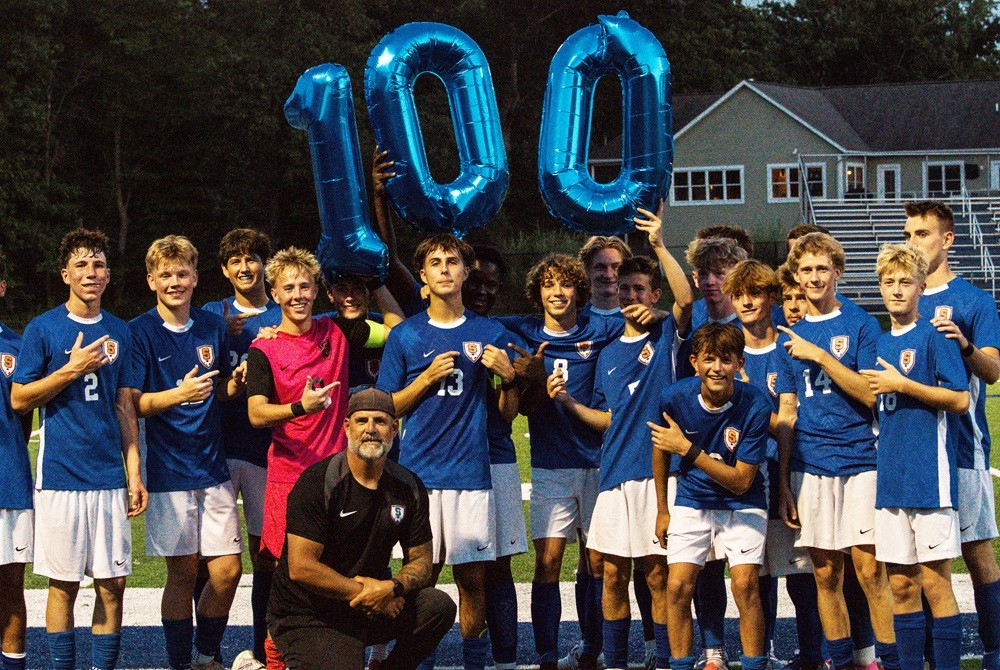
SAUGATUCK – In MHSAA boys soccer history, fewer than 50 players have scored 100 or more career goals.

Dante Holley recently added his name to that prestigious list and into the record books.
The Saugatuck senior standout reached the milestone on Aug. 28 against Wyoming Lee during a 4-0 victory.
“My freshman year I scored only 12 goals, so I didn’t think it was something that was possible,” Holley said. “I started scoring more my sophomore year, and then my junior year, and I was 13 away from it this year so it was something that I really wanted.
“I was really looking forward to it for the season, and it was a big goal for me from the start, individual-wise, so it was good to finally get over the finish line that I’ve been working hard to get to.”
Saugatuck boys soccer coach Nate Holley has watched his son score an abundance of goals through the years, but was most proud of No. 100.
“The way he scored it was amazing in itself,” Nate Holley said. “He correctly predicted the opposition’s back pass to their keeper and made a 30-yard sprint that in all likelihood wouldn’t pay off, but in that moment it did. It wasn't a cheap or easy goal, and was a 100-percent teaching moment to the rest of the team in terms of asking them to make runs that might be fruitless but nonetheless necessary for team success.
“I was incredibly nervous as he neared the milestone, fearing an injury or the stress of being on the precipice affecting his play, so it was a relief and an incredible moment. It had been a goal of his since his freshman year.”
Dante Holley set a school record for goals in a season with 38 his sophomore year and then followed that with 37 as a junior.
He currently has 26 goals in 10 games this fall for the unbeaten (8-0-2) and seventh-ranked team in Division 4.
While his scoring prowess has been impressive, Dante Holley’s decision-making and passing have been equally noteworthy. He entered the week with 45 career assists to go along with his now 113 goals.
“His ability to put the ball in the back of the net is obviously a strong suit, but honestly, his ability to find teammates is probably a stronger suit,” Nate Holley said. “He’s had some jaw-dropping passes in matches.”
Dante Holley has never wanted to be known as just an elite scorer.

“I’ve always tried to keep myself well-rounded,” he said. “I don't want to be good at one thing. I want to be able to help my team with different things than just scoring. And, to me, sometimes a good assist feels just as good as a goal.
“There’s something about getting a crisp through ball behind everyone that just feels so good to me and something I've worked on and taken pride in. I also don't want to be known as a ball hog. It’s not something I want to live by.”
Holley, who helped his Michigan Rangers club team win the State Cup this past spring, has been a captain and leader since his sophomore year.
While his work ethic and competitiveness stand out, he’s also never satisfied. He possesses a determination to fix certain aspects of his game.
“He’s one of the hardest-working kids I’ve ever coached, and he takes losses personally and makes achieving goals a priority,” Nate Holley said. “I've watched him immediately work on things that bothered him during a match, directly after the match.
"I love his leadership, and he raises the level of trainings and the level of expectations for the entire team.”
Dante Holley wants to achieve one more goal before he graduates, and this one is team oriented.
The Trailblazers have never won a conference or District title in boys soccer, but Holley hopes to change that this season.
“That’s been a big motivation for me,” he said. “I said when I came into this program that I didn’t want to leave without winning a trophy of some sort. I want us to be the first, and we want to go on a run. That’s been a big focus point.”
This Saugatuck team might just have the talent and experience to accomplish the feat.
“We’ve been together since we were really young, and the one thing that helps high school teams become good is how long they’ve played together,” Holley said. “We’ve really bought into the system we want to play, and it’s a dedicated group of guys.”
Dante Holley has received interest from several collegiate programs, but is undecided where he will play next.
“I’m not thinking about the level,” he said. “I’m thinking more of the college that will fit me athletically and academically because I know some day soccer isn’t going to be there for me, so I want to get a good education while I’m at it.”
 Dean Holzwarth has covered primarily high school sports for Grand Rapids-based WOOD-TV for five years after serving at the Grand Rapids Press and MLive for 16 years along with shorter stints at the Ionia Sentinel and WZZM. Contact him at [email protected] with story ideas for Allegan, Kent and Ottawa counties.
PHOTOS (Top) Saugatuck’s Dante Holley (13) stands for a photo with his team after scoring his 100th career goal. (Middle) Holley and an opposing defender pursue the ball. (Photos provided by the Saugatuck boys soccer program.)