


Classes Still Create Hoosier Hysteria
July 27, 2017
By Rob Kaminski
MHSAA benchmarks editor
This is the fourth part in a series on MHSAA tournament classification, past and present, that will be published over the next two weeks. This series originally ran in this spring's edition of MHSAA benchmarks.
Twenty years ago, Bloomington North High School won the Indiana High School Athletic Association boys basketball championship, defeating Delta 75-54 at the RCA Dome in Indianapolis.
The date, March 22, 1997, is at the same time revered and disdained by traditionalists in the state who saw it as the last schoolboy championship game the state would ever host.
That’s how devout the game of basketball, particularly interscholastic basketball, had become in the Hoosier state during the 87 years a state champion – one state champion, to be precise – was crowned.
Following that 1997 season, the IHSAA moved to a four-class system for its roundball tournaments, like so many of its state association counterparts had done years earlier.
It would be shocking to find more than a small percentage of current high school basketball players around the country unfamiliar with the iconic movie Hoosiers, even though the film is now more than 30 years old.
And, the storyline for that blockbuster unfolded more than 30 years prior to its release, when small-town, undermanned Milan High School defeated Muncie Central High School 32-30 in the 1954 IHSAA title game.
Perhaps it’s because of the David vs Goliath notion, or the fame of the movie that replaced Milan with the fictional Hickory and real-life star Bobby Plump with Hollywood hero Jimmy Chitwood, or the simple fact that Indiana had something other states didn’t.
Whatever the reason, plenty of opposition remains to this day to basketball classification in the state.
The fact is, the small rural schools were regularly being beaten handily by the much larger suburban and city schools as the tournament progressed each season.
Small schools also were closing at a rapid rate following the state’s School Reorganization Act in 1959, as students converged on larger, centralized county schools. From 1960 to 2000, the number of schools entering the tournament dropped from 694 to 381, and in 1997 a total of 382 schools and 4,584 athletes began competition at the Sectional level (the first level of the IHSAA Basketball Tournament).
It was at the entry level of the tournament where school administrators felt the pain of the new class system, but not necessarily for the same nostalgic reasons as the fans who either attended or boycotted the tournament.
At the Sectional round of the tournament, the IHSAA was culling just 2 percent of the revenue, with the participating schools splitting the balance. So, when Sectional attendance dropped by 14 percent in that first year of class basketball, many schools realized a financial loss. It was money they had grown to count on in prior years to help fund various aspects of the department.
Schools cumulatively received more than $900,000 from Sectional competition in 1998, but that total was down from more than $1 million in the last year of the single-class tournament.
Yet, the current format provides a great deal more opportunity and realistic chances at championship runs for schools of all enrollments.
To date, 60 additional teams have championship or runner-up trophies on display in school trophy cases around Indiana.
That was the mission in front of then-IHSAA commissioner Bob Gardner (now National Federation executive director) once the board made its decision: to give thousands more student-athletes the opportunity for once-in-a-lifetime experiences.
As any statistician knows, figures can be manipulated to tell any side of a story. Declining attendance in year one of class basketball is such a number.
The truth is tournament attendance had been on a steady downward spiral since its peak of just over 1.5 million in 1962. By the last single-class event in 1997, the total attendance was half that.
The challenge then and today, as it is for all state associations, is to find that delicate balance for those holding onto tradition, those holding onto trophies, and the number of trophies to hand out.
Editor’s Note: Stories from the Fort Wayne Journal Gazette in 1998 and from a 2007 issue of Indianapolis Monthly provided facts in this article.
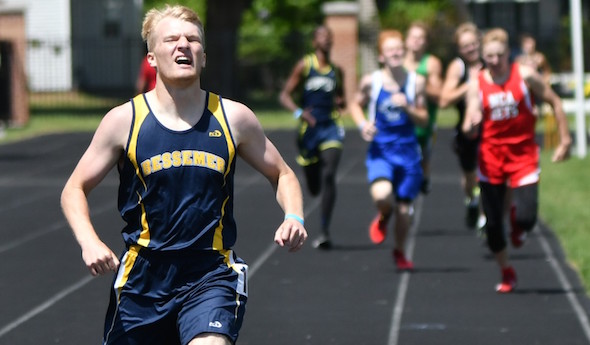
Bessemer Speediest for 1st Time since '51
By
John Vrancic
Special for MHSAA.com
June 3, 2018
KINGSFORD — It had been a long time since a Bessemer track team was last crowned Upper Peninsula champion.
A very long time.
The Speedboys changed that in convincing fashion Saturday, scoring 151 points for their first title since 1951, when they were competing in Class C.
Two-time reigning champ Rapid River was runner-up this time with 84 points, and Pickford took third at 45 in the U.P. Division 3 Finals at Flivver Field.
“Last year we lost by four points after winning every meet before the Finals,” said Bessemer assistant coach Tracy Rowe. “We were pretty hopeful coming in here. Our depth helped us out.”
The Speedboys won the first four running events and finished with nine firsts.
They began their quest with a victory in the 3,200-meter relay, covering the eight-lap race in 8 minutes, 31.15 seconds.
“The 3,200 relay set the tone for the day,” said assistant coach David Rowe. “We emphasized concentrating on the present, and the guys weren’t intimidated. This is something everybody was a part of. Our cross country team (co-op Gogebic Miners) won the U.P. (Division 2) title last fall, and the distances are where we racked up the points.”
Senior Isaiah Aili set a U.P. meet record in the 800 at 2:01.08, topping the previous mark (2:01.45) by Munising’s Brett Hannah run three years ago.
“I knew it was a big race, and there was a lot of competition,” said Aili, who was runner-up in the 1,600 (4:45.66). “I thought to myself, ‘I don’t want to lose this race.’ This means a lot to our school, team and coaches who have been there for us all year.”
Aili also helped the Speedboys win the 1,600 relay (3:37.74), as did senior Brayden Tomes, who took the 100 (11.92), 200 (23.7) and 300 hurdles (41.94).
“I can’t think of a better way to end my career, especially with all my teammates,” said Tomes. “This has been our goal since last year. We wanted to come back here and take the title.”
 Uriah Aili added a first in the 3,200 (10:25.29) and took second in pole vault (11-6), and sophomore Jamie Jett captured the 110 hurdles (16.97), took second in the 300 hurdles (44.11) and anchored the winning 800 relay (1:36.72), nipping Rapid River sophomore Tyler Sundling at the wire.
“One of the negative things is our handoffs weren’t as good as usual,” said Jett, who made up a 10-15 yard deficit in the anchor leg. “I like that distance (200 meters). I think 100 meters is a little too short, and I die a little in the end of a 400. I had a good start and used the three-step in the hurdles. I’ve been working on that, and I find it increases my speed (over the four-step).”
Junior Andy Aspinwall was also part of the 800 relay, and Tyler Busch added a first in shot put (46-6).
“We knew it would be real close with (Rapid River),” said Aspinwall. “I think they were our best competition. They’re a real good team.
“It’s awesome to go home with the U.P. title.”
Rapid River senior Logan Hardwick earned his third straight discus title (144-11), and junior teammate Gunnar Larson was runner-up (138-11).
Classmate Lucas Sundling won the 400 (53.06), followed by Tyler Sundling (54.0).
Cedarville sophomore Thomas Bohn set a U.P. meet record in the 1,600 (4:33.24), shaving 77 hundredths of a second off the previous best by Rapid River’s Tyler Crossman (4:34.01) in 2008.
“I knew I had to go out hard and tried to set the pace early,” said Bohn. “I knew there would be a lot of good runners. Bessemer especially had good runners. They have a good program.”
Bohn was runner-up in the 800 (2:02.8) and 3,200 (10:37.25).
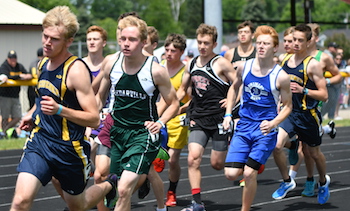
PHOTOS: (Top) Bessemer’s Isaiah Aili outdistances the field in the 800. (Middle) The pack takes a turn during the 1,600. (Photos by Cara Kamps. Click for more at RunMichigan.com.)