


Classes Still Create Hoosier Hysteria
July 27, 2017
By Rob Kaminski
MHSAA benchmarks editor
This is the fourth part in a series on MHSAA tournament classification, past and present, that will be published over the next two weeks. This series originally ran in this spring's edition of MHSAA benchmarks.
Twenty years ago, Bloomington North High School won the Indiana High School Athletic Association boys basketball championship, defeating Delta 75-54 at the RCA Dome in Indianapolis.
The date, March 22, 1997, is at the same time revered and disdained by traditionalists in the state who saw it as the last schoolboy championship game the state would ever host.
That’s how devout the game of basketball, particularly interscholastic basketball, had become in the Hoosier state during the 87 years a state champion – one state champion, to be precise – was crowned.
Following that 1997 season, the IHSAA moved to a four-class system for its roundball tournaments, like so many of its state association counterparts had done years earlier.
It would be shocking to find more than a small percentage of current high school basketball players around the country unfamiliar with the iconic movie Hoosiers, even though the film is now more than 30 years old.
And, the storyline for that blockbuster unfolded more than 30 years prior to its release, when small-town, undermanned Milan High School defeated Muncie Central High School 32-30 in the 1954 IHSAA title game.
Perhaps it’s because of the David vs Goliath notion, or the fame of the movie that replaced Milan with the fictional Hickory and real-life star Bobby Plump with Hollywood hero Jimmy Chitwood, or the simple fact that Indiana had something other states didn’t.
Whatever the reason, plenty of opposition remains to this day to basketball classification in the state.
The fact is, the small rural schools were regularly being beaten handily by the much larger suburban and city schools as the tournament progressed each season.
Small schools also were closing at a rapid rate following the state’s School Reorganization Act in 1959, as students converged on larger, centralized county schools. From 1960 to 2000, the number of schools entering the tournament dropped from 694 to 381, and in 1997 a total of 382 schools and 4,584 athletes began competition at the Sectional level (the first level of the IHSAA Basketball Tournament).
It was at the entry level of the tournament where school administrators felt the pain of the new class system, but not necessarily for the same nostalgic reasons as the fans who either attended or boycotted the tournament.
At the Sectional round of the tournament, the IHSAA was culling just 2 percent of the revenue, with the participating schools splitting the balance. So, when Sectional attendance dropped by 14 percent in that first year of class basketball, many schools realized a financial loss. It was money they had grown to count on in prior years to help fund various aspects of the department.
Schools cumulatively received more than $900,000 from Sectional competition in 1998, but that total was down from more than $1 million in the last year of the single-class tournament.
Yet, the current format provides a great deal more opportunity and realistic chances at championship runs for schools of all enrollments.
To date, 60 additional teams have championship or runner-up trophies on display in school trophy cases around Indiana.
That was the mission in front of then-IHSAA commissioner Bob Gardner (now National Federation executive director) once the board made its decision: to give thousands more student-athletes the opportunity for once-in-a-lifetime experiences.
As any statistician knows, figures can be manipulated to tell any side of a story. Declining attendance in year one of class basketball is such a number.
The truth is tournament attendance had been on a steady downward spiral since its peak of just over 1.5 million in 1962. By the last single-class event in 1997, the total attendance was half that.
The challenge then and today, as it is for all state associations, is to find that delicate balance for those holding onto tradition, those holding onto trophies, and the number of trophies to hand out.
Editor’s Note: Stories from the Fort Wayne Journal Gazette in 1998 and from a 2007 issue of Indianapolis Monthly provided facts in this article.
Oak Park Climbs Podium Again in LPD1
By
Paul Costanzo
Special for MHSAA.com
June 2, 2018
EAST KENTWOOD – Aasia Laurencin crossed the finish line at East Kentwood High School multiple times Saturday, but the sweetest crossing for the Oak Park sophomore came after a race in which she didn’t compete.
Laurencin was the first to greet teammate Dorriann Coleman following the 1,600-meter relay which clinched a Lower Peninsula Division 1 championship for the Knights, their fourth in five years.
“It’s been a long outdoor season, and we finally got the win we’ve been looking for,” Laurencin said. “Last year we didn’t get it, but now it’s all excitement, all joyful tears.”
Oak Park finished with 66 points to claim the title, with Rockford close behind at 59.5. East Kentwood was third with 52 points, followed by Lake Orion with 48 and Northville with 41.
The Knights thrived on the track, especially in the relays, despite losing a runner early in the meet and coming to East Kentwood with just 10. They won the 3,200 relay and 1,600 relay with the team of Coleman, Makayla Gates, Jayla Jones and Mariyah Archibald, and placed second in the 400 relay. Oak Park looked to be on its way to competing for first place in the 800 relay before Jada Roundtree suffered an injury on the anchor leg.
“We really, really showed some grit and toughness,” Oak Park coach Brandon Jiles said. “We really showed that we can win if we don’t have the perfect meet.”
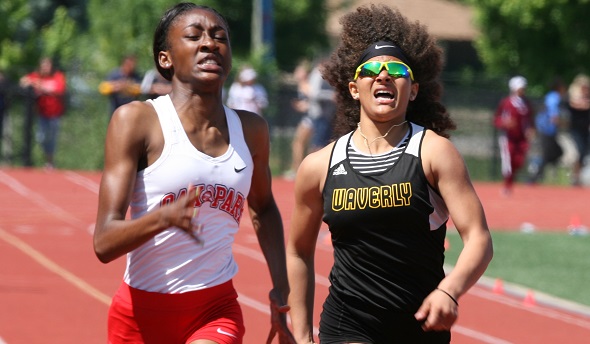
Laurencin and Brooks were the lone Knights to win individual titles, as Laurencin won the 200 with a time of 24.64, and Brooks won the 400 in 55.12.
“I wanted to run faster, but it was OK,” said Laurencin, who was second in the 100 hurdles and a member of both sprint relays. “I’m satisfied. I’m really satisfied with today.”
Grace Stark of White Lake Lakeland denied Laurencin a title in the 100 hurdles, and she did it in record-breaking fashion. Stark finished in 13.12 seconds, a Finals record for all divisions. One event later, she doubled her title count, winning the 100 meters in 11.74 seconds.
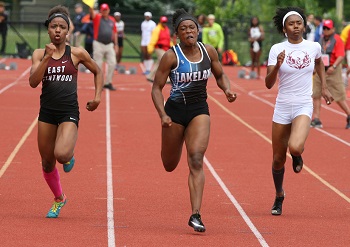 “I really wanted it last year and I missed out, and I was really excited I got to do it here today,” said Stark, who was runner-up in both events a year ago. “I was just hoping to win it. Last year kind of hurt me, and I was upset, but I wanted redemption.”
While Stark and Laurencin had a duel early on, Rockford’s Ericka VanderLende and Ann Arbor Pioneer’s Anne Forsyth had their own in the distance events.
VanderLende won the 1,600 with a personal best time of 4:45.17, while Forsyth won the 3,200 with a time of 10:08.07, an all-division Finals record.
In each race, the other finished second, and in each race, it was VanderLende who took control of the pace. For the 1,600, it worked to perfection.
“I didn’t really want to pay attention to what other people around me were doing,” VanderLende said. “I just wanted to stick to the race plan I knew I was capable of. I normally even split or negative split, so I wasn’t really too surprised that if I took it out hard I could hold it.”
The middle distance events supplied equal drama, as a strong 800-meter field provided a strong race. Waterford Mott’s Katie Osika came out on top, winning in 2:08.88, using a late kick to defeat Hudsonville’s Melanie Helder, who was second at 2:09.28.
“Of course you’ve got that fast time on your mind,” Osika said. “I’m running in New Balance Nationals, so I want to get a good time, but I had to put winning first, like, ‘You have to win state champ first.’ It was definitely tough; it wasn’t easy. This was probably one of the most competitive races I’ve been in all year.”
Lake Orion’s Melissa Symons was used to competition, as Troy’s Lauren Felcher had been pushing her all year in the 300 hurdles. But on the final day of the season, it was Symons, who didn’t run the event a year ago because of injury, who came out on top. As she finished, Symons had a look of shock and excitement on her face, and immediately looked to Felcher, who finished second, and gave her a hug.
“She’s amazing, she’s been my biggest competitor this entire year, and so we were just pushing each other so well throughout this entire year,” Symons said. “I know she’s going to go out strong, so I can just stick with her and then it’s just a battle of the wills at the end to see who can go. I know how she runs, so I think it really does help.”
East Kentwood’s Corrine Jemison set a meet record in the shot put, winning the event with a throw of 49 feet, 11¾ inches. Lansing Waverly’s Malin Smith won the discus with an all-division Finals record throw of 163-9.
Waterford Kettering’s Jessica Mercier won the pole vault with a height of 12-10. Novi’s Hannah Hood-Blaxill won the high jump with a height of 5-6. Northville’s Clare McNamara won the long jump with a distance of 18-7½.
Detroit Renaissance (Makylah Slappy, Mizan Thomas, Paige Chapman and Donae Adams) won the 800 relay in 1:39.91. Adams, Chapman and Thomas joined Imani Jackson to win the 400 relay in 47.42.
VIDEO: Waterford Mott's Katie Osika kicks to win the 800.
PHOTOS: (Top) Oak Park’s Aasia Laurencin, left, surges ahead of Lansing Waverly’s Priscilla Trainor and the rest of the championship heat in the 200 on Saturday. (Middle) Lakeland’s Grace Stark, middle, pulls away for the 100-meter championship. (Click for more from RunMichigan.com.)