


Classes Still Create Hoosier Hysteria
July 27, 2017
By Rob Kaminski
MHSAA benchmarks editor
This is the fourth part in a series on MHSAA tournament classification, past and present, that will be published over the next two weeks. This series originally ran in this spring's edition of MHSAA benchmarks.
Twenty years ago, Bloomington North High School won the Indiana High School Athletic Association boys basketball championship, defeating Delta 75-54 at the RCA Dome in Indianapolis.
The date, March 22, 1997, is at the same time revered and disdained by traditionalists in the state who saw it as the last schoolboy championship game the state would ever host.
That’s how devout the game of basketball, particularly interscholastic basketball, had become in the Hoosier state during the 87 years a state champion – one state champion, to be precise – was crowned.
Following that 1997 season, the IHSAA moved to a four-class system for its roundball tournaments, like so many of its state association counterparts had done years earlier.
It would be shocking to find more than a small percentage of current high school basketball players around the country unfamiliar with the iconic movie Hoosiers, even though the film is now more than 30 years old.
And, the storyline for that blockbuster unfolded more than 30 years prior to its release, when small-town, undermanned Milan High School defeated Muncie Central High School 32-30 in the 1954 IHSAA title game.
Perhaps it’s because of the David vs Goliath notion, or the fame of the movie that replaced Milan with the fictional Hickory and real-life star Bobby Plump with Hollywood hero Jimmy Chitwood, or the simple fact that Indiana had something other states didn’t.
Whatever the reason, plenty of opposition remains to this day to basketball classification in the state.
The fact is, the small rural schools were regularly being beaten handily by the much larger suburban and city schools as the tournament progressed each season.
Small schools also were closing at a rapid rate following the state’s School Reorganization Act in 1959, as students converged on larger, centralized county schools. From 1960 to 2000, the number of schools entering the tournament dropped from 694 to 381, and in 1997 a total of 382 schools and 4,584 athletes began competition at the Sectional level (the first level of the IHSAA Basketball Tournament).
It was at the entry level of the tournament where school administrators felt the pain of the new class system, but not necessarily for the same nostalgic reasons as the fans who either attended or boycotted the tournament.
At the Sectional round of the tournament, the IHSAA was culling just 2 percent of the revenue, with the participating schools splitting the balance. So, when Sectional attendance dropped by 14 percent in that first year of class basketball, many schools realized a financial loss. It was money they had grown to count on in prior years to help fund various aspects of the department.
Schools cumulatively received more than $900,000 from Sectional competition in 1998, but that total was down from more than $1 million in the last year of the single-class tournament.
Yet, the current format provides a great deal more opportunity and realistic chances at championship runs for schools of all enrollments.
To date, 60 additional teams have championship or runner-up trophies on display in school trophy cases around Indiana.
That was the mission in front of then-IHSAA commissioner Bob Gardner (now National Federation executive director) once the board made its decision: to give thousands more student-athletes the opportunity for once-in-a-lifetime experiences.
As any statistician knows, figures can be manipulated to tell any side of a story. Declining attendance in year one of class basketball is such a number.
The truth is tournament attendance had been on a steady downward spiral since its peak of just over 1.5 million in 1962. By the last single-class event in 1997, the total attendance was half that.
The challenge then and today, as it is for all state associations, is to find that delicate balance for those holding onto tradition, those holding onto trophies, and the number of trophies to hand out.
Editor’s Note: Stories from the Fort Wayne Journal Gazette in 1998 and from a 2007 issue of Indianapolis Monthly provided facts in this article.
Country Day Reign Continues with 3-Peat
June 2, 2018
By Jeff Febus
Special for Second Half
HOLLAND – The Detroit Country Day dominance continues in MHSAA girls tennis.
The Yellowjackets captured their third consecutive Lower Peninsula Division 3 championship Saturday afternoon at Hope College, posting a final team score of 38 points. Bloomfield Hills Cranbrook Kingswood – an eight-time Division 3 girls tennis title winner – was second with 22 points followed by Ada Forest Hills Eastern with 21.
A year after claiming 39 out of a possible 40 points at the Finals, Country Day reverted to near-perfect form as it claimed all four singles flights and three of the four doubles flights.
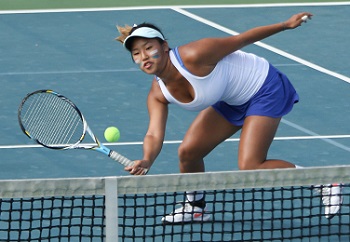
Country Day entered the day owning only one of the top seeds in the four doubles flights, but pulled upsets at No. 1 and No. 4. Seeded second, Heather Zimmerman and Nina Khaghany pulled off the upset win at No. 1 doubles, defeating the top-seeded tandem of Kate Cao and Amelia Smith of Cranbrook Kingswood 5-7, 6-4, 6-1.
At No. 4 doubles, the second-seeded duo of Anushri Radhakrishnan and Maria Sicilia from Country Day topped Cranbrook Kingswood’s top- seeded team of Simrin Nagaraju and Mia Inakage 3-6, 6-2, 6-2. Country Day also won at No. 3 doubles as its team of Maya Nassif and Ruhi Nayak downed Allegan’s team of Delaney Heckman and Maddy Layton 6-4, 6-2 in the final.
“I thought our doubles teams really rose to the occasion today,” said Country Day head coach Jessica Stencel. “We had a couple of two seeds and a four seed, and the two seeds came up with the upsets.”
Stencel noted that the upset at No. 1 doubles was filled with emotion. “We had lost to them two times in straight sets during the regular season, so it was a really emotional match for (our No. 1 doubles),” said Stencel. “They knew they had to play really well to win. They rose to the occasion and didn’t look back. We’re really proud of them because it was the best tennis they played all year.”
In singles action, the Yellow Jackets came in with the top seed in all four flights and held serve. “In singles we had a few obstacles today, but our singles players fought like they have all year,” Stencel said. They’re really talented girls, so it wasn’t a surprise that we came out on top there.”
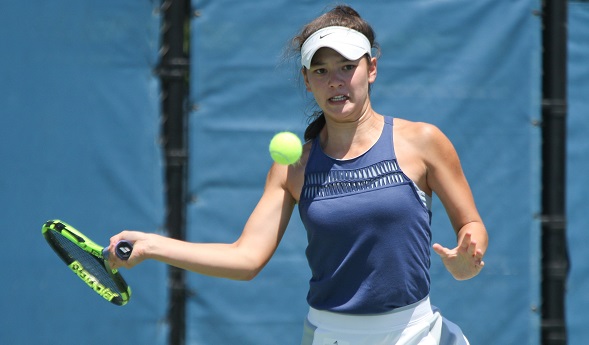
Leading the charge was freshman Julia Fleigner, who did not drop a set during the weekend and cruised to a 6-3, 6-1 victory over third-seeded Claire Danko of Grand Rapids Catholic Central in the championship final. “She’s a great leader and a top-20 player individually in the country,” said Stencel. “She’s such a great girl, and we’re really lucky to have her.”
 According to Fleigner, playing in front of teammates made a difference. “It was great. It’s amazing to work with this team and be state champions together,” she said. “It’s the best feeling. There were definitely some nerves today. There’s a little bit of pressure being here on the big stage, but it’s better to be out here with the team and feeling the support.”
Fleigner’s championship at No. 1 singles came a year after current teammate Monique Karoub won the No. 1 singles crown. The emergence of Fleigner provided Country Day greater firepower but also bumped the reigning No. 1 singles champion down a flight. A junior, Karoub won the No. 2 singles title with a 6-0, 6-3 win over Deena Haddad of Flint Powers Catholic.
“She’s a competitor. No one is going to be happy from going from No. 1 to No. 2 when they’re that much of a competitor,” said Stencel of her junior captain. “Monique also has a lot of respect for Julia. They know each other well off the court. When Julia took that number one spot, she was happy for her but she knew that she still had a big position on the team. No. 1 singles doesn’t get more points than No. 2 singles. She’s a very good sport about things. She’s a team captain. She’s well respected by her teammates. I can’t speak enough positive things about her.”
Despite playing at the No 1 singles spot before, Karoub felt nerves of her own Saturday. “I was really nervous,” said Karoub. “I get nervous coming out here every year. There was a lot more pressure knowing that since I won (No. 1 singles) last year I should be able to win it at a lower spot, but I was able to use that pressure to help me. I just used what my coaches were telling me. We’re a close-knit team, and the support of my teammates really helps.
Also claiming singles titles for Country Day were Elle Hartje and Alexis Nardicchio. Hartje was a 6-0, 6-0 winner over Claire VerBrugge of Forest Hills Eastern at No. 3 singles, while Nardicchio was a 6-0, 6-0 winner over Avneet Deol of Forest Hills Eastern at No. 4.
Cranbrook Kingswood was the lone school to break through the Country Day brigade, winning the title at No. 2 doubles. The Cranbrook Kingswood team of Sophia Moustakas and Abby Foltyn won a spirited 7-6 (4), 6-4 match over Allegan’s tandem of Emma Phillippus and Nicole Galloway. The victory allowed Cranbrook Kingswood to seal second place in the final team standings.
“It’s always tough to beat a team with an all-star lineup like Country Day, but I thought we competed extremely well,” said Cranbrook Kingswood head coach Steve Herdoiza. “I am happy with our performance. All in all the weekend was a great success. It gives us confidence for next year. We came together as a group and really peaked at this tournament. I think we played some of our best tennis here. We are a junior-laden team, so I think next year we will be full of confidence.”
PHOTOS: (Top) Detroit Country Day’s Julia Fleigner returns a volley during a No. 1 singles match Saturday at Hope College. (Middle) Cranbrook Kingswood’s Kate Cao returns a low shot at No. 1 doubles. (Click to see more from HighSchoolSportsScene.com.)