


Classes Still Create Hoosier Hysteria
July 27, 2017
By Rob Kaminski
MHSAA benchmarks editor
This is the fourth part in a series on MHSAA tournament classification, past and present, that will be published over the next two weeks. This series originally ran in this spring's edition of MHSAA benchmarks.
Twenty years ago, Bloomington North High School won the Indiana High School Athletic Association boys basketball championship, defeating Delta 75-54 at the RCA Dome in Indianapolis.
The date, March 22, 1997, is at the same time revered and disdained by traditionalists in the state who saw it as the last schoolboy championship game the state would ever host.
That’s how devout the game of basketball, particularly interscholastic basketball, had become in the Hoosier state during the 87 years a state champion – one state champion, to be precise – was crowned.
Following that 1997 season, the IHSAA moved to a four-class system for its roundball tournaments, like so many of its state association counterparts had done years earlier.
It would be shocking to find more than a small percentage of current high school basketball players around the country unfamiliar with the iconic movie Hoosiers, even though the film is now more than 30 years old.
And, the storyline for that blockbuster unfolded more than 30 years prior to its release, when small-town, undermanned Milan High School defeated Muncie Central High School 32-30 in the 1954 IHSAA title game.
Perhaps it’s because of the David vs Goliath notion, or the fame of the movie that replaced Milan with the fictional Hickory and real-life star Bobby Plump with Hollywood hero Jimmy Chitwood, or the simple fact that Indiana had something other states didn’t.
Whatever the reason, plenty of opposition remains to this day to basketball classification in the state.
The fact is, the small rural schools were regularly being beaten handily by the much larger suburban and city schools as the tournament progressed each season.
Small schools also were closing at a rapid rate following the state’s School Reorganization Act in 1959, as students converged on larger, centralized county schools. From 1960 to 2000, the number of schools entering the tournament dropped from 694 to 381, and in 1997 a total of 382 schools and 4,584 athletes began competition at the Sectional level (the first level of the IHSAA Basketball Tournament).
It was at the entry level of the tournament where school administrators felt the pain of the new class system, but not necessarily for the same nostalgic reasons as the fans who either attended or boycotted the tournament.
At the Sectional round of the tournament, the IHSAA was culling just 2 percent of the revenue, with the participating schools splitting the balance. So, when Sectional attendance dropped by 14 percent in that first year of class basketball, many schools realized a financial loss. It was money they had grown to count on in prior years to help fund various aspects of the department.
Schools cumulatively received more than $900,000 from Sectional competition in 1998, but that total was down from more than $1 million in the last year of the single-class tournament.
Yet, the current format provides a great deal more opportunity and realistic chances at championship runs for schools of all enrollments.
To date, 60 additional teams have championship or runner-up trophies on display in school trophy cases around Indiana.
That was the mission in front of then-IHSAA commissioner Bob Gardner (now National Federation executive director) once the board made its decision: to give thousands more student-athletes the opportunity for once-in-a-lifetime experiences.
As any statistician knows, figures can be manipulated to tell any side of a story. Declining attendance in year one of class basketball is such a number.
The truth is tournament attendance had been on a steady downward spiral since its peak of just over 1.5 million in 1962. By the last single-class event in 1997, the total attendance was half that.
The challenge then and today, as it is for all state associations, is to find that delicate balance for those holding onto tradition, those holding onto trophies, and the number of trophies to hand out.
Editor’s Note: Stories from the Fort Wayne Journal Gazette in 1998 and from a 2007 issue of Indianapolis Monthly provided facts in this article.

Early End to 2017 Drives Veteran Sturgis
May 8, 2018
By Wes Morgan
Special for Second Half
All the pieces are in place for the Sturgis varsity baseball team to potentially still be playing in June.
 As of Wednesday’s Michigan High School Baseball Coaches Association poll, the Trojans fit in at No. 19 in Division 2, though the rankings are somewhat arbitrary as some teams on the list had played as few as four games.
But after a 19-14 season in 2017 — without a single senior on the squad — Sturgis fourth-year head coach Drew Rutenbar knew the program had an opportunity to do something special this spring.
With 11 seniors this year and a five-man junior class that made a significant impact last season, the Trojans are gunning to win a Wolverine Conference championship after finishing third in the league in 2017, which was followed by a disappointing Pre-District ouster by St. Joseph County rival Three Rivers.
“First goal on our minds right now is the Wolverine Conference,” Rutenbar said. “In my time as a coach, that’s the piece that’s missing and this group is ready to make that happen. This is a group of guys that I have heard about since they entered middle school. Last year’s season came to an abrupt stop, and we didn’t take care of what we wanted to do. These guys are all in.”
The seniors are Dalton Smith, Sam Leck, Korbin Whitcomb, Jacob Morales, Jake Abbs, Avery Cleveland, Brian Jordan, Brecken Stewart, James Campbell, Tyler Lovelace and Anthony Harper. Juniors Isaac Harper, Zach Chapman, Drew Murphy, Parker Stephens and Braydon Bathgate round out the talented roster.
At 15-2 overall and 9-1 in league play (tied with Edwardsburg atop the standings), the Trojans have upped their offensive production from last spring and outscored opponents 100-55. Seven players are hitting above .300, and not a single pitcher in the rotation has allowed more than six earned runs. Defense always has been a strength, but Sturgis adds more speed and power with this year’s lineup.
Murphy is 3-0 on the bump with a 3.51 ERA, Leck is 3-1 operating with a 1.47 ERA, Jordan and Harper are both 2-0 and Stewart, Abbs, Lovelace and Campbell all have won games, helping to preserve arms for the final stretch.
 Abbs leads the team with 22 hits to go along with 13 RBI, 11 stolen bases and 16 runs scored. Murphy is hitting .396 with 19 hits and 12 RBI, Whitcomb is hitting at a .395 clip and boasts 17 hits, a pair of home runs and 12 RBI; and Stevens, who has appeared in 12 games, is hitting .452 with 14 hits and 10 RBI.
Cleveland, Morales, Leck and Bathgate all are hitting higher than .300, Stewart is pacing the squad with 17 RBI, and Whitcomb and Leck have eight steals apiece.
“We’ve been in a handful of character-building games that we had to battle back or make last at-bat comebacks,” Rutenbar explained. “Our four go-to conference pitchers have come in and taken care of business. And a big help to our success this season is being so deep with guys who can throw.
“As coaches, it’s our job to find how each team works best. This group is laid back, goofy and plays best when playing relaxed. If our dugout was quiet and we were putting pressure on them because a game might be important, they don’t play their best.”
Beyond experience, talent and atmosphere, there are sometimes other intangible factors that can take a team to the next level. Whitcomb’s expedient rehabilitation after a torn anterior cruciate ligament early in the football season has been priceless. Originally told he would not be healthy in time for his final year of baseball, Whitcomb beat those odds and has been a driving force for the Trojans both in his play and his guidance.
“It was a long five or six months,” Whitcomb said. “It was rough. I got back into weight training 2-3 months after (surgery). I’ve been working on my hitting, and I learned a couple new pitches in the offseason. We had a lot of potential last year and we had a decent season, but we could have done a lot better. That’s been our motivation for this year.”
That and simply not taking the ability to compete for granted, which Whitcomb clearly understands. The mild-mannered student-athlete has stepped up this spring to vocally ensure everyone else is on the same page.
“With 11 seniors it has been interesting to see who will really step up and lead,” Rutenbar said. “Korbin has been that guy so far for us. I think he’s just happy to be able to play baseball this season, and he’s doing everything he can to make sure they live up to their full potential.”
 Wes Morgan has reported for the Kalamazoo Gazette, ESPN and ESPNChicago.com, 247Sports and Blue & Gold Illustrated over the last 12 years and is the publisher of JoeInsider.com. He can be reached at [email protected] with story ideas for Berrien, Cass, St. Joseph and Branch counties.
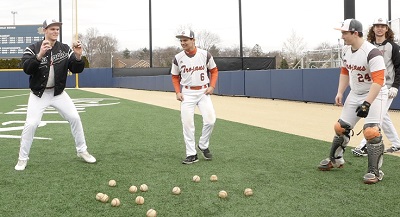
PHOTOS: (Top) Sturgis teammates congratulate Korbin Whitcomb as he heads back to the dugout during a game against Marshall on March 26 at Notre Dame University. (Middle) The Trojans enjoy a lighter moment during that doubleheader. (Photos courtesy of JoeInsider.com.)