


Classes Still Create Hoosier Hysteria
July 27, 2017
By Rob Kaminski
MHSAA benchmarks editor
This is the fourth part in a series on MHSAA tournament classification, past and present, that will be published over the next two weeks. This series originally ran in this spring's edition of MHSAA benchmarks.
Twenty years ago, Bloomington North High School won the Indiana High School Athletic Association boys basketball championship, defeating Delta 75-54 at the RCA Dome in Indianapolis.
The date, March 22, 1997, is at the same time revered and disdained by traditionalists in the state who saw it as the last schoolboy championship game the state would ever host.
That’s how devout the game of basketball, particularly interscholastic basketball, had become in the Hoosier state during the 87 years a state champion – one state champion, to be precise – was crowned.
Following that 1997 season, the IHSAA moved to a four-class system for its roundball tournaments, like so many of its state association counterparts had done years earlier.
It would be shocking to find more than a small percentage of current high school basketball players around the country unfamiliar with the iconic movie Hoosiers, even though the film is now more than 30 years old.
And, the storyline for that blockbuster unfolded more than 30 years prior to its release, when small-town, undermanned Milan High School defeated Muncie Central High School 32-30 in the 1954 IHSAA title game.
Perhaps it’s because of the David vs Goliath notion, or the fame of the movie that replaced Milan with the fictional Hickory and real-life star Bobby Plump with Hollywood hero Jimmy Chitwood, or the simple fact that Indiana had something other states didn’t.
Whatever the reason, plenty of opposition remains to this day to basketball classification in the state.
The fact is, the small rural schools were regularly being beaten handily by the much larger suburban and city schools as the tournament progressed each season.
Small schools also were closing at a rapid rate following the state’s School Reorganization Act in 1959, as students converged on larger, centralized county schools. From 1960 to 2000, the number of schools entering the tournament dropped from 694 to 381, and in 1997 a total of 382 schools and 4,584 athletes began competition at the Sectional level (the first level of the IHSAA Basketball Tournament).
It was at the entry level of the tournament where school administrators felt the pain of the new class system, but not necessarily for the same nostalgic reasons as the fans who either attended or boycotted the tournament.
At the Sectional round of the tournament, the IHSAA was culling just 2 percent of the revenue, with the participating schools splitting the balance. So, when Sectional attendance dropped by 14 percent in that first year of class basketball, many schools realized a financial loss. It was money they had grown to count on in prior years to help fund various aspects of the department.
Schools cumulatively received more than $900,000 from Sectional competition in 1998, but that total was down from more than $1 million in the last year of the single-class tournament.
Yet, the current format provides a great deal more opportunity and realistic chances at championship runs for schools of all enrollments.
To date, 60 additional teams have championship or runner-up trophies on display in school trophy cases around Indiana.
That was the mission in front of then-IHSAA commissioner Bob Gardner (now National Federation executive director) once the board made its decision: to give thousands more student-athletes the opportunity for once-in-a-lifetime experiences.
As any statistician knows, figures can be manipulated to tell any side of a story. Declining attendance in year one of class basketball is such a number.
The truth is tournament attendance had been on a steady downward spiral since its peak of just over 1.5 million in 1962. By the last single-class event in 1997, the total attendance was half that.
The challenge then and today, as it is for all state associations, is to find that delicate balance for those holding onto tradition, those holding onto trophies, and the number of trophies to hand out.
Editor’s Note: Stories from the Fort Wayne Journal Gazette in 1998 and from a 2007 issue of Indianapolis Monthly provided facts in this article.
Edison Brings Another Title to PSL
March 24, 2018
By Geoff Kimmerly
Second Half editor
EAST LANSING – Perseverance and patience anchored the explanation as pride in the Detroit Public School League flowed Saturday evening at the Breslin Center.
The great majority of the conference’s nearly 30 MHSAA boys basketball championships have been won over the years in Class A. Most of the league’s schools lately have played in Class A and B.
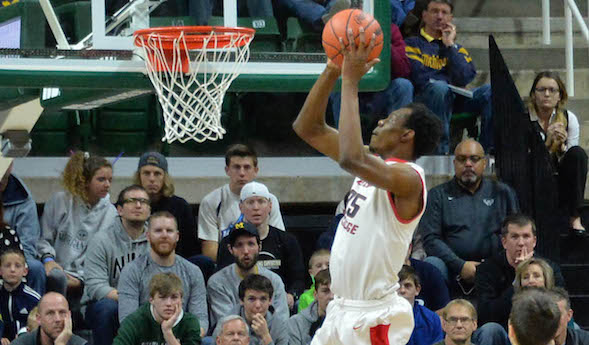
And from Class C this weekend emerged the latest PSL champion, Detroit Edison, which entered the postseason with a .500 record but more than ready to run after weathering a regular-season schedule loaded with larger opponents.
Edison completed its first MHSAA title run with a 53-38 win over Maple City Glen Lake, the Pioneers’ 12th victory over its final 13 games this winter.
“We didn’t struggle the whole year. We played in the toughest league, the PSL,” Edison senior Pierre Mitchell, Jr., said. “We won the PSL championship; the state run was a little easier than the PSL playoffs. We just had to click at the right time.”
Edison (17-10) became the fourth team to enter the playoffs with a record of .500 or worse and win an MHSAA boys basketball title, joining 1933 Grand Haven and 1967 Menominee in Class B and 1969 Marquette Baraga in Class D. The Pioneers also became the third to enter with double-digit losses and win it all – Menominee was 6-10 (in part because of four forfeits) at the end of the 1967 regular season and finished 13-10, and Baraga was 8-10 in 1969 and finished 16-10.
Edison finished fourth during its regular season in the PSL’s East Division 1, which also included Class A Detroit East English and Martin Luther King, Class B Osborn and Class C Pershing. But the Pioneers won the PSL tournament title by beating Pershing plus Class A Cass Tech and Class B Mumford and Renaissance.
The early losses weren’t by design, of course, but Edison didn’t employ its full attack until late in the season to keep opponents from being able to scout everything that might be coming their way during the playoffs.
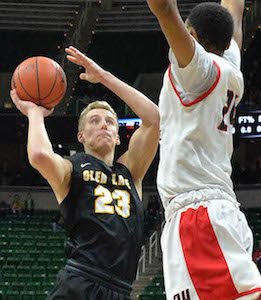 “To go 2-6 (in the league) was a big disappointment, but we always understood that everyone makes it to the playoffs,” Pioneers coach Brandon Neely said. “I was very optimistic that once we got into the playoffs, we were going to be a tough team.”
Glen Lake (24-3) was a formidable final opponent. The Northwest Conference co-champion led the first seven minutes Saturday and then most of the first three of the second half.
With 4:58 to go in the third quarter, Mitchell made a free throw to tie the score at 25-25 and then missed his second. Glen Lake senior forward Cade Peterson came down with the rebound – by also twisted his right ankle as his foot came down on the foot of an Edison player behind him.
Peterson left the game, and 20 seconds later Mitchell drilled a 3-pointer to give the Pioneers a 28-25 lead. Starting with his basket, they finished the period on a 14-6 run. Edison pushed the lead to double digits three minutes into the fourth quarter, even as Peterson returned to the floor.
“He does it all. He defends, he scores, he attacks, he rebounds at both ends, and he’s our leader on the floor,” Glen Lake coach Rich Ruelas said of Peterson, who finished with 12 points and 10 rebounds. “When you take that away – and we’ve been resilient all year – obviously he’s pretty important to our team.
“Cade was our rock this year and just led us every step of the way. … He wants to win as badly as anyone I’ve ever met.”
Junior guard Xander Okerlund led the Lakers with 19 points and seven rebounds as they played in their first MHSAA championship game since 1996 and first ever in Class C and making all three previous Final appearances in Class D.
Mitchell finished with 17 points and three steals, making 6 of 12 shots from the floor. Senior guard Gary Solomon made 7 of 14 shots for 16 points to go with four steals. Senior center Deante Johnson and junior forward Brian Taylor, Jr., both had 10 points, Johnson with 11 rebounds and Taylor with three steals as well.
“We had a tough season, but these guys preserved and continued to dig in,” Neely said. “And it was very gratifying to see these guys reap the benefits of hard work. They’ve grown as men and they understand what it takes to get to the next level whether it’s in basketball, whether it’s in school, whatever needs to be done. These guys understand when you’re dedicated to something and commit yourself, you can be successful.”
Edison also became the fourth school to celebrate boys and girls MHSAA basketball championships during the same school year; the Pioneers' girls won their second straight Class C title last weekend. Edison joined the Detroit Country Day teams of 1989-90 and 1995-96, Flint Northern's teams of 1994-95 and Flint Northwestern's teams of 1983-84 and 1984-85 in that achievement.
PHOTOS: (Top) Detroit Edison’s Deante Johnson approaches for a dunk during Saturday’s Class C Final at the Breslin Center. (Middle) Glen Lake’s Cade Peterson goes up for a shot while Edison’s Brian Taylor, Jr., defends.