


Classes Still Create Hoosier Hysteria
July 27, 2017
By Rob Kaminski
MHSAA benchmarks editor
This is the fourth part in a series on MHSAA tournament classification, past and present, that will be published over the next two weeks. This series originally ran in this spring's edition of MHSAA benchmarks.
Twenty years ago, Bloomington North High School won the Indiana High School Athletic Association boys basketball championship, defeating Delta 75-54 at the RCA Dome in Indianapolis.
The date, March 22, 1997, is at the same time revered and disdained by traditionalists in the state who saw it as the last schoolboy championship game the state would ever host.
That’s how devout the game of basketball, particularly interscholastic basketball, had become in the Hoosier state during the 87 years a state champion – one state champion, to be precise – was crowned.
Following that 1997 season, the IHSAA moved to a four-class system for its roundball tournaments, like so many of its state association counterparts had done years earlier.
It would be shocking to find more than a small percentage of current high school basketball players around the country unfamiliar with the iconic movie Hoosiers, even though the film is now more than 30 years old.
And, the storyline for that blockbuster unfolded more than 30 years prior to its release, when small-town, undermanned Milan High School defeated Muncie Central High School 32-30 in the 1954 IHSAA title game.
Perhaps it’s because of the David vs Goliath notion, or the fame of the movie that replaced Milan with the fictional Hickory and real-life star Bobby Plump with Hollywood hero Jimmy Chitwood, or the simple fact that Indiana had something other states didn’t.
Whatever the reason, plenty of opposition remains to this day to basketball classification in the state.
The fact is, the small rural schools were regularly being beaten handily by the much larger suburban and city schools as the tournament progressed each season.
Small schools also were closing at a rapid rate following the state’s School Reorganization Act in 1959, as students converged on larger, centralized county schools. From 1960 to 2000, the number of schools entering the tournament dropped from 694 to 381, and in 1997 a total of 382 schools and 4,584 athletes began competition at the Sectional level (the first level of the IHSAA Basketball Tournament).
It was at the entry level of the tournament where school administrators felt the pain of the new class system, but not necessarily for the same nostalgic reasons as the fans who either attended or boycotted the tournament.
At the Sectional round of the tournament, the IHSAA was culling just 2 percent of the revenue, with the participating schools splitting the balance. So, when Sectional attendance dropped by 14 percent in that first year of class basketball, many schools realized a financial loss. It was money they had grown to count on in prior years to help fund various aspects of the department.
Schools cumulatively received more than $900,000 from Sectional competition in 1998, but that total was down from more than $1 million in the last year of the single-class tournament.
Yet, the current format provides a great deal more opportunity and realistic chances at championship runs for schools of all enrollments.
To date, 60 additional teams have championship or runner-up trophies on display in school trophy cases around Indiana.
That was the mission in front of then-IHSAA commissioner Bob Gardner (now National Federation executive director) once the board made its decision: to give thousands more student-athletes the opportunity for once-in-a-lifetime experiences.
As any statistician knows, figures can be manipulated to tell any side of a story. Declining attendance in year one of class basketball is such a number.
The truth is tournament attendance had been on a steady downward spiral since its peak of just over 1.5 million in 1962. By the last single-class event in 1997, the total attendance was half that.
The challenge then and today, as it is for all state associations, is to find that delicate balance for those holding onto tradition, those holding onto trophies, and the number of trophies to hand out.
Editor’s Note: Stories from the Fort Wayne Journal Gazette in 1998 and from a 2007 issue of Indianapolis Monthly provided facts in this article.
Block Party: 2026 Girls Volleyball Week 5 Report
By
Geoff Kimmerly
MHSAA.com senior editor
September 23, 2026
We’re a little more than a month into this high school girls volleyball season, and although we often know going in several teams which should emerge as contenders, we’re also in the midst of many more beginning to rise from the 700-school statewide pack.
League play is picking up, several major tournaments are behind us and many more are on the way, and this week’s report highlights not just some of the expected elite but also a handful of teams pushing into the rankings during this fall’s first half.
Records below are those reported and tracked on this website, and rankings referred to below reflect the latest polls posted by the Michigan Interscholastic Volleyball Coaches Association (MIVCA).
Week in Review
The countdown of last week’s five most intriguing results:
1. Jenison d. Farmington Hills Mercy (20-25, 25-21, 15-9) East defeated West 13-10 at the East vs. West Showdown on Saturday, but Division 1 honorable mention Jenison (17-7-1) made the day’s biggest wave by downing the top-ranked Marlins.
2. Essexville Garber d. Kingsley (26-24, 25-17) The Division 2 honorable mention Dukes (20-7-4) finished 4-1 at their invitational, also defeating No. 10 North Branch but with this win over the No. 5 Stags (26-3-1) getting the slight edge for the Garber highlight of the day.
3. Calumet d. Crystal Falls Forest Park (16-25, 25-18, 25-17, 25-10) The Copper Kings (9-7) lost the first set by a significant margin before coming back to win the next three by similarly notable scores over the Division 4 No. 7 Trojans (17-3-1).
4. Battle Creek Lakeview d. Battle Creek Harper Creek (25-23, 25-27, 15-9) Division 1 honorable mention Lakeview (21-3-2) finished a 6-0 day at the Battle Creek All-City Tournament with its only match to go three sets, defeating Harper Creek (20-9-1) for a second time to clinch the title.
5. Cass City d. Millington (28-26, 25-18, 26-24) This key Big Thumb Conference White victory didn’t come easily for Division 3 No. 6 Cass City (8-4-3) as the Cardinals (13-4) pushed the Red Hawks especially far in the first and third sets.
Watch List
With an eye toward November, here are two teams in each division making sparks:
DIVISION 1
Bloomfield Hills Marian (21-3) The Mustangs remain ranked No. 2 in Division 1 coming off a 4-0 day at the East vs. West Showdown that included wins over No. 6 Hudsonville, No. 10 Lowell, honorable mention Jenison and Salem. Their only losses have been to Grand Rapids Christian and twice to Farmington Hills Mercy, the top-ranked teams in Divisions 2 and 1, respectively.
Zeeland East (18-2) The Chix are an honorable mention in Division 1 this week for the second straight with a pair of wins over Division 2 honorable mention Holland Christian and a single over Division 3 No. 8 Hart among most recent highlights. Zeeland East finished 22-10 two years ago, improved to 31-5 last season and is on pace to match and potentially surpass that win total with its only losses this fall to Allendale and No. 8 Grand Haven.
DIVISION 2
Kingsley (26-3-1) The Stags moved back into Division 2 this season after winning the Division 3 championship a year ago and sit No. 5 in the latest coaches poll after going 4-1-1 at Garber with a pair of wins over North Branch included. Last week they celebrated Jenna Middleton becoming the 34th player in MHSAA history to reach 2,000 career kills, and she’ll surely continue to be relied on as Kingsley faces multiple Division 3 contenders over the next month.
Macomb Lutheran North (19-1) The Mustangs have appeared on the verge of taking off the last few seasons, and they’ve been almost impossible to catch this fall with only Port Huron Northern in August dealing them a defeat. Lutheran North is up to No. 8 in Division 2 and succeeded in its toughest challenges to date with a five-set win over North Branch and four-setter over honorable mention Richmond.
DIVISION 3
Manton (13-7-1) The Rangers jumped from unranked last week to No. 7 in the latest poll after a close loss to Kingsley on Saturday and wins over Beaverton, Saginaw Swan Valley, Reed City and Lake City over those seven days. Manton fell to Roscommon in five sets Tuesday, the last two sets by two points apiece and could build on last year’s 32-12-2 finish – especially with Kingsley not lined up as a potential District stopper like a year ago.
Saginaw Valley Lutheran (25-4-1) The Chargers have been ranked No. 1 in Division 3 since the season’s start coming off their third-straight Regional title and a trip to the Semifinals last fall with the same roster. They’ve faced several larger opponents already this season, with their losses to Division 1 Plymouth, Division 2 Yale and North Branch and Division 4 No. 3 Traverse City Christian, and a notable win Saturday over Division 4 No. 4 Mount Pleasant Sacred Heart.
DIVISION 4
Adrian Lenawee Christian (14-3) The Cougars brought a five-year District championship streak into this season and moved back into the No. 1 spot in Division 4 this week after one week at No. 2. The schedule has been filled almost completely with larger opponents and the losses have come to Division 1 Mason, Division 2 No. 4 Parma Western and over the weekend Division 3 No. 5 Clinton, and Lenawee Christian also has a win over Mason.
St. Joseph Michigan Lutheran (15-2-1) The Titans are another returning District champion and most recently went 6-0 at the Bridgman Invitational with a notable sweep of Three Oaks River Valley – which had defeated, lost to and tied Michigan Lutheran during the season’s first week. Only one other opponent, Division 2 South Haven, has taken a set off the Titans all season, doing so in dealing them their only other defeat.
Can’t-Miss Contests
Be on the lookout for results of these matches and tournaments coming up:
Wednesday – Marshall (17-5-1) at Parma Western (20-0) – This Interstate 8 Athletic Conference battle also features the No. 7 and No. 4 teams, respectively, in Division 2 statewide.
Wednesday – Orchard Lake St. Mary’s (8-6-1) at Bloomfield Hills Marian (21-3) – St. Mary’s is an honorable mention this week and has been climbing the last few seasons and would love to take the next step as it attempts to avenge an opening-weekend loss to the Mustangs.
Thursday – Onekama (13-7) at Traverse City Christian (22-3) – Christian is ranked No. 3 in Division 4 and Onekama is an honorable mention, and Christian also won their Regional Final matchup last season.
Saturday – Hudsonville Tournament – The Division 1 No. 6 Eagles (15-2) host Division 2 No. 1 Grand Rapids Christian (16-1), No. 7 Marshall (17-5-1), South Lyon (14-8-1), Battle Creek Harper Creek (20-9-1), Vicksburg (14-8), Grand Rapids Northview (3-10), Grand Rapids Forest Hills Central (8-13) and Hudsonville Unity Christian (6-9-1).
Saturday – Motor City Power Series at UWM Sports Complex – Arguably the most intriguing pool this weekend includes Division 1 honorable mention Bloomfield Hills (15-5), Canton (6-13-2), Division 2 honorable mentions Flat Rock (11-2-1) and Grand Rapids Catholic Central (15-5-1), and Ionia (9-6).
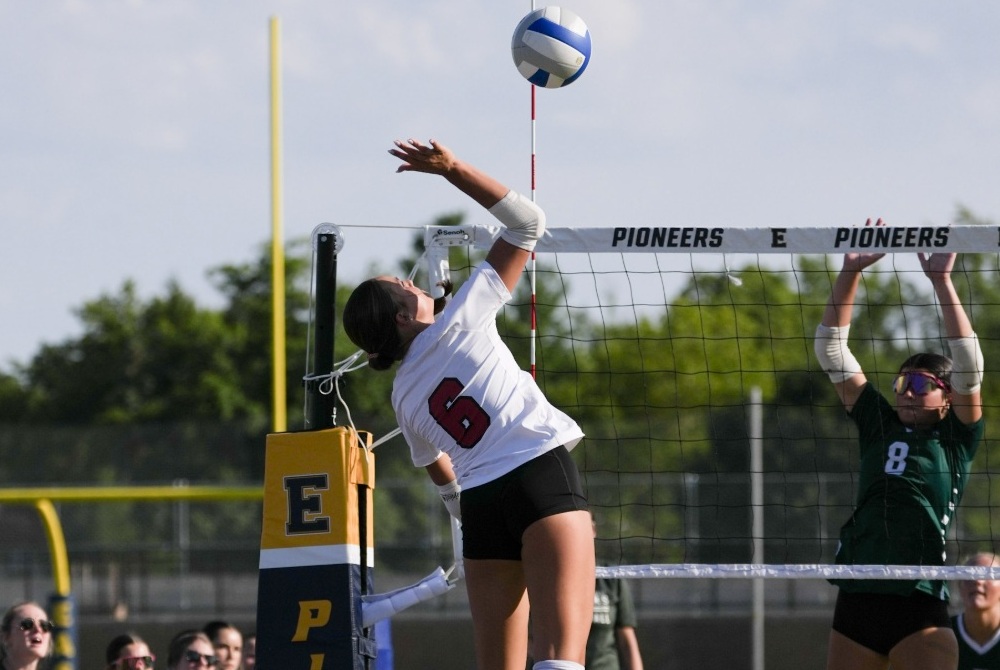
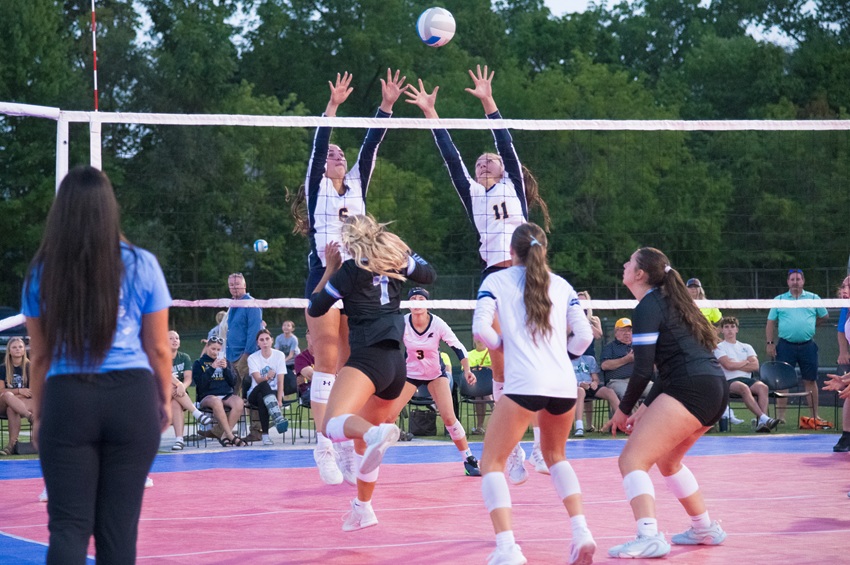
PHOTOS (Top) Allendale’s Josie Brose (6) winds up for a kill attempt while facing Grand Rapids Forest Hills Central at East Grand Rapids’ Rally on Reeds on Aug. 19. (Middle) DeWitt and Lansing Catholic face off during the Cougars’ Volley Turf Takeover on Aug. 20. (Allendale/FHC photo by Michigan Sports Photo. DeWitt/Lansing Catholic photo by TCP Photography.)