


Classes Still Create Hoosier Hysteria
July 27, 2017
By Rob Kaminski
MHSAA benchmarks editor
This is the fourth part in a series on MHSAA tournament classification, past and present, that will be published over the next two weeks. This series originally ran in this spring's edition of MHSAA benchmarks.
Twenty years ago, Bloomington North High School won the Indiana High School Athletic Association boys basketball championship, defeating Delta 75-54 at the RCA Dome in Indianapolis.
The date, March 22, 1997, is at the same time revered and disdained by traditionalists in the state who saw it as the last schoolboy championship game the state would ever host.
That’s how devout the game of basketball, particularly interscholastic basketball, had become in the Hoosier state during the 87 years a state champion – one state champion, to be precise – was crowned.
Following that 1997 season, the IHSAA moved to a four-class system for its roundball tournaments, like so many of its state association counterparts had done years earlier.
It would be shocking to find more than a small percentage of current high school basketball players around the country unfamiliar with the iconic movie Hoosiers, even though the film is now more than 30 years old.
And, the storyline for that blockbuster unfolded more than 30 years prior to its release, when small-town, undermanned Milan High School defeated Muncie Central High School 32-30 in the 1954 IHSAA title game.
Perhaps it’s because of the David vs Goliath notion, or the fame of the movie that replaced Milan with the fictional Hickory and real-life star Bobby Plump with Hollywood hero Jimmy Chitwood, or the simple fact that Indiana had something other states didn’t.
Whatever the reason, plenty of opposition remains to this day to basketball classification in the state.
The fact is, the small rural schools were regularly being beaten handily by the much larger suburban and city schools as the tournament progressed each season.
Small schools also were closing at a rapid rate following the state’s School Reorganization Act in 1959, as students converged on larger, centralized county schools. From 1960 to 2000, the number of schools entering the tournament dropped from 694 to 381, and in 1997 a total of 382 schools and 4,584 athletes began competition at the Sectional level (the first level of the IHSAA Basketball Tournament).
It was at the entry level of the tournament where school administrators felt the pain of the new class system, but not necessarily for the same nostalgic reasons as the fans who either attended or boycotted the tournament.
At the Sectional round of the tournament, the IHSAA was culling just 2 percent of the revenue, with the participating schools splitting the balance. So, when Sectional attendance dropped by 14 percent in that first year of class basketball, many schools realized a financial loss. It was money they had grown to count on in prior years to help fund various aspects of the department.
Schools cumulatively received more than $900,000 from Sectional competition in 1998, but that total was down from more than $1 million in the last year of the single-class tournament.
Yet, the current format provides a great deal more opportunity and realistic chances at championship runs for schools of all enrollments.
To date, 60 additional teams have championship or runner-up trophies on display in school trophy cases around Indiana.
That was the mission in front of then-IHSAA commissioner Bob Gardner (now National Federation executive director) once the board made its decision: to give thousands more student-athletes the opportunity for once-in-a-lifetime experiences.
As any statistician knows, figures can be manipulated to tell any side of a story. Declining attendance in year one of class basketball is such a number.
The truth is tournament attendance had been on a steady downward spiral since its peak of just over 1.5 million in 1962. By the last single-class event in 1997, the total attendance was half that.
The challenge then and today, as it is for all state associations, is to find that delicate balance for those holding onto tradition, those holding onto trophies, and the number of trophies to hand out.
Editor’s Note: Stories from the Fort Wayne Journal Gazette in 1998 and from a 2007 issue of Indianapolis Monthly provided facts in this article.
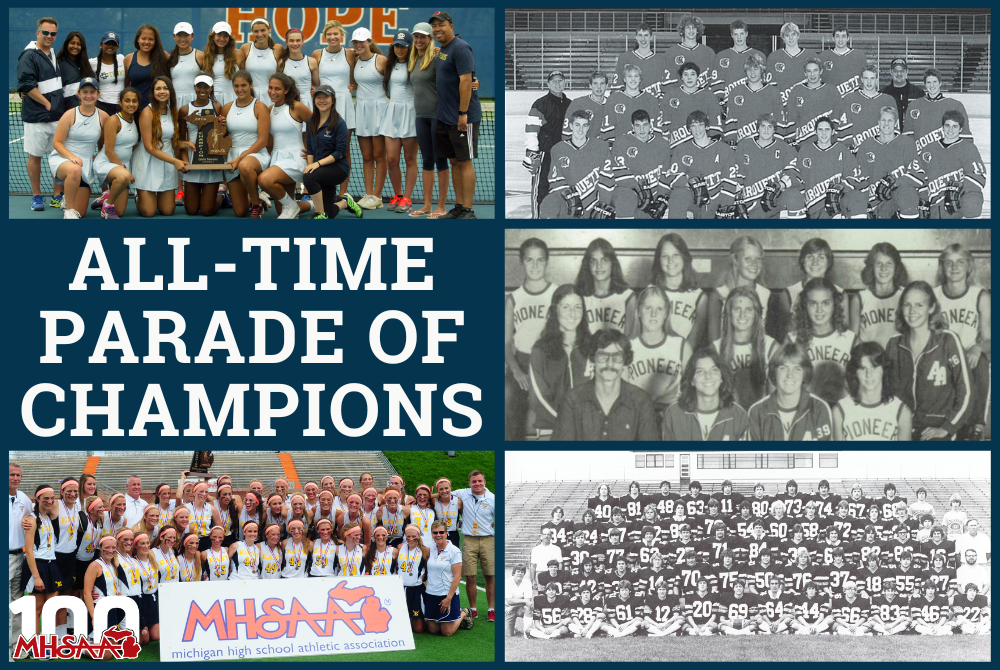
Century of School Sports: All-Time 'Parade of Champions'
By
Geoff Kimmerly
MHSAA.com senior editor
June 25, 2025
As we do every June, we will complete 2024-25 this week by publishing our “Parade of Champions” – a listing of every team to win an MHSAA Finals championship trophy this school year.
Recognizing about 130 champions annually – give or take a few if there were shared titles along the way during that past fall, winter and spring – it’s always an impressive list. So we’re plenty stoked – maybe even 100 times more – to present as our second-to-last “Century of School Sports” feature a few findings from our work-in-progress all-time “Parade of Champions.”
Eventually, the data we’ve collected will be provided on the MHSAA website as a searchable data base – there’s more work to come, and I’ll explain some of that below. But for today, here are some of the first facts that jump off the pages from this massive collection.
Starting with the biggest: Since its first titles were awarded to finish the Winter 1924-25 season, the MHSAA has recognized 6,876 teams for winning Finals championships.
Five schools have won at least 100 Finals titles, and 17 schools have won 50 or more. Marquette leads the list with 295, followed by East Grand Rapids (145), Escanaba (134), Ann Arbor Pioneer (122) and Detroit Country Day (107).
For several reasons, it’s difficult to compare championship totals among Upper Peninsula and Lower Peninsula schools as apples to apples – chiefly, schools in both peninsulas compete against each other in postseason competition in only 16 of 28 MHSAA-sponsored sports, and a handful of those 16 have little or no representation from the U.P. despite being statewide tournaments.
That said, here’s a look at some expanded school Finals title rankings, but by peninsula, going deeper on Lower Peninsula schools ranked because the majority of Michigan’s high schools are below Mackinac Bridge:
Lower Peninsula: 1. East Grand Rapids (145), 2. Ann Arbor Pioneer (122), 3. Detroit Country Day (107), 4. Bloomfield Hills Cranbrook Kingswood 88, 5. Detroit Catholic Central (74), 6. Bloomfield Hills Brother Rice (69), 7. Grosse Pointe Woods University Liggett (64), 8. Jackson Lumen Christi (55), 9. Petoskey (46), 10. Traverse City Central (45).
11. Okemos (44), 12. Detroit St. Martin dePorres (41), 13. East Lansing (39), 14. Rockford (37), T-15. Ann Arbor Greenhills (35), T-15. Birmingham Seaholm (35), 17. Flint Powers Catholic (33), T-18. Bloomfield Hills Marian (32), T-18. Kalamazoo Central (32), 20. Grand Rapids Forest Hills Northern (31).
Upper Peninsula: 1. Marquette (295), 2. Escanaba (134), 3. Iron Mountain (78), 4. Menominee (66), 5. Ishpeming Westwood (65), T-6. Ishpeming (64), T-6. Pickford (64), T-8. Negaunee (50), T-8. Ontonagon (50), 10. Houghton (49).
A few more interesting notes:
• Note Detroit dePorres at No. 12 among Lower Peninsula schools; dePorres closed in 2005. Flint Northern ranks 21st among Lower Peninsula schools with 30 championships despite closing in 2013. The former Ypsilanti High School, which consolidated with Willow Run in 2013 to form Ypsilanti Community, also is high on the list with 24 titles.
• Larger schools generally play more sports, and hence have more opportunities to win Finals titles. But Lower Peninsula small schools fell just outside those listed above, including Battle Creek St. Philip and Fowler – both with 29 championships – and Flint Beecher, Kalamazoo Hackett Catholic Prep and Pewamo-Westphalia with 26 apiece.
• We don’t have an easy way – yet – to figure out which schools have won at least once in the most sports. But among the top five, East Grand Rapids and Marquette both have won titles in 18 sports, Country Day has won in 17, Ann Arbor Pioneer in 15 and Escanaba in 13. Pioneer’s 15 include boys gymnastics, which was sponsored by the MHSAA from 1925-31 and 1961-81.
• Detroit Catholic Central has the most championships among all-boys schools, among 11 sports. Bloomfield Hills Marian ranks highest among all-girls schools, with its titles covering seven sports.
As noted, this remains a work in progress, as we’re continuing to research several school closings, consolidations or other name changes over the last 100 years and how those might affect our championship totals. We also need to continue figuring in how to list championships won by cooperative programs and if those are credited to primary schools or as standalone programs.
In the meantime, we’ll continue to update the data with championships won each season, including in our new sports of girls field hockey and boys volleyball debuting in 2025-26. Once the data is fully edited and complete, we’ll add this substantial source to our growing collection of historical information available for all to enjoy.
Previous "Century of School Sports" Spotlights
June 17: Top Performers Tell Us What High School Sports Mean to Them - Read
June 10: 'The Mitten' Becomes Sought-After Symbol of MHSAA Greatness - Read
June 3: MHSAA's Move to TV, Now Internet, 60 Years Old & Growing - Read
May 27: Upper Peninsula Helps Make Michigan's School Sports Story Unique - Read
May 20: From Nearly A to Z, Schools Repped by 221 Nicknames - Read
May 13: These Record-Setters were Nearly Impossible to Defeat - Read
May 6: 200+ Representatives Fill All-Time Council Roster - Read
April 29: MHSAA Programs Prioritize Health & Safety - Read
April 23: Patches Signify Registered Officials' Role in MHSAA Story - Read
April 16: Student Advisory Council Gives Voice to Athletes - Read
April 9: State's Storytellers Share Spring Memories - Read
April 2: Sharp Leadership Synonymous with MHSAA Success - Read
March 25: Athletic Directors Indispensable to Mission of School Sports - Read
March 18: 2025 Finals Begin Next Half-Century of Girls Hoops Championships - Read
March 11: Boys Basketball's Best 1st to Earn MHSAA Finals Titles - Read
March 5: Everything We Do Begins with Participation - Read
Feb. 25: Slogans & Logos Remain Unforgettable Parts of MHSAA History - Read
Feb. 19: MHSAA Tickets Continue to Provide Fan-Friendly Value - Read
Feb. 11: We Recognize Those Who Make Our Games Go - Read
Feb. 4: WISL Conference Continues to Inspire Aspiring Leaders - Read
Jan. 28: Michigan's National Impact Begins at NFHS' Start - Read
Jan. 21: Awards Celebrate Well-Rounded Educational Experience - Read
Jan. 14: Predecessors Laid Foundation for MHSAA's Formation - Read
Jan. 9: MHSAA Blazes Trail Into Cyberspace - Read
Dec. 31: State's Storytellers Share Winter Memories - Read
Dec. 17: MHSAA Over Time - Read
Dec. 10: On This Day, December 13, We Will Celebrate - Read
Dec. 3: MHSAA Work Guided by Representative Council - Read
Nov. 26: Finals Provide Future Pros Early Ford Field Glory - Read
Nov. 19: Connection at Heart of Coaches Advancement Program - Read
Nov. 12: Good Sports are Winners Then, Now & Always - Read
Nov. 5: MHSAA's Home Sweet Home - Read
Oct. 29: MHSAA Summits Draw Thousands to Promote Sportsmanship - Read
Oct. 23: Cross Country Finals Among MHSAA's Longest Running - Read
Oct. 15: State's Storytellers Share Fall Memories - Read
Oct. 8: Guided by 4 S's of Educational Athletics - Read
Oct. 1: Michigan Sends 10 to National Hall of Fame - Read
Sept. 25: MHSAA Record Books Filled with 1000s of Achievements - Read
Sept. 18: Why Does the MHSAA Have These Rules? - Read
Sept. 10: Special Medals, Patches to Commemorate Special Year - Read
Sept. 4: Fall to Finish with 50th Football Championships - Read
Aug. 28: Let the Celebration Begin - Read
PHOTOS These are all past MHSAA Finals champions, clockwise from top left: The 2016 Detroit Country Day girls tennis team, 2004 Marquette ice hockey team, 1978 Ann Arbor Pioneer girls cross country team, 1981 Escanaba football team and 2013 East Grand Rapids girls lacrosse team.