


Classes Still Create Hoosier Hysteria
July 27, 2017
By Rob Kaminski
MHSAA benchmarks editor
This is the fourth part in a series on MHSAA tournament classification, past and present, that will be published over the next two weeks. This series originally ran in this spring's edition of MHSAA benchmarks.
Twenty years ago, Bloomington North High School won the Indiana High School Athletic Association boys basketball championship, defeating Delta 75-54 at the RCA Dome in Indianapolis.
The date, March 22, 1997, is at the same time revered and disdained by traditionalists in the state who saw it as the last schoolboy championship game the state would ever host.
That’s how devout the game of basketball, particularly interscholastic basketball, had become in the Hoosier state during the 87 years a state champion – one state champion, to be precise – was crowned.
Following that 1997 season, the IHSAA moved to a four-class system for its roundball tournaments, like so many of its state association counterparts had done years earlier.
It would be shocking to find more than a small percentage of current high school basketball players around the country unfamiliar with the iconic movie Hoosiers, even though the film is now more than 30 years old.
And, the storyline for that blockbuster unfolded more than 30 years prior to its release, when small-town, undermanned Milan High School defeated Muncie Central High School 32-30 in the 1954 IHSAA title game.
Perhaps it’s because of the David vs Goliath notion, or the fame of the movie that replaced Milan with the fictional Hickory and real-life star Bobby Plump with Hollywood hero Jimmy Chitwood, or the simple fact that Indiana had something other states didn’t.
Whatever the reason, plenty of opposition remains to this day to basketball classification in the state.
The fact is, the small rural schools were regularly being beaten handily by the much larger suburban and city schools as the tournament progressed each season.
Small schools also were closing at a rapid rate following the state’s School Reorganization Act in 1959, as students converged on larger, centralized county schools. From 1960 to 2000, the number of schools entering the tournament dropped from 694 to 381, and in 1997 a total of 382 schools and 4,584 athletes began competition at the Sectional level (the first level of the IHSAA Basketball Tournament).
It was at the entry level of the tournament where school administrators felt the pain of the new class system, but not necessarily for the same nostalgic reasons as the fans who either attended or boycotted the tournament.
At the Sectional round of the tournament, the IHSAA was culling just 2 percent of the revenue, with the participating schools splitting the balance. So, when Sectional attendance dropped by 14 percent in that first year of class basketball, many schools realized a financial loss. It was money they had grown to count on in prior years to help fund various aspects of the department.
Schools cumulatively received more than $900,000 from Sectional competition in 1998, but that total was down from more than $1 million in the last year of the single-class tournament.
Yet, the current format provides a great deal more opportunity and realistic chances at championship runs for schools of all enrollments.
To date, 60 additional teams have championship or runner-up trophies on display in school trophy cases around Indiana.
That was the mission in front of then-IHSAA commissioner Bob Gardner (now National Federation executive director) once the board made its decision: to give thousands more student-athletes the opportunity for once-in-a-lifetime experiences.
As any statistician knows, figures can be manipulated to tell any side of a story. Declining attendance in year one of class basketball is such a number.
The truth is tournament attendance had been on a steady downward spiral since its peak of just over 1.5 million in 1962. By the last single-class event in 1997, the total attendance was half that.
The challenge then and today, as it is for all state associations, is to find that delicate balance for those holding onto tradition, those holding onto trophies, and the number of trophies to hand out.
Editor’s Note: Stories from the Fort Wayne Journal Gazette in 1998 and from a 2007 issue of Indianapolis Monthly provided facts in this article.
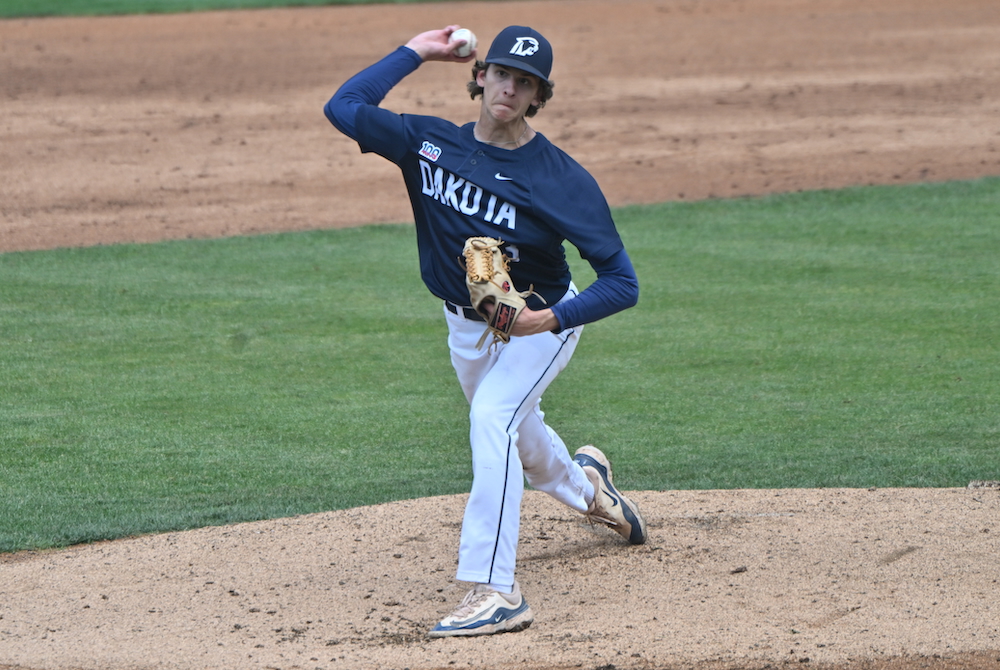
Dakota Wins Battle of Aces, Hartland's Crowe Brothers Come Through in Clutch
By
Steve Vedder
Special for MHSAA.com
June 13, 2025
EAST LANSING – Luke DeMasse wouldn't be opposed to continuing as a two-way threat in college, but for now he'll settle for mastery on the pitching mound.
Especially if it contributes to a Division 1 championship.
The Macomb Dakota senior was outstanding both pitching and at the plate in Friday's 6-2 Semifinal win over Bay City Western at Michigan State's McLane Stadium.
In a matchup of the top two ranked teams in Division 1, DeMasse remained unbeaten as a pitcher (8-0) in tossing a three-hitter while also contributing a two-run single that sparked a five-run fourth inning. He also singled, stole second and scored on a sacrifice fly by Jacob Gjonaj in the sixth inning.
On top of his eight straight wins as a pitcher, DeMasse, bound for Ball State next season, is a key to the offense. He's third on the team in extra-base hits (11), fourth on the team in RBIs (26) and batting (.351), and fifth in runs (29). Still, DeMasse said he's a pitcher first.
"Definitely I'm a pitcher who also hits," he said. "It'd be cool to two-way (in college); maybe if I worked at it. But when I pitch, I focus on pitching. I just try to help the team on both sides, especially in high pressure situations. I just try to stay calm."
DeMasse's three-hitter furthered an amazing stretch of pitching for No. 1-ranked Macomb Dakota, which will play Hartland in Saturday's 2:30 p.m. Final. Cougars pitchers have allowed two runs or fewer in six tournament games while giving up one run or fewer or tossing a shutout 16 times this year.
"I knew going into the season we had some very good arms," Macomb Dakota coach Angelo Plouffe said. "I've been around for years, and I'm not surprised. They way they act on the mound, they know how to throw it."
Gjonaj, a junior shortstop, said it's a huge positive playing behind such talented arms. Gjonaj and Jadon Ford each had RBI singles during the five-run fourth inning.
"We probably have the best pitching in the state, and the offense comes through when we need it," Gjonaj said. "Our pitchers get groundouts and easy fly balls, and that's good for us."
Bay City Western, ranked No. 2 in Division 1, got a two-run single by Brayden Simmon in the fifth inning.
Plouffe said the five-run inning was a game-changer.
"The big inning was there for us," he said. "The kids kind of grinded out at-bats against a great, great pitcher."
Warriors coach Tim McDonald said he saw Dakota (36-6-1) in two tournaments this year, but his team hadn’t played the Cougars.
"That's impressive from (DeMasse), but I'll take my chances with (Warriors starter Luke LaCourse)," he said. "He's carried us so many times this year. I told them after the big inning that we need to pick him up, he's carried us so much this year. And we made some noise."
Hartland 4, Grosse Point South 2
Making good on a guess was just enough for Dylan Crowe to help Hartland advance to the Division 1 championship game.
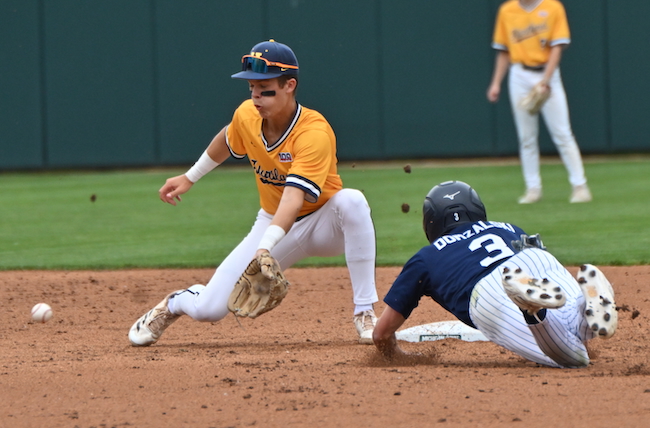
The Eagles sophomore third baseman lined a two-out, two-run double in the third inning to give Hartland a 4-2 win over Grosse Pointe South. The clutch hit wiped out a 2-1 deficit and was another step in Crowe overcoming a personally-tough second varsity season.
"I got a first pitch changeup, he came back with it and I stayed back and drove it," said Crowe, who drove in all four Hartland runs. "We've been barreling the ball against people, and today they just fell.
 “(The win) means a lot because I've struggled with adversity. My dad passed away last November, and it's been tough. But I wouldn't want to do this with any other team."
Crowe's father died last fall after battling cancer, but Crowe has responded by leading the team with 36 RBIs while batting in the middle of the team's order. His first inning sacrifice fly gave Hartland a 1-0 lead, his two-run double made it 3-2 in the third inning and Crowe added a fifth-inning RBI double for the 4-2 win.
"He's had a tough season obviously when you lose a loved one," Hartland coach Brad Guenther said of Crowe, whose brother Brayden singled, doubled and scored a run Friday. "His dad was a rock, and it's hard not to have him around for that support. But (the brothers) have handled it. Dylan kind of grinds it out with the tough times."
Brayden Crowe, a senior catcher, said it doesn't surprise the Eagles that they find themselves in the Final.
"We're always the underdog, but we feel like we should be here," he said. "We were hoping to get hot for the playoffs, and we have been. We have a lot of trust in our pitching and defense – they keep us going."
The win upped unranked Hartland to 27-15-1, while Grosse Point South finished 35-8. The Blue Devils, who had outscored five tournament opponents by a combined 38-9, set a school record for wins while playing in their ninth Semifinals.
Coach Dan Griesbaum, finishing his 42nd year as coach, credited Hartland starter Ty Kraut with an excellent showing. Kraut scattered eight hits, allowing an RBI double to Evan Bernard and sacrifice fly by James Michelotti during the second inning.
"He did a real nice job of keeping us off-balance and throwing strikes,' Griesbaum said. "That's the name of the game, and I give him a lot of credit. Our starting pitcher doesn't throw that hard. He needs to hit his spots, and the strike zone was tight for both teams. But I give them credit for playing hard and being well-coached."
PHOTOS (Top) Macomb Dakota’s Luke DeMasse throws a pitch during his team’s Division 1 Semifinal win Friday. (Middle) Grosse Pointe South’s Henry Domzalski slides into second base as a Hartland throw approaches.