


Classes Still Create Hoosier Hysteria
July 27, 2017
By Rob Kaminski
MHSAA benchmarks editor
This is the fourth part in a series on MHSAA tournament classification, past and present, that will be published over the next two weeks. This series originally ran in this spring's edition of MHSAA benchmarks.
Twenty years ago, Bloomington North High School won the Indiana High School Athletic Association boys basketball championship, defeating Delta 75-54 at the RCA Dome in Indianapolis.
The date, March 22, 1997, is at the same time revered and disdained by traditionalists in the state who saw it as the last schoolboy championship game the state would ever host.
That’s how devout the game of basketball, particularly interscholastic basketball, had become in the Hoosier state during the 87 years a state champion – one state champion, to be precise – was crowned.
Following that 1997 season, the IHSAA moved to a four-class system for its roundball tournaments, like so many of its state association counterparts had done years earlier.
It would be shocking to find more than a small percentage of current high school basketball players around the country unfamiliar with the iconic movie Hoosiers, even though the film is now more than 30 years old.
And, the storyline for that blockbuster unfolded more than 30 years prior to its release, when small-town, undermanned Milan High School defeated Muncie Central High School 32-30 in the 1954 IHSAA title game.
Perhaps it’s because of the David vs Goliath notion, or the fame of the movie that replaced Milan with the fictional Hickory and real-life star Bobby Plump with Hollywood hero Jimmy Chitwood, or the simple fact that Indiana had something other states didn’t.
Whatever the reason, plenty of opposition remains to this day to basketball classification in the state.
The fact is, the small rural schools were regularly being beaten handily by the much larger suburban and city schools as the tournament progressed each season.
Small schools also were closing at a rapid rate following the state’s School Reorganization Act in 1959, as students converged on larger, centralized county schools. From 1960 to 2000, the number of schools entering the tournament dropped from 694 to 381, and in 1997 a total of 382 schools and 4,584 athletes began competition at the Sectional level (the first level of the IHSAA Basketball Tournament).
It was at the entry level of the tournament where school administrators felt the pain of the new class system, but not necessarily for the same nostalgic reasons as the fans who either attended or boycotted the tournament.
At the Sectional round of the tournament, the IHSAA was culling just 2 percent of the revenue, with the participating schools splitting the balance. So, when Sectional attendance dropped by 14 percent in that first year of class basketball, many schools realized a financial loss. It was money they had grown to count on in prior years to help fund various aspects of the department.
Schools cumulatively received more than $900,000 from Sectional competition in 1998, but that total was down from more than $1 million in the last year of the single-class tournament.
Yet, the current format provides a great deal more opportunity and realistic chances at championship runs for schools of all enrollments.
To date, 60 additional teams have championship or runner-up trophies on display in school trophy cases around Indiana.
That was the mission in front of then-IHSAA commissioner Bob Gardner (now National Federation executive director) once the board made its decision: to give thousands more student-athletes the opportunity for once-in-a-lifetime experiences.
As any statistician knows, figures can be manipulated to tell any side of a story. Declining attendance in year one of class basketball is such a number.
The truth is tournament attendance had been on a steady downward spiral since its peak of just over 1.5 million in 1962. By the last single-class event in 1997, the total attendance was half that.
The challenge then and today, as it is for all state associations, is to find that delicate balance for those holding onto tradition, those holding onto trophies, and the number of trophies to hand out.
Editor’s Note: Stories from the Fort Wayne Journal Gazette in 1998 and from a 2007 issue of Indianapolis Monthly provided facts in this article.
Preview: Historic Opportunities Abound as Contenders Conclude at DeMartin Stadium
By
Geoff Kimmerly
MHSAA.com senior editor
June 12, 2025
The MHSAA Girls Soccer Finals have seen 18 champions also finish their seasons undefeated, the most recent in 2021.
Both Saline and Hudsonville Unity Christian have the opportunity this weekend to become the next.
And that’s not all on the all-time historical side of these two days of championships at DeMartin Stadium.
Byron Center, New Boston Huron and both Division 3 contenders – Grand Rapids Catholic Central and Warren Regina – are set to play in their first championship matches, meaning the Division 3 champion is guaranteed to be a first-time Finals winner.
Following is this weekend’s schedule at Michigan State University:
Division 1 - Saturday - 4 p.m. - Stream
Byron Center vs. Saline
Division 2 - Friday - 4 p.m. - Stream
Hudsonville Unity Christian vs. New Boston Huron
Division 3 - Friday - 1 p.m. - Stream
Grand Rapids Catholic Central vs. Warren Regina
Division 4 - Saturday - 1 p.m. - Stream
Kalamazoo Christian vs. Grosse Pointe Woods University Liggett
Tickets cost $11 and may be purchased online only at GoFan. One ticket is good for all soccer, softball and baseball games at MSU’s Old College Field that day. All four Finals will be broadcast and available with subscription from MHSAA.tv.
Below is a glance at all eight contenders, with statistics through Regionals:
Division 1
BYRON CENTER
Record/rank: 19-1-3, No. 12
League finish: First in Ottawa-Kent Conference Green
Coach: John Conlon, fifth season (85-13)
Championship history: Has never played in an MHSAA Final.
Players to watch: Ella Alexander, soph. F (9 goals, 14 assists); Morgan Malek, sr. M (11 goals, 9 assists), Jordan Kerns, sr. D (7 goals, 2 assists), Nora Schans, fr. GK (0.30 goals-against average, 12 shutouts).
Outlook: Byron Center claimed its third Regional title under Conlon, who previously coached East Kentwood and is one of the winningest coaches in state history for both girls and boys soccer. Only No. 6 Midland, in the Regional Final, has scored against Byron Center during this MHSAA Tournament; the Bulldogs have shut out Northville, No. 3 Rockford, Grand Haven and Hudsonville. The team’s scoring has been impressively balanced with eight players netting between 7-12 goals heading into this week; freshman Bristol Collard (12) is the leading goal-scorer, and sophomore Nora Leavitt (10) is also high on the list. Kerns earned an all-state honorable mention last season.
SALINE
Record/rank: 21-0-2, No. 1
League finish: First in Southeastern Conference Red
Coach: Leigh Rumbold, seventh season (78-21-17)
Championship history: Division 1 champion 2015.
Players to watch: Sienna Snyder, sr. D (30 goals, 9 assists); Sadie Walsh, jr. M (20 goals, 12 assists); MaKena Means, jr. D (16 goals, 5 assists); Kaylee Mitzel, soph. GK (0.23 goals-against average, 18 shutouts).
Outlook: Saline’s run to its second Final has seen plenty of offensive power, with a combined 19 goals, but the defense has been just as impressive with shutouts in all five games including against No. 13 Ann Arbor Skyline and No. 8 Troy Athens. Total, Mitzel and the Hornets have given up only five goals this season. Sophomore Laynie Tousa (12 goals/9 assists) is another top scorer, and four more teammates had found the net at least five times heading into this week. Snyder and Walsh both earned all-state honorable mentions last season. Rumbold formerly played professionally in this country and also in England and New Zealand.
Division 2
HUDSONVILLE UNITY CHRISTIAN
Record/rank: 21-0-2, No. 1
League finish: First in O-K Conference Black
Coach: Randy Heethuis, 36th season (663-105-44)
Championship history: 12 MHSAA titles (most recent 2024), four runner-up finishes.
Players to watch: Ava Lutke, sr. F (28 goals, 27 assists); Kyla Kobryzcki, soph. F (15 goals, 10 assists); Ava Steen, jr. D (6 goals, 4 assists); Tessa Ponstein, jr. F (14 goals, 10 assists).
Outlook: Unity Christian is playing for a third-straight championship, and this time in Division 2 after winning Division 3 the last two years. The Crusaders have not lost in 30 games, going back more than a calendar year, and they have 19 shutouts this season including seven straight. Junior Payton Barendsen (0.10 goals-against average) and senior Kennidee Crump (0.31) have split time almost evenly in net. Lutke and Steen made the all-state first team in their former division last season, and Kobryzcki made the third.
NEW BOSTON HURON
Record/rank: 21-1-1, No. 4
League finish: First in Huron League
Coach: Matt Lividini, third season (39-9-7)
Championship history: Has never played in an MHSAA Final.
Players to watch: Brooklyn Burke, jr. GK (0.50 goals-against average, 15 shutouts); Rylie Cassett, sr. F (23 goals, 25 assists); Miley Skamiera, soph. F (28 goals, 15 assists); Avery Turk, jr. F (20 goals, 9 assists).
Outlook: Huron has gone from 5-7-3 during Lividini’s first season leading the program to a combined 34-2-4 over the last two. Huron has allowed only one goals over its last seven matches, a run that’s included a 1-0 win over No. 9 DeWitt in the Semifinal. Senior Gabby Emelian is another key contributor in the midfield, with seven goals and 16 assists. Lividini played on Riverview Gabriel Richard’s 1991 Class C-D runner-up team before going on to play professionally and also compete in the Olympics in bobsled for San Marino.
Division 3
GRAND RAPIDS CATHOLIC CENTRAL
Record/rank: 12-8-2, No. 7
League finish: Sixth in O-K White
Coach: Genevieve Sandner, 19th season (209-132-34)
Championship history: Has never played in an MHSAA Final.
Players to watch: Natalie Beachler, sr. GK (1.53 goals-against average, .753 save %); Maris Klein, sr. M (11 goals, 7 assists); Maurine Schneider, sr. M (11 goals, 9 assists); Emma Mead, sr. F (10 goals, 3 assists).
Outlook: Grand Rapids Catholic Central is riding a three-game shutout streak that included a 3-0 Regional Final win over No. 10 Traverse City St. Francis. The Cougars played in the same league as three top-14 teams from Division 2 and emerged from a 1-7-1 run midway through the season and defeated Division 2 No. 7 Forest Hills Central heading into the playoffs. Mead earned all-state honorable mention last season, and Sandner returned this spring after two away from the program she began leading in 2005.
WARREN REGINA
Record/rank: 7-5-6, No. 11
League finish: Fourth in Catholic High School League Central
Coach: Stefano Moraccini, ninth season (record N/A).
Championship history: Has never played in an MHSAA Final.
Players to watch: Jenna Moeller, sr. D/M/F; Ava Janusch, jr. M/F; Anna Booms, fr. D/M; Kate Booms, jr. D/M. (Statistics not submitted.)
Outlook: Regina advanced to its first Semifinal since 2019 and now will play in its first championship game. The Saddlelites haven’t given up more than one goal in any of five playoff matches, and they’ve defeated No. 2 Detroit Country Day, No. 8 Pontiac Notre Dame Prep and No. 14 Ann Arbor Greenhills along the way. Moeller earned an all-state honorable mention last season.
Division 4
GROSSE POINTE WOODS UNIVERSITY LIGGETT
Record/rank: 14-3-4, No. 5
League finish: Tied for fourth in CHSL AA
Coach: David Dwaihy, 17th season (188-103-14)
Championship history: Division 4 champion 2016 and 2005.
Players to watch: Aline Rahaim, soph. GK (1.00 goals-against average, 8 shutouts); Aubrey Hermann, soph. M (7 goals, 7 assists); Jasmine Diaz-Don, jr. M (4 goals, 8 assists); Kerith Short, sr. M (13 goals, 11 assists).
Outlook: Liggett won its second Regional title in three seasons this spring and jumped from finishing 8-8 overall a year ago, navigating an impressive playoffs that’s included wins over No. 2 Royal Oak Shrine Catholic, No. 9 Plymouth Christian Academy, No. 10 Clarkston Everest Collegiate and No. 12 Madison Heights Bishop Foley. Three of the team’s eight shutouts have come during the postseason. Six seniors anchor the lineup, with Short a returning all-state third-team selection from a year ago.
KALAMAZOO CHRISTIAN
Record/rank: 17-4-2, No. 4
League finish: First in Southwestern Athletic Conference Valley
Coach: Jay Allen, 11th season (184-43-15)
Championship history: Five MHSAA titles (most recent 2023), five runner-up finishes.
Players to watch: Maysen Steensma, sr. D; Izzy Suloff, jr. M; Jordyn Bonnema, sr. M; Emily Gorton, jr. F. (Statistics not submitted.)
Outlook: Kalamazoo Christian will play in its fourth-straight Division 4 championship game, having finished runner-up both in 2022 and last year in a shootout defeat to Jackson Lumen Christi to go with its 2023 title clincher. The Comets have defeated top-ranked Muskegon Western Michigan Christian, No. 7 Saginaw Nouvel Catholic Central and No. 14 Kalamazoo Hackett Catholic Prep during this run, and also avenged last year’s Lumen Christi loss in an April rematch. Steensma and Bonnema made the all-state first team last season.
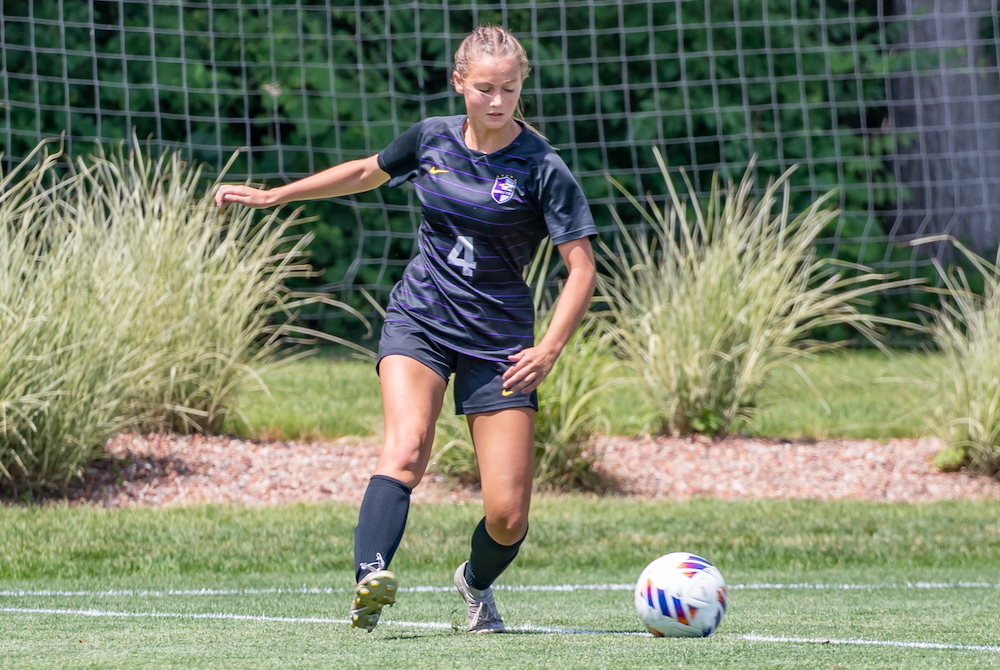
PHOTO Kalamazoo Christian’s Emily Gorton controls possession during last season’s Division 4 championship match.