


Classes Still Create Hoosier Hysteria
July 27, 2017
By Rob Kaminski
MHSAA benchmarks editor
This is the fourth part in a series on MHSAA tournament classification, past and present, that will be published over the next two weeks. This series originally ran in this spring's edition of MHSAA benchmarks.
Twenty years ago, Bloomington North High School won the Indiana High School Athletic Association boys basketball championship, defeating Delta 75-54 at the RCA Dome in Indianapolis.
The date, March 22, 1997, is at the same time revered and disdained by traditionalists in the state who saw it as the last schoolboy championship game the state would ever host.
That’s how devout the game of basketball, particularly interscholastic basketball, had become in the Hoosier state during the 87 years a state champion – one state champion, to be precise – was crowned.
Following that 1997 season, the IHSAA moved to a four-class system for its roundball tournaments, like so many of its state association counterparts had done years earlier.
It would be shocking to find more than a small percentage of current high school basketball players around the country unfamiliar with the iconic movie Hoosiers, even though the film is now more than 30 years old.
And, the storyline for that blockbuster unfolded more than 30 years prior to its release, when small-town, undermanned Milan High School defeated Muncie Central High School 32-30 in the 1954 IHSAA title game.
Perhaps it’s because of the David vs Goliath notion, or the fame of the movie that replaced Milan with the fictional Hickory and real-life star Bobby Plump with Hollywood hero Jimmy Chitwood, or the simple fact that Indiana had something other states didn’t.
Whatever the reason, plenty of opposition remains to this day to basketball classification in the state.
The fact is, the small rural schools were regularly being beaten handily by the much larger suburban and city schools as the tournament progressed each season.
Small schools also were closing at a rapid rate following the state’s School Reorganization Act in 1959, as students converged on larger, centralized county schools. From 1960 to 2000, the number of schools entering the tournament dropped from 694 to 381, and in 1997 a total of 382 schools and 4,584 athletes began competition at the Sectional level (the first level of the IHSAA Basketball Tournament).
It was at the entry level of the tournament where school administrators felt the pain of the new class system, but not necessarily for the same nostalgic reasons as the fans who either attended or boycotted the tournament.
At the Sectional round of the tournament, the IHSAA was culling just 2 percent of the revenue, with the participating schools splitting the balance. So, when Sectional attendance dropped by 14 percent in that first year of class basketball, many schools realized a financial loss. It was money they had grown to count on in prior years to help fund various aspects of the department.
Schools cumulatively received more than $900,000 from Sectional competition in 1998, but that total was down from more than $1 million in the last year of the single-class tournament.
Yet, the current format provides a great deal more opportunity and realistic chances at championship runs for schools of all enrollments.
To date, 60 additional teams have championship or runner-up trophies on display in school trophy cases around Indiana.
That was the mission in front of then-IHSAA commissioner Bob Gardner (now National Federation executive director) once the board made its decision: to give thousands more student-athletes the opportunity for once-in-a-lifetime experiences.
As any statistician knows, figures can be manipulated to tell any side of a story. Declining attendance in year one of class basketball is such a number.
The truth is tournament attendance had been on a steady downward spiral since its peak of just over 1.5 million in 1962. By the last single-class event in 1997, the total attendance was half that.
The challenge then and today, as it is for all state associations, is to find that delicate balance for those holding onto tradition, those holding onto trophies, and the number of trophies to hand out.
Editor’s Note: Stories from the Fort Wayne Journal Gazette in 1998 and from a 2007 issue of Indianapolis Monthly provided facts in this article.
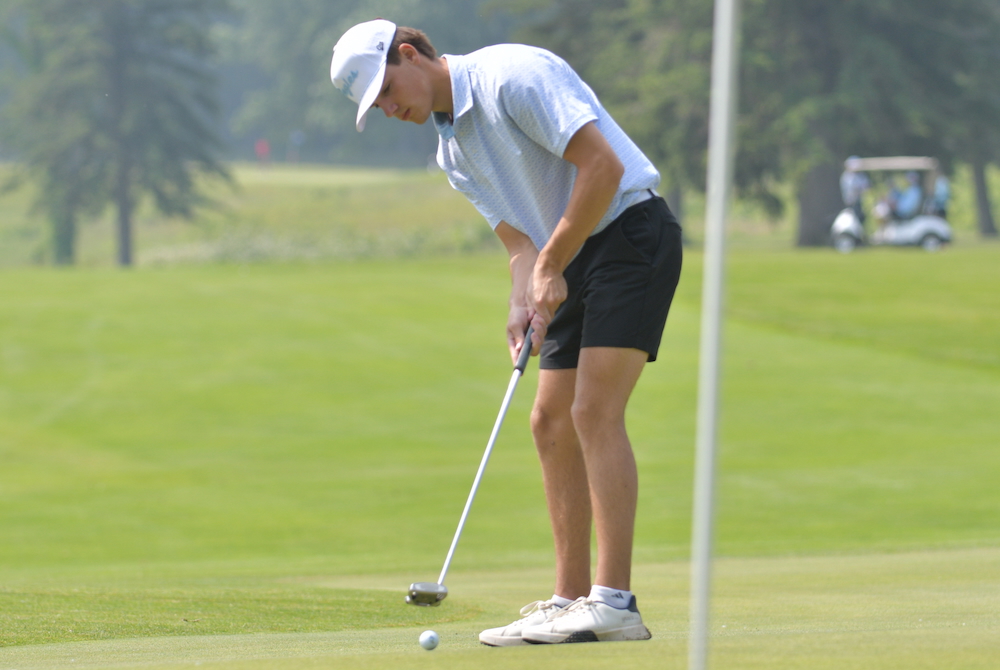
Top-Ranked Grand Rapids Christian Returns to Top of D2 Championship Standings
By
Scott Hassinger
Special for MHSAA.com
June 7, 2025
BATTLE CREEK - Kevin Broene credits Grand Rapids Christian’s latest Lower Peninsula Division 2 boys golf title won Saturday to the difficult schedule the Eagles face in the Ottawa-Kent Conference White.
The Eagles, runners-up last season to Orchard Lake St. Mary's by just one stroke, re-claimed the championship by winning this weekend’s two-day 36-hole tournament at Beford Valley Golf Course with a team score of 584.
The Eagles outpaced runner-up Bloomfield Hills Cranbrook Kingswood by nine strokes. Ada Forest Hills Eastern (603) earned third place, followed by Grand Rapids South Christian (610) in fourth and Orchard Lake St. Mary's (611) in fifth.
"Last year was difficult for the guys we graduated and those that we returned this season. Orchard Lake St. Mary's played fantastic, and it was tough not winning that,” said Broene, who also coached Christian to the 2023 championship. “We all dealt with it differently, but our returners were highly motivated to make it happen this time.
"The opportunity we had to come here and play again in the state finals is something we'll never take for granted. Then to come out on top this time is certainly a blessing. There were so many teams from our league represented this weekend in the state finals. It's one of the best conferences in Michigan. It's fantastic to be able to go against those coaches and players all season. You have to credit Cranbrook Kingswood with how well they played today too. We could feel the pressure. Iron sharpens iron, and that helps us a great deal emotionally, mentally and physically."
Grand Rapids Christian, which came in ranked No. 1, was led by its dynamic junior duo of Cooper Reitsma and Sawyer O'Grady.
The Eagles finished with a 289 for the first round and carded a 295 on Saturday. Cranbrook posted a 304 before improving to 289 for the final round.
Reitsma carded a total two-day score of 140, missing out on the medalist honor by only one stroke to Chelsea senior Brian Tillman (139).
Reitsma shot a 69 on Friday and added a 71 on Saturday, while O'Grady finished in a third-place tie with Andrew Chang from Cranbrook Kingswood at 141. O'Grady finished with a 69 in Friday's round and added a 72 on Saturday. Chang, a junior as well, put together rounds of 71 and 70.
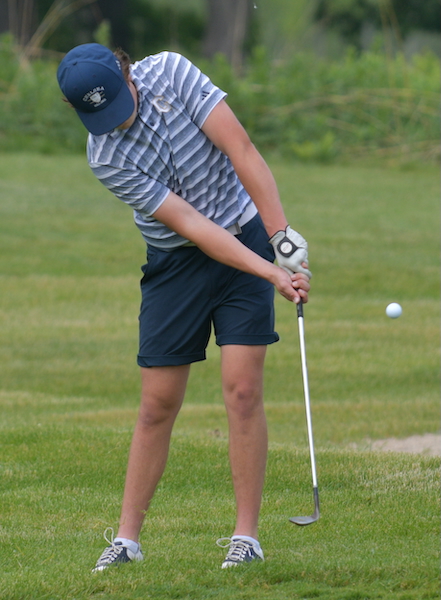 Also figuring heavily in Grand Rapids Christian's winning score were senior John Cassiday with a 76 and 74 for 150, junior Ty Erickson with 75 and 78 for 153, and senior Brody Baysore bagged identical scores of 79 for 158.
"Those three guys who were at the top of our scoring today have played in some really big matches for us. They have been right up there for us these last three years,” Broene said. “They are battled-tested, and the challenge they faced this weekend was incredible. The way they handled the ups and downs really says something about their character. All of the guys we lost from last year showed up this weekend to support us, along with several others from the community and school."
Tillman recorded the lowest score during the final round with a 68, with a birdie on the final hole allowing him to take first place.
"I knew I had some ground to make up after coming in two strokes down to Cooper on Friday. He's a great player, but I was able to get the job done with a great round today," Tillman said.
Tillman pointed to his short game, especially his putter, as a key factor.
"There weren't many putts that didn't fall for me. The ball was rolling just about everywhere I wanted it to. I set myself up pretty good with my driver, and I was able to reach several greens with my second shot," Tillman added.
Although not feeling 100 percent, Reitsma stated he was pleased with how the weekend and his final round of 18 unfolded.
"Today was a very intense round, and I was dealing with a lot of mental battles. Recently it was determined that I have mononucleosis and that has left me feeling really fatigued,” Reitsma said. “If you had told me I was going to shoot the scores I did this weekend, I wouldn't have believed you. I'm really happy with how things went for myself and our team.”
Cranbrook put forth an impressive showing in both rounds despite missing two seniors – Ryan Li and David Schmidt – in its lineup Friday due to their participation in graduation ceremonies.
The Cranes' Friday lineup included Chang, junior Henry Delzer (73-70-143), junior Brennan Tato (79-78-157), sophomore Jack Cannarsa (81) and junior Nathan Yan (90). Li replaced Cannarsa in Saturday's round and finished with a 76, while Schmidt fired a 73 playing the second round in Yan’s slot.
"We played pretty well on Friday with the best lineup we could put out there. The two guys that filled in for us played well, but they are just young and inexperienced,” Cranbrook Kingswood coach John Minnich said. “My two seniors have played in state finals every year since they were freshmen, either as individuals or with the team. Graduation is pretty special, but we told our two seniors if they could drive over here on Saturday we'd get them in the lineup.
"Grand Rapids Christian had a 15-stroke lead on us after Friday's round. We stressed to our kids that their lead was not insurmountable. I think (Grand Rapids Christian) might've realized with about four holes left that we were getting closer. I told our kids that the only thing we could control was our own game. We gave five shots back to them down the stretch, and that was the difference. We have a deep team with 16 kids, and we only lose two kids. We learned things this weekend that will help us next season."
Delzer's score earned him a top finish individually. He and Plainwell’s Drew Rayman tied for fifth at 143, followed by JP Levan from East Grand Rapids (145), Jack Klimek (148) from Ada Forest Hills Eastern and Harris Hoekwater (148) from Grand Rapids South Christian tied for eighth, and Allendale teammates Sumner Meekhof and Seeton Hoogerhyde tied for 10th place scores of 149.
(Click for more photos from High School Sports Scene.)