


Classes Still Create Hoosier Hysteria
July 27, 2017
By Rob Kaminski
MHSAA benchmarks editor
This is the fourth part in a series on MHSAA tournament classification, past and present, that will be published over the next two weeks. This series originally ran in this spring's edition of MHSAA benchmarks.
Twenty years ago, Bloomington North High School won the Indiana High School Athletic Association boys basketball championship, defeating Delta 75-54 at the RCA Dome in Indianapolis.
The date, March 22, 1997, is at the same time revered and disdained by traditionalists in the state who saw it as the last schoolboy championship game the state would ever host.
That’s how devout the game of basketball, particularly interscholastic basketball, had become in the Hoosier state during the 87 years a state champion – one state champion, to be precise – was crowned.
Following that 1997 season, the IHSAA moved to a four-class system for its roundball tournaments, like so many of its state association counterparts had done years earlier.
It would be shocking to find more than a small percentage of current high school basketball players around the country unfamiliar with the iconic movie Hoosiers, even though the film is now more than 30 years old.
And, the storyline for that blockbuster unfolded more than 30 years prior to its release, when small-town, undermanned Milan High School defeated Muncie Central High School 32-30 in the 1954 IHSAA title game.
Perhaps it’s because of the David vs Goliath notion, or the fame of the movie that replaced Milan with the fictional Hickory and real-life star Bobby Plump with Hollywood hero Jimmy Chitwood, or the simple fact that Indiana had something other states didn’t.
Whatever the reason, plenty of opposition remains to this day to basketball classification in the state.
The fact is, the small rural schools were regularly being beaten handily by the much larger suburban and city schools as the tournament progressed each season.
Small schools also were closing at a rapid rate following the state’s School Reorganization Act in 1959, as students converged on larger, centralized county schools. From 1960 to 2000, the number of schools entering the tournament dropped from 694 to 381, and in 1997 a total of 382 schools and 4,584 athletes began competition at the Sectional level (the first level of the IHSAA Basketball Tournament).
It was at the entry level of the tournament where school administrators felt the pain of the new class system, but not necessarily for the same nostalgic reasons as the fans who either attended or boycotted the tournament.
At the Sectional round of the tournament, the IHSAA was culling just 2 percent of the revenue, with the participating schools splitting the balance. So, when Sectional attendance dropped by 14 percent in that first year of class basketball, many schools realized a financial loss. It was money they had grown to count on in prior years to help fund various aspects of the department.
Schools cumulatively received more than $900,000 from Sectional competition in 1998, but that total was down from more than $1 million in the last year of the single-class tournament.
Yet, the current format provides a great deal more opportunity and realistic chances at championship runs for schools of all enrollments.
To date, 60 additional teams have championship or runner-up trophies on display in school trophy cases around Indiana.
That was the mission in front of then-IHSAA commissioner Bob Gardner (now National Federation executive director) once the board made its decision: to give thousands more student-athletes the opportunity for once-in-a-lifetime experiences.
As any statistician knows, figures can be manipulated to tell any side of a story. Declining attendance in year one of class basketball is such a number.
The truth is tournament attendance had been on a steady downward spiral since its peak of just over 1.5 million in 1962. By the last single-class event in 1997, the total attendance was half that.
The challenge then and today, as it is for all state associations, is to find that delicate balance for those holding onto tradition, those holding onto trophies, and the number of trophies to hand out.
Editor’s Note: Stories from the Fort Wayne Journal Gazette in 1998 and from a 2007 issue of Indianapolis Monthly provided facts in this article.
1st & Goal: 2026 Week 3 Preview
By
Geoff Kimmerly
MHSAA.com senior editor
September 10, 2026
Settle in, because things are about to get interesting.
 That’s usually where we’re at when we hit Week 3 of the high school football season, with the early-season jitters fading and the first ideas emerging of which teams have looked good enough to be standing at the end.
Multiple matchups that decided league championships last season will be played out again this week and are highlighted below. So are a few more titanic nonleague tussles before the rest of the state jumps into conference play as we move into mid-September.
Games below are Friday unless noted. There are 19 games being played Thursday this week and 11 on Saturday. Tune in to the NFHS Network to watch the majority and follow the MHSAA Scores page for results as they’re submitted.
Bay & Thumb
New Lothrop (2-0) at Montrose (1-1)
Montrose’s 28-14 win over New Lothrop last season helped put the finishing touches on the Rams’ perfect run through the Mid-Michigan Activities Conference, although the Hornets do still own a 5-3 edge in the series since the league was formed in 2018. New Lothrop finished fourth in the MMAC last season but already has avenged a 2025 defeat to Durand, while Montrose opened this fall with a loss but to much larger Marshall.
Keep an eye on these FRIDAY Traverse City Central (2-0) at Davison (1-1), Mount Pleasant (2-0) at Midland Dow (1-1), Elkton-Pigeon-Bay Port Laker (1-1) at Millington (2-0), North Branch (2-0) at Armada (1-1).
Greater Detroit
Bloomfield Hills Brother Rice (2-0) at Warren De La Salle Collegiate (2-0)
While it’s fair to consider two-time reigning champion Detroit Catholic Central the favorite in the Catholic High School League Central, these two are almost always in the conversation as well. They’ve split their last 20 meetings, and neither has won this matchup more than two times in a row since Rice saw a run of victories end in 2006. The Warriors claimed last year’s game 22-17.
Keep an eye on these THURSDAY South Lyon East (2-0) at North Farmington (2-0). FRIDAY Detroit Country Day (1-1) at Dearborn Divine Child (2-0), Detroit Edison (1-1) at Romulus Summit Academy North (2-0), Detroit Cody (2-0) at Detroit Central (2-0).
Mid-Michigan
Dearborn (2-0) at Howell (2-0)
Howell has won 13 of its last 14 Kensington Lakes Activities Association divisional games, but the division alignments were changed for this fall and these two now find themselves together in the KLAA Gold and two of three (with Brighton) that have started the season 2-0. Dearborn has doubled up White Lake Lakeland and Dearborn Heights Crestwood, while Howell has double-digit wins over Traverse City West and Belleville.
Keep an eye on these FRIDAY Ogemaw Heights (2-0) at Clare (1-1), Grand Ledge (2-0) at Okemos (2-0), Perry (2-0) at Pewamo-Westphalia (2-0), Olivet (1-1) at Portland (2-0).
Northern Lower Peninsula
Charlevoix (2-0) at Kingsley (2-0)
These two met last season in a Week 9 nonleague matchup with Charlevoix undefeated and Kingsley emerging with a 44-18 victory on the way to reaching Ford Field and finishing Division 6 runner-up. Both are off to solid starts again, but now playing together in the Northern Shores Conference – making this a potential eventual league title decider.
Keep an eye on these FRIDAY Maple City Glen Lake (2-0) at East Jordan (1-1), Cadillac (1-1) at Gaylord (1-1), Coopersville (2-0) at Petoskey (2-0), Manton (1-1) at McBain (1-1).
Southeast & Border
Traverse City St. Francis (1-1) at Jackson Lumen Christi (2-0)
Even with St. Francis’ loss last week to Ogemaw Heights, this one is going to get statewide eyes especially with the possibility these two could meet again during the Division 6 playoffs. Lumen has won four straight over the Gladiators beginning with its Division 7 championship game victory in 2022 at Ford Field, and claimed last year’s matchup 27-12.
Keep an eye on these FRIDAY Chelsea (2-0) at Adrian (2-0), Napoleon (2-0) at Jonesville (2-0), Battle Creek Harper Creek (2-0) at Parma Western (1-1), Beal City (2-0) at Springport (2-0).
Southwest Corridor
Kalamazoo United (2-0) at Lawton (2-0)
United won the Southwestern Athletic Conference Lakeshore last season and Lawton was second in the SAC Valley, and with the league together as one division this fall these two certainly are among the favorites. They did play nonleague a year ago, with Lawton claiming a 22-19 victory, but this one will mean a lot more with both also looking toward matchups with reigning Valley champ Schoolcraft coming up.
Keep an eye on these FRIDAY Hastings (1-1) at Marshall (2-0), Portage Central (1-1) at Portage Northern (1-1), St. Joseph (1-1) at Stevensville Lakeshore (2-0), Plainwell (2-0) at Vicksburg (2-0).
Upper Peninsula
Bark River-Harris (2-0) at Iron Mountain (1-1)
Bark River-Harris’ wins over Iron Mountain last season – in Week 2 and again in a Division 8 District Final – were the Broncos’ first over the Mountaineers since the two began playing each other annually in 2018. That regular-season matchup decided the Western Peninsula Athletic Conference Iron title, and this one could too although L’Anse also is off to a 2-0 start gets Iron Mountain next.
Keep an eye on these FRIDAY Negaunee (2-0) at Calumet (2-0), Kingsford (2-0) at Gladstone (1-1), Manistique (1-1) at Hancock (1-1), Alpena (1-1) at Escanaba (0-2).
West Michigan
Grand Rapids South Christian (2-0) at Grand Rapids West Catholic (1-1)
Both have made Ford Field trips over the last three seasons, South Christian as Division 4 runner-up in 2023 and West Catholic as Division 5 champion last fall, and they’ve loaded up their schedules again. The Sailors already had to get past East Grand Rapids last week and have Hudsonville Unity Christian and Zeeland West up next after this one, and Grand Rapids Catholic Central in Week 9. West Catholic is coming off a loss to Coopersville and after league play will finish up this regular season with Traverse City St. Francis.
Keep an eye on these FRIDAY Rockford (1-1) at Caledonia (1-1), Grandville (1-1) at East Kentwood (2-0), Grand Haven (2-0) at Hudsonville (1-1), Hudsonville Unity Christian (1-1) at Zeeland East (2-0).
8-Player
Bay City All Saints (2-0) at Kinde North Huron (2-0)
These two finished first and second in the Big Thumb Conference Red last season, thanks to All Saints’ big win in Week 8. North Huron has shown early this fall it can pull off the close calls, defeating Mayville and Peck by six points apiece. All Saints has blasted out of the gate with a pair of shutouts and 93 points total over the first two weeks.
Keep an eye on these FRIDAY Marcellus (2-0) at Bridgman (2-0), Dansville (2-0) at Potterville (2-0), Blanchard Montabella (2-0) at Breckenridge (2-0). SATURDAY Deckerville (2-0) at Byron (2-0).
MHSAA.com's weekly “1st & Goal” previews and reviews are powered by MI Student Aid, a division within the Department of Lifelong Education, Advancement, and Potential (MiLEAP). MI Student Aid encourages students to pursue postsecondary education by providing access to student financial resources and information. MI Student Aid administers the state’s scholarship and grant programs that help make college Accessible, Affordable and Attainable for you. Click to connect with MI Student Aid and find more information on Facebook and Twitter @mistudentaid.
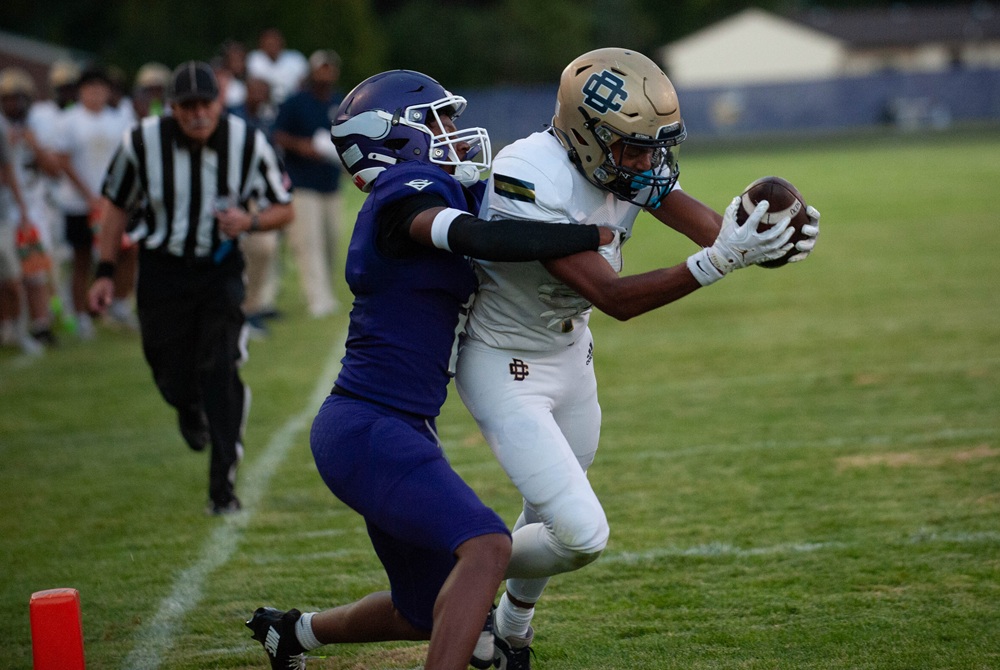
PHOTO Detroit Country Day’s Gavin Shaw (14) stretches for the end zone during his team’s 19-14 loss to Saginaw Swan Valley on Aug. 27. (Click for more from High School Sports Scene.)