

The Changing Face(book?) of Coaching
March 26, 2013
By Rob Kaminski
MHSAA benchmarks editor
From online video exchange programs such as hudl.com to social media platforms like Facebook, Twitter, and LinkedIn, the face of coaching and communicating with teams is ever-changing. How much is too much, and how are the new tools being used by the old guard?
With increasing frequency, today’s coaches are turning to technology to assist in their endeavors, particularly in video review and data compilation, as the number of programs available to them seems to grow on a daily basis.
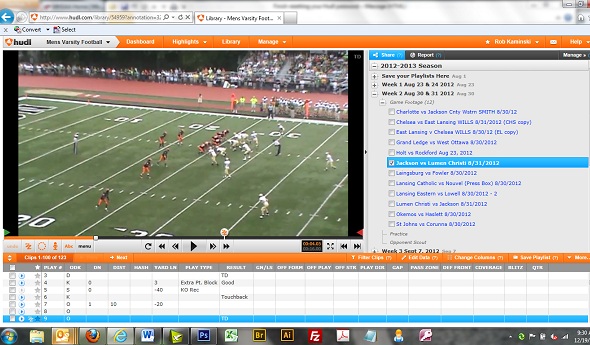
Among the recent leaders, hudl.com seems to have won the favor of football coaches across the state, reducing video exchange and study to a couple clicks of the mouse.
Several members of the MHSAA Student Advisory Council report that their football coaches use the web-based program, and even local officials associations are using it for film study.
Similar programs are making it easier for today’s coaches to analyze data and compile statistics as well.
“The dispensing of information is much quicker than it used to be,” said Marshall bowling coach Sue Hutchings. “We use a scoring software for our stats.”
In more “visual” sports such as competitive cheer, online video is now essential.
“Video playback and feedback to athletes has helped the sport 10-fold,” said Middleville Thornapple-Kellogg coach Abby Kanitz.
In some cases, coaches are taking the lead on such initiatives.
“I run the MISCA (Michigan Interscholastic Swim Coaches Association) website and receive plenty of positive feedback about us posting meet results and top times reports,” said Bloomfield Hills Andover coach David Zulkiewski. “I also visit MHSAA.com weekly. Since I run the MISCA website, I want to make sure I have accurate and up-to-date information posted.”
Technology has also made the world a bit “greener” even in the small corner that is interscholastic athletics. From the required MHSAA rules meetings moving to an online format, to volumes of data now stored on flash drives rather than in file cabinets, coaches are realizing savings in both time and cost.
“The current state of track and field and cross country is so much more manageable than when I began,” said East Kentwood’s Dave Emeott. “I remember compiling actual papers from all over the state to keep track of the opposition, and now thanks to Athletic.net we have this access at the tip of our fingers. These programs have also replaced nights spent inputting data and record-keeping. I am sure I have replaced all that time elsewhere, but it is probably spent with kids and not with data.”
With the saturation and availability of these reports around the clock also comes temptation for those who are driven, and even obsessed, with such numbers. Coaches can rank near the top of that list.
“Technology can be extremely helpful and time-saving for coaches and teachers,” said Grand Haven wrestling coach James Richardson. “But, the disadvantage is the coaches and athletes have a more difficult time getting away from the sport, as we have access to so much information, and others have more access to us. This can lead to too much time being devoted to our sport.”
It also might even take some of the fun out of the actual competition.
“I think the one negative side of technology is the lack of the unknown,” Emeott said. “There was a day when we would enter a meet and not really know how the day would turn out. Now I have most meets scored within 10 points the day before we arrive.”
At times, such advance information also can lead to overconfidence heading into competition.
“Currently the MHSAA Final draw is posted online, and my players often see it and draw their own conclusions before I have a chance to talk to them about it,” said Allegan tennis coach Gary Ellis. “In the past, I was able to present their draw in the light in which I wanted them to see it.”
Another side effect is the indirect push to play beyond high school.
“There is a lot more social promotion and glamourizing of the athletes,” said Mike Van Antwerp, Holt lacrosse coach. “The recruiting pressure has increased tremendously, which is causing kids to commit earlier and go to great lengths to have a chance at being recruited.”
The world has indeed become a smaller, more familiar place. Not only can students and coaches learn pertinent statistics relating to any given opponent, they can also learn personal information about their competition through the deluge of social media vehicles.
It is in this realm where the greatest divide exists between coaches and their athletes when the subject of technology comes up.
Several members of the MHSAA Student Advisory Council indicate that their coaches do not use social media to assist with the daily activities involved with their sport, while others are but only on a limited basis.
It’s not that the coaches don’t know about Facebook, Twitter, LinkedIn, or the other platforms. More likely, they are all too well versed in the abuses of such mediums by young adults not yet ready to understand the lasting ramifications of a random tweet or damaging photo.
“We have specific rules for use of cell phones at practice, games, in the locker room, etc.,” said Diane Laffey, athletic director and coach at Warren Regina. “We also have a form for parents to sign if they want the coach to be able to text their daughter about practice or game cancellations or changes. We stress that the texting only be for necessary things, and the parents are to give permission.”
Safeguarding against the misuse of handheld devices is becoming as commonplace as handing out uniforms prior to the season.
“By rule, our players aren’t allowed to bring electronic devices to the court with them. We restrict cell phone usage at practice,” said Portage Central tennis coach Peter Militzer. “Players must ‘friend’ the coach on either Facebook or Twitter, and I monitor their activities to make sure their language and behavior meets our standards. We restricted a player’s opportunity to play on varsity last season due to excessive use of crude language and an offensive user name on Twitter.”
PHOTO: This is a screenshot from Hudl.com, an online service used by high school football coaches for video analysis and archiving.
Peck Bands Together to Honor Welch's Memory as Pirates Return to Diamond
By
Paul Costanzo
Special for MHSAA.com
April 15, 2026
Bill Kerr didn’t need to spend much time back at the Little League fields in Peck before his childhood friend James Welch caught his ear.
 Not in conversation, but from the dugout, doing one of the things he loved most – coaching kids.
“When I got back to Peck 10 years ago, he was coaching Little League. We started talking about how we could get him in front of more kids and doing more,” said Kerr, the Peck superintendent. “I always joked that I was recruiting him. I’ve been around coaches forever, evaluated coaches forever, and you could just hear it, even at the Little League fields. You could hear his message and how strong it was.”
Kerr brought Welch on board at Peck, first as the baseball coach and eventually as athletic director, and over a few short years he made an out-sized impact on the kids he worked with and the community at large.
Welch died unexpectedly on Nov. 6, 2025, but that impact is still being felt today on the baseball diamond and beyond.
“He was always so authentic and positive with (students),” Kerr said. “In this day and age, a lot of adults are kind of hesitant to kind of address some of the things that don’t apply on the field. He and I talked a lot about making them good people and leaders rather than worry about what type of athlete they were. That was the most important thing to him, with his baseball players, he wanted to make sure they were good people.”
The Peck gymnasium was required to host all the people who showed up for Welch’s memorial service, and school was canceled the day after his passing.
His players were there, however.
“The next day we had school off, but the school was open because staff had to report,” said Jen Kluger, Welch’s friend and assistant coach. “All the boys came in. We all sat in James’ office and talked and cried. We were just together.”
Kluger, who began working in Peck in 2023, was surprised at how much the community came together in the days after Welch’s passing.
“It happened on a Thursday, and that Sunday we had a booster meeting because the funeral was going to be at the school and the boosters were going to handle everything,” Kluger said. “Normally, we have five or six people show up, and on that day, I don’t even know how many people were there. I was blown away. Jessica Royle is the booster president and we were texting a couple days later, I was like, ‘I am blown away by all these people that just showed up.’ She was like, ‘That’s Peck. That’s what they do.’”
While the entire community was mourning Welch, it was also there to support his family – his wife Shane and son Grady, who is a junior at Peck.
 “I would say it definitely helped,” Grady said. “I felt like I wasn’t alone in grieving. Everyone in the whole community knew him, knew everything about him and what he stood for.”
The Welch family was part of the Peck community long before James began working at the school. He was a star athlete for the Pirates during the 1990s, playing football, basketball and baseball. He was part of the 1995 Peck football team that advanced to the Semifinals, and the 1994 baseball team that advanced to the Quarterfinals.
That 1994 team was inducted into the Peck High School Hall of Fame – something Welch worked with Kerr to establish – shortly after his passing.
“He was like one of those five-tool guys,” said Kerr, who graduated from Peck a year before Welch. “His best sport was football, but he was a very good baseball player.”
Now, while weather has not allowed them to get onto the field much for practice let alone play a game, Welch’s players are together again for the start of baseball season. Kluger has taken over the program as coach, which was announced in December.
“The day before we went on Christmas break, I called them all down to the gym, and I couldn’t say anything until the board approved it, so I had to sit on it for three weeks,” Kluger said. “I sat them all down, and I didn’t know how they were going to react. They didn’t seem upset about it. I got some hugs, got some claps, got some high fives.”
Not only were the players not upset, it’s the move they wanted as they had to move into a world without their coach.
“It definitely helped a lot,” Grady Welch said. “She knew how my dad ran practices, everyone knows her and she’s a nice person. It definitely helps to transition into baseball season knowing that things aren’t going to change.”
Of course, for Grady, it’s much more than simply not having a coach. He admits that the beginning of the season has been difficult – as does Kluger – but his teammates have been there to lift him up when he needs it. Many of them have been his teammates, and played for his father, since T-ball.
“I always have my space if I do need to take space,” Grady said. “But we’ve always been a group that’s been together all the time. We have a very good friendship between all of us.”
To honor James Welch, Kerr said supporters are working to create a scholarship in his name, and that his former high school number will be hung on the outfield fence at Peck.
Welch wore No. 9, as his father’s favorite player was Roger Maris. That number has been worn the past two years by Grady, who switched to it in middle school because of his dad.
Stepping onto the field in a game for the first time – which would be Thursday if weather permits – is certain to be an emotional moment for Kluger, Grady, his teammates and everyone in attendance. But it will also be the next step in honoring Welch by being together and playing the sport he loved.
“There’s a few that are going to struggle (emotionally),” Kluger said. “But I think at this point, they all want to be on the field and want to play.”
 Paul Costanzo served as a sportswriter at The Port Huron Times Herald from 2006-15, including three years as lead sportswriter, and prior to that as sports editor at the Hillsdale Daily News from 2005-06. He can be reached at [email protected] with story ideas for Genesee, Lapeer, St. Clair, Sanilac, Huron, Tuscola, Saginaw, Bay, Arenac, Midland and Gladwin counties.
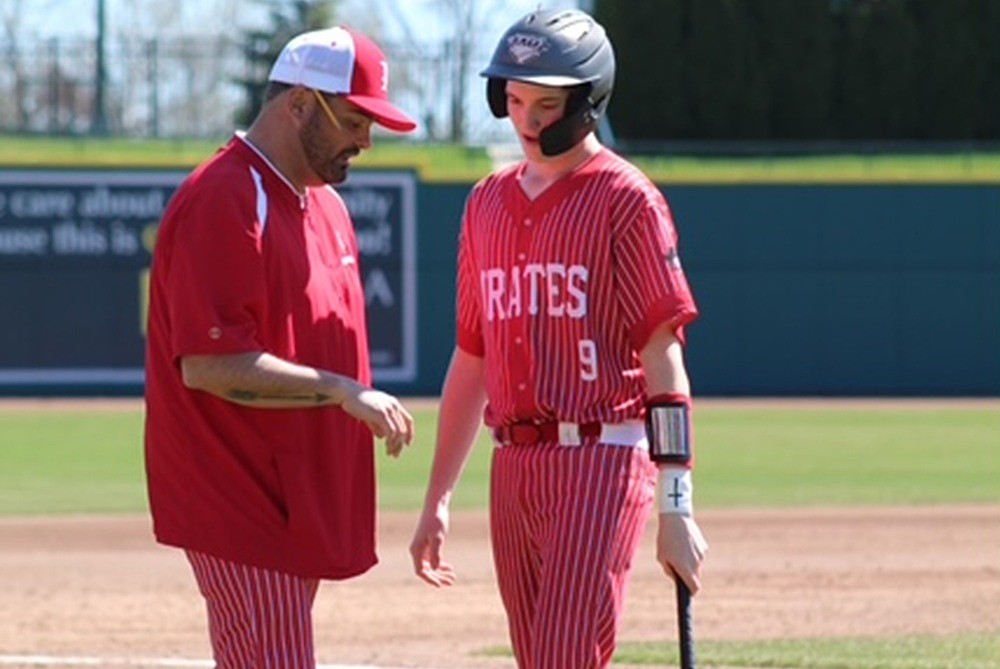
PHOTOS (Top) Peck baseball coach James Welch, left, talks with son Grady during a game from a recent season. (Middle) Welch, far left, stands at the plate for a pregame conference before taking on Capac. (Photos provided by Jen Kluger.)