


Coaches Get U-M Concussion Training
July 24, 2012
Already administering a strong set of protocols addressing the removal and return to play of young athletes suspected of sustaining concussions in competition, the Michigan High School Athletic Association is further ramping up its concussion education efforts of coaches, student-athletes and parents as the 2012-13 school year approaches.
In partnership with the University of Michigan’s NeuroSport and the Pediatric Trauma Program at C.S. Mott Children’s Hospital, required online rules meetings for coaches and officials will include an education component illustrating the serious nature of concussions; recognition of the signs and symptoms; a review of return to play protocols; applicable MHSAA regulations; and downloadable co-branded resources from NeuroSport, as well as materials produced by a joint effort of the Brian Injury Association of Michigan, the Detroit Lions, the Center for Disease Control and the MHSAA.
This is the second year the MHSAA has included concussion education in its online rules meetings, which are annually viewed by nearly 20,000 coaches and game officials. This year, the Michigan NeuroSport Concussion Education - High School Coach edition, endorsed by the American Academy of Neurology last fall, has been modified for the MHSAA audience. The MHSAA will also promote the availability of the NeuroSport concussion education modules offered specifically for parents and coaches.
“These educational efforts, coupled with protocols addressing concussions when they take place on the field of play, put our schools in the best possible position to minimize the risk to young people,” said John E. “Jack” Roberts, executive director of the MHSAA. “We’re pleased to have our new partnership with University of Michigan NeuroSport and our ongoing partnership with the Brian Injury Association of Michigan which put our state at the forefront of addressing the critical health issue for interscholastic athletes.”
Roberts added that the same educational materials the Association has co-branded with its partners will also be used to help raise concussion awareness in other youth sports by other sponsors in the state.
“We are proud to partner with MHSAA and bring the most up-to-date concussion education to those on the frontline of athletics. Education is a vital component to improving player safety,” says Amy Teddy, injury prevention program manager at C.S. Mott Children’s Hospital. “We believe that ‘It takes a team to keep concussions on the sidelines.’ Parents, coaches, teammates, officials and athletic trainers all have a role in protecting athletes from serious injury.
“In addition to our coach modules, we recently launched our parent edition to help another member of the ‘team’ better recognize and understand concussion.” added Teddy, who also is director of education for Michigan Neurosport.
The NeuroSport online programs for parents, high school coaches and youth sports coaches is now available at http://www.MichiganNeuroSport.com. An online program for athletes will be available soon.
NeuroSport has also produced a 60-second public service announcement in which one of the state’s all-time winningest football coaches – John Herrington of Farmington Hills Harrison – talks about concussions. This video, along with a 30-second PSA recently updated by the MHSAA, “No Such Thing As Just Getting Your Bell Rung,” will be made available to media outlets in time for the coming sports season, and will be shown during MHSAA programming online and on cable television.
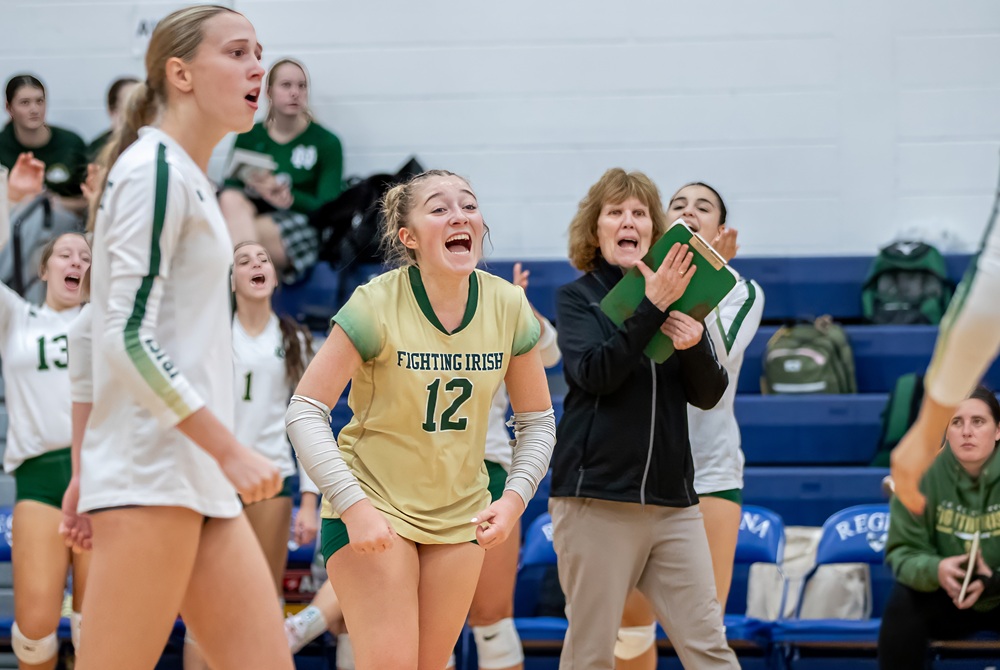
Chase Remains On Pace as Wroubel Ranks 2nd Among Nation's Winningest Active Coaches
By
Keith Dunlap
Special for MHSAA.com
September 18, 2026
PONTIAC — While the Pontiac Notre Dame Prep girls volleyball team pursues wins in Michigan this fall, parents, supporters and others around the program are also paying attention to what a program in Alabama is doing.
 Why? It has everything to do with a prominent coaching record on the national level.
At the moment, it’s a nice neck-and-neck race to see who will finish this season as the active coach with the most wins nationally, Betty Wroubel of Notre Dame Prep or Ann Schilling of Bayside Academy in Daphne, Ala.
Going into the season, Schilling had 1,796 career wins, three more than Wroubel. As of Wednesday, Schilling had added 16 wins to her total to make it 1,812, while Wroubel added 14 for a grand total of 1,807.
The two are also third and fourth, respectively, on the overall all-time wins list nationally. Two coaches who are retired, Jodi Manore of Temperance Bedford (2,231) and Jack Magelssen of Portage Northern (1,832), top the list.
Schilling and Wroubel are fast approaching Magelssen, but if there is one person who isn’t too occupied with it all, it’s Wroubel.
Sure, she has a good laugh or smile when parents or other school officials have casually come up to her over the past few weeks to mention the situation. But as has been the case throughout her legendary career, there is a greater purpose for her.
“It’s the kids’ winning,” Wroubel said. “I get to facilitate a little bit. But it’s really about the kids, and I’ve been blessed with some really good kids here over the years and some coaches who have coached with me.”
Notre Dame Prep senior Nicole McDowell said trying to win so Wroubel can keep up with Schilling hasn’t really been talked about much among players this season. But that doesn’t mean the chase can’t provide a little more incentive the rest of the fall.
“That will help motivate us more,” McDowell said.
The head coach of Notre Dame Prep since 1994, Wroubel remains an institution for not only her school, but the volleyball coaching community statewide.
Wroubel has guided Notre Dame Prep to four Finals titles in Class B/Division 2, with the latest in 2021. When Notre Dame Prep won the Class B championship in 2007 (fall season), the Fighting Irish not only captured the school’s first volleyball title but became the first program in Oakland County history to win at the Finals.
“I just love being around the kids, and they provide the energy and keep you going,” said Wroubel, who is also the athletic director and varsity softball coach at Notre Dame Prep.
Even as eras and the sport have changed drastically, players have enjoyed playing for Wroubel as much as she’s enjoyed coaching them.
“She really is competitive and she’s hard on us, but she wants to win and all of her intentions are good,” said McDowell, who has committed to play collegiately for Rider University (N.J.) and is a returning all-state player. “Outside of volleyball, she is the most generous person I know.”
Time will tell if Notre Dame Prep (14-12-2) can continue to pile up wins this season for itself and Wroubel.
While the coaching wins angle could be a fun storyline for the program and its supporters to follow, it certainly won’t sway Wroubel from her ultimate objective to make her players better volleyball players and women.
“I just love my job,” she said. “I think this is where God has placed me. There’s a place where we’re all supposed to be, and this is part of my mission. This is where I’m supposed to be. God has blessed me with great support and great athletes, and I just love it here.”
 Keith Dunlap has served in Detroit-area sports media for more than two decades, including as a sportswriter at the Oakland Press from 2001-16 primarily covering high school sports but also college and professional teams. His bylines also have appeared in USA Today, the Washington Post, the Detroit Free Press, the Houston Chronicle and the Boston Globe. He served as the administrator for the Oakland Activities Association’s website from 2017-2020. Contact him at [email protected] with story ideas for Oakland, Macomb and Wayne counties.
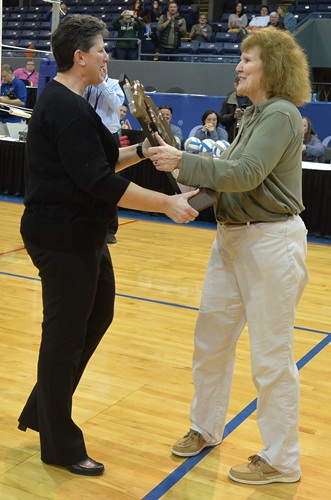
PHOTOS (Top) Pontiac Notre Dame Prep girls volleyball coach Betty Wroubel encourages her team during a match last season against Warren Regina. (Middle) Wroubel, right, accepts the 2021 Division 2 championship trophy from Vicky Groat. (Top photo by KMS Photography.)