

Concussion Testing Pilots Kick Off Fall
August 4, 2015
By Geoff Kimmerly
Second Half editor
The Michigan High School Athletic Association kicked off the 2015-16 school year Monday by hosting 70 member high schools for training in two pilot sideline concussion testing programs aimed at assisting in decision-making regarding the removal of athletes from activity after possible concussion events and record-keeping of those events beginning this fall.
Illinois-based King-Devick Test and Maryland-based XLNTbrain Sport each will be used to monitor approximately 10,000 Michigan high school student-athletes drawn from schools representing all four classes and a variety of regions statewide.
The pilot programs are part of a three-pronged advance by the MHSAA in concussion care this fall. In addition to becoming the first state association to offer pilot sideline concussion testing, the MHSAA will be the first to mandate record-keeping by member schools of all possible concussion events from detection to an athlete’s return to play. The requirement applies to both practices and events, all levels of all sports in grades 7 through 12.
The MHSAA also this fall is the first state association to provide all participants at every MHSAA member high school and junior high/middle school with insurance intended to pay accident medical expense benefits – covering deductibles and co-pays left unpaid by other policies – resulting from concussions sustained during MHSAA practices or competitions. There is no cost to either schools or families.
“These pilot programs are intended to not only improve what’s actually happening on the sidelines at practices and contests in these communities that are part of the pilot programs, they’re intended to spread the word of the need for improved concussion detection across every community,” MHSAA Executive Director John E. “Jack” Roberts said. “We hope these schools involved will become involved in their leagues and conferences and with their peers across the state as we expand the awareness of the need for better sideline detection and provide ways to get it done.”
The MHSAA asked schools at the end of this spring to volunteer for the pilot programs and then selected participants in order to guarantee a variety of schools based on enrollment and location. Schools are committed to involving at least two sports for each gender each season.
Schools participating in the XLNTbrain Sport pilot program are: Adrian, Adrian Madison, AuGres-Sims, Bay City Central, Bear Lake, Brethren, Belding, Birmingham Groves, Brighton, Chesaning, Corunna, Detroit Collegiate Prep, East Kentwood, Fennville, Fowlerville, Gibraltar Carlson, Grand Rapids Christian, Grandville, Greenville, Grosse Ile, Hamilton, Harrison Township L’Anse Creuse, Hazel Park, Kalamazoo Christian, Lansing Christian, Macomb L’Anse Creuse North, Owosso, Pewamo-Westphalia, Portland, Reese, Rochester Hills Lutheran Northwest, St. Clair Shores Lakeview, St. Johns, Stanton Central Montcalm, Vermontville Maple Valley, West Bloomfield and Wyoming Kelloggsville.
Schools participating in the King-Devick Test pilot are: Bay City Western, Benton Harbor, Buchanan, Calumet, Caro, Caseville, Detroit Cody, Detroit Martin Luther King, Fenton, Flint Kearsley, Frankenmuth, Fruitport, Garden City, Grand Ledge, Grand Rapids Northview, Lake Leelanau St. Mary, Lake Linden-Hubbell, Lincoln Alcona, Midland Bullock Creek, Montague, Muskegon, Niles, Pontiac Notre Dame Prep, Romeo, Saginaw Heritage, Scottville Mason County Central, Shelby, St. Charles, St. Joseph, Tawas, Vicksburg, Whitehall and Yale.
The King-Devick Test is a rapid eye movement screening evaluation that requires athletes to read single-digit numbers displayed on a tablet computer in order to detect impairments of eye movement, attention, language, concentration and other symptoms of abnormal brain function. The test has been validated in more than 50 recent peer reviewed articles published in elite medical journals and is associated with the Mayo Clinic.
The test is administered on the sidelines during evaluations for suspected head injuries, and the post-injury results are then compared to an athlete’s preseason baseline. Any worsening of performance (increased time and/or errors) suggests a concussion has occurred and the athlete should be “removed from play” for further evaluation.
“The first and most critical step in managing concussion in the youth athlete is to recognize when one has occurred – not always a simple task,” said Dr. David Dodick, professor of neurology and director of sports concussion services at the Mayo Clinic. “The King-Devick test helps take the guesswork and subjectivity out of the sideline evaluation in a rapid, accurate, and objective way.”
 XLNTbrain Sport includes balance and web-based neuro-cognitive tests also used before the start of a season to create a baseline measurement of reaction time, attention, inhibition, impulsivity, memory, information processing efficiency and executive function. The test also assesses mood, anxiety, stress and emotionality.
After a possible head injury, a sideline assessment is done using a smartphone or tablet with those results then compared with the athlete’s baseline measurements. The program documents the severity of a concussion, provides a guide for on-the-field decision making regarding treatment and recovery time and can report results via email to parents, coaches, training staff and medical professionals.
Dr. Harry Kerasidis, who designed the XLNTbrain Sport software, presented at the Coalition for Concussion Treatment Summit at the United Nations building in 2014.
“We included an objective balance test that relies on smartphone accelerometer technology which is effective in the field during practice and game situations,” Kerasidis said. “Should a concussion injury be suspected, the system automatically generates a notification to parents and medical professionals and creates a recovery protocol and post-injury tracking so the right people can monitor the athlete’s progress. Then, the system assists medical professionals with the all-important return-to-learn and return-to-play clearance.”
Click for information on XLNTbrain Sport. Click for information on the King-Devick Test.
For more on Health & Safety, including preseason physical examination, hydration and cardiovascular resources in addition to concussion information and online training sessions, visit the MHSAA’s redesigned Health & Safety web page.
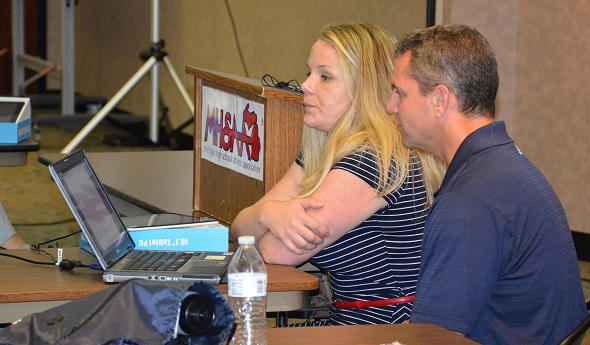
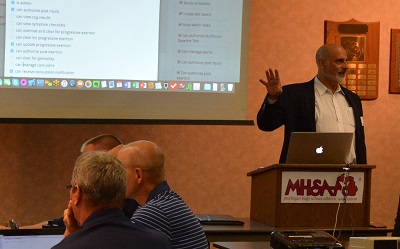
PHOTOS: (Top) Saginaw Heritage athletic director Peter Ryan (right) is administered the King-Devick baseline test by K-D's Samantha Figueroa. (Middle) XLNTbrain Sport creater Dr. Harry Kerasidis provides insight on his program to those being trained to use it Monday.
Fresh from Cancer Fight, Disbrow Returns to Coaching Ready to Continue 'Winning the Day'
By
Doug Donnelly
Special for MHSAA.com
September 16, 2026
Nikki Disbrow grabbed her keys and started to get into the family vehicle to pick up her son from a summer 7-on-7 practice. Her husband, Sand Creek football coach Sid Disbrow, told her he wanted to come, too.
 “What are you doing?” she asked. “You can barely walk.”
Sid, who had just returned home from surgery to have a tumor removed while battling colorectal cancer for the second time in three years, wasn’t having it. He got in the vehicle.
When Nikki arrived at the field, Sid opened the door.
“Where are you going?” she asked.
Sid, unrelenting, got out of the car and began making his way to the field.
“She was kind of my walker,” he said. “I couldn’t walk on my own, but I needed to address the kids. I needed to be out there. I needed to show them that it’s about winning the day, because you never know what might happen.”
Disbrow, 49, has been coach for just about 30 years. It’s part of who he is in the Sand Creek school district and community. He’s been an assistant football coach, youth baseball and softball coach, varsity boys and middle school basketball coach. He’s detailed, organized, loves the competition and thrives on being around kids.
Last year around the eighth or ninth week of the football season, he began noticing the symptoms of the cancer he had chemotherapy and radiation to treat a couple years prior. He finished the season, knowing middle school basketball was getting ready to start.
Within a week of finding out the cancer had indeed returned, he was able to get everything scheduled and begin chemotherapy. He was getting treated at Flower Hospital in Sylvania, Ohio, about 45 minutes from Sand Creek.
 “They would give me the last appointment of the day so I could get there after school,” he said. “They were great to work with.”
It wasn’t easy trying to maintain a rigorous coaching schedule while fighting cancer.
“There are no rules in cancer. You don’t get to do as you wish. Chemotherapy is real,” Disbrow said.
He wasn’t deterred. He coached the entire middle school basketball season – which ended around Christmas. Some days, he was exhausted. Still, quitting wasn’t an option.
“I wanted to be out there for my son and all of the other kids that I’ve been coaching all the way through,” he said. “That was important to me. That was my driving force.”
Not long after basketball season ended, he began eight weeks of radiation. It ended just in time for him to coach his son’s baseball team.
After that season ended, something still wasn’t right. Doctors found a tumor, although they weren’t sure if it was shrinking or growing. They gave him an option – surgery to remove it or wait a few months, get tested again. At that point, if it returned, it meant starting chemotherapy and radiation all over again. He checked the calendar.
“I thought about football season,” he said. “My son is on JV this year. That’s not something I want to miss.”
He went in for surgery and had the tumor successfully removed. Doctors found out later it was indeed cancerous and growing.
“I made the right decision,” he said.
He was recovering from that round of surgery when he made it onto the football field to talk to the Aggies players. The football field is more than a place for Disbrow to forget all about cancer and focus on the lives of the young men on the field. It’s a place him and Nikki, a former varsity volleyball coach at Sand Creek herself, got married.
“It’s probably the first time there was a wedding on the football field, and probably the last time,” he said.
On Aug. 3 – one week before two-a-days started for Sand Creek – he found out the cancer was in remission. He was back with the team when practice began.
“I brought my lawn chair with me,” he said. “There were some days where I just didn’t have the strength.”
Through it all, he’s endured, never wavering.
“The credit goes to God,” he said. “I don’t see how people go through something like this without their faith. I owe it all to Him. He’s given me this chance to continue to teach and coach. I don’t take that lightly.”
 Sand Creek varsity football coach Derek Hewitt said seeing Disbrow come back to practice after all he went through was inspiring. Disbrow coaches special teams, the quarterbacks and helps Hewitt with the offense. On most Fridays he’s in the coach’s box.
“It’s great to have him back out there,” Hewitt said. “He’s not the scout team quarterback anymore, but he’s there, every day. It’s great for me to have him by my side.”
One thing Disbrow is not planning to do is stop coaching. In fact, he’s going to be even busier. He was recently named the school’s junior varsity boys basketball head coach.
“Coaching really kept me going through all of this,” he said. “The kids have been great through it all.”
The father of four is from Morenci, the neighboring town to the south and heated rival of Sand Creek, which he admits caused some angst when he moved from coaching football at his alma mater to Sand Creek.
He was part of the 1995 Morenci football team that played for a Class C championship in the Pontiac Silverdome, graduating in 1996. He was a sophomore at Adrian College when a Morenci coach asked him to join that coaching staff. A couple years later he began coaching at Sand Creek.
Now, he, his wife and four kids are engrained in the Aggies community.
“I wasn’t one of those people who got into teaching because I wanted to coach,” he said. “I wanted to be a teacher, to be around young people and help them. Coaching was something I loved once I started doing it. It’s who we are now as a family. It’s part of our lives.”
 Doug Donnelly has served as a news and sports reporter at the Adrian Daily Telegram and the Monroe News for 30 years, including 10 years as city editor in Monroe. He's written a book on high school basketball in Monroe County and compiles record books for various schools in southeast Michigan. He is now publisher and editor of The Blissfield Advance, a weekly newspaper. E-mail him at [email protected] with story ideas for Jackson, Washtenaw, Hillsdale, Lenawee and Monroe counties.
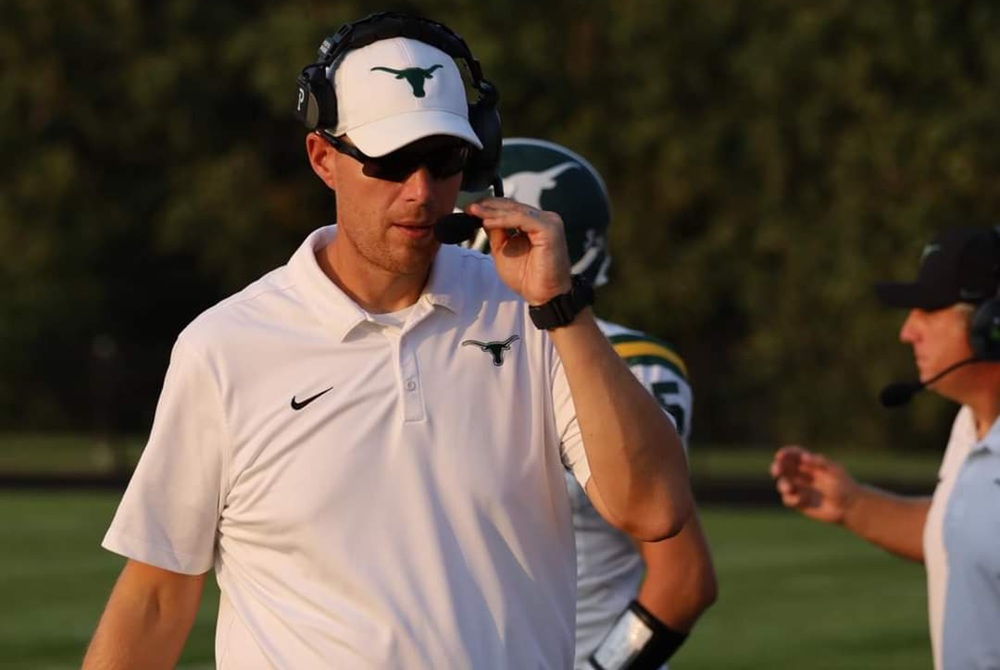
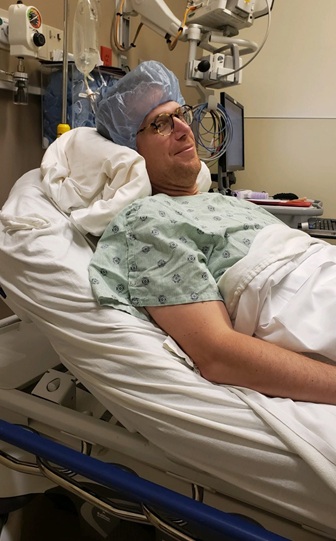
PHOTOS (Top) Sand Creek assistant football coach Sid Disbrow mans the headset while on the sideline during a game. (Middle) Disbrow lays in a hospital bed while receiving care in 2023. (Below) Disbrow stands for a photo with wife Nikki last fall. (Top photo by Becky Serin. Hospital and family photos courtesy of the Disbrow family.)