

Concussion Testing Pilots Kick Off Fall
August 4, 2015
By Geoff Kimmerly
Second Half editor
The Michigan High School Athletic Association kicked off the 2015-16 school year Monday by hosting 70 member high schools for training in two pilot sideline concussion testing programs aimed at assisting in decision-making regarding the removal of athletes from activity after possible concussion events and record-keeping of those events beginning this fall.
Illinois-based King-Devick Test and Maryland-based XLNTbrain Sport each will be used to monitor approximately 10,000 Michigan high school student-athletes drawn from schools representing all four classes and a variety of regions statewide.
The pilot programs are part of a three-pronged advance by the MHSAA in concussion care this fall. In addition to becoming the first state association to offer pilot sideline concussion testing, the MHSAA will be the first to mandate record-keeping by member schools of all possible concussion events from detection to an athlete’s return to play. The requirement applies to both practices and events, all levels of all sports in grades 7 through 12.
The MHSAA also this fall is the first state association to provide all participants at every MHSAA member high school and junior high/middle school with insurance intended to pay accident medical expense benefits – covering deductibles and co-pays left unpaid by other policies – resulting from concussions sustained during MHSAA practices or competitions. There is no cost to either schools or families.
“These pilot programs are intended to not only improve what’s actually happening on the sidelines at practices and contests in these communities that are part of the pilot programs, they’re intended to spread the word of the need for improved concussion detection across every community,” MHSAA Executive Director John E. “Jack” Roberts said. “We hope these schools involved will become involved in their leagues and conferences and with their peers across the state as we expand the awareness of the need for better sideline detection and provide ways to get it done.”
The MHSAA asked schools at the end of this spring to volunteer for the pilot programs and then selected participants in order to guarantee a variety of schools based on enrollment and location. Schools are committed to involving at least two sports for each gender each season.
Schools participating in the XLNTbrain Sport pilot program are: Adrian, Adrian Madison, AuGres-Sims, Bay City Central, Bear Lake, Brethren, Belding, Birmingham Groves, Brighton, Chesaning, Corunna, Detroit Collegiate Prep, East Kentwood, Fennville, Fowlerville, Gibraltar Carlson, Grand Rapids Christian, Grandville, Greenville, Grosse Ile, Hamilton, Harrison Township L’Anse Creuse, Hazel Park, Kalamazoo Christian, Lansing Christian, Macomb L’Anse Creuse North, Owosso, Pewamo-Westphalia, Portland, Reese, Rochester Hills Lutheran Northwest, St. Clair Shores Lakeview, St. Johns, Stanton Central Montcalm, Vermontville Maple Valley, West Bloomfield and Wyoming Kelloggsville.
Schools participating in the King-Devick Test pilot are: Bay City Western, Benton Harbor, Buchanan, Calumet, Caro, Caseville, Detroit Cody, Detroit Martin Luther King, Fenton, Flint Kearsley, Frankenmuth, Fruitport, Garden City, Grand Ledge, Grand Rapids Northview, Lake Leelanau St. Mary, Lake Linden-Hubbell, Lincoln Alcona, Midland Bullock Creek, Montague, Muskegon, Niles, Pontiac Notre Dame Prep, Romeo, Saginaw Heritage, Scottville Mason County Central, Shelby, St. Charles, St. Joseph, Tawas, Vicksburg, Whitehall and Yale.
The King-Devick Test is a rapid eye movement screening evaluation that requires athletes to read single-digit numbers displayed on a tablet computer in order to detect impairments of eye movement, attention, language, concentration and other symptoms of abnormal brain function. The test has been validated in more than 50 recent peer reviewed articles published in elite medical journals and is associated with the Mayo Clinic.
The test is administered on the sidelines during evaluations for suspected head injuries, and the post-injury results are then compared to an athlete’s preseason baseline. Any worsening of performance (increased time and/or errors) suggests a concussion has occurred and the athlete should be “removed from play” for further evaluation.
“The first and most critical step in managing concussion in the youth athlete is to recognize when one has occurred – not always a simple task,” said Dr. David Dodick, professor of neurology and director of sports concussion services at the Mayo Clinic. “The King-Devick test helps take the guesswork and subjectivity out of the sideline evaluation in a rapid, accurate, and objective way.”
 XLNTbrain Sport includes balance and web-based neuro-cognitive tests also used before the start of a season to create a baseline measurement of reaction time, attention, inhibition, impulsivity, memory, information processing efficiency and executive function. The test also assesses mood, anxiety, stress and emotionality.
After a possible head injury, a sideline assessment is done using a smartphone or tablet with those results then compared with the athlete’s baseline measurements. The program documents the severity of a concussion, provides a guide for on-the-field decision making regarding treatment and recovery time and can report results via email to parents, coaches, training staff and medical professionals.
Dr. Harry Kerasidis, who designed the XLNTbrain Sport software, presented at the Coalition for Concussion Treatment Summit at the United Nations building in 2014.
“We included an objective balance test that relies on smartphone accelerometer technology which is effective in the field during practice and game situations,” Kerasidis said. “Should a concussion injury be suspected, the system automatically generates a notification to parents and medical professionals and creates a recovery protocol and post-injury tracking so the right people can monitor the athlete’s progress. Then, the system assists medical professionals with the all-important return-to-learn and return-to-play clearance.”
Click for information on XLNTbrain Sport. Click for information on the King-Devick Test.
For more on Health & Safety, including preseason physical examination, hydration and cardiovascular resources in addition to concussion information and online training sessions, visit the MHSAA’s redesigned Health & Safety web page.
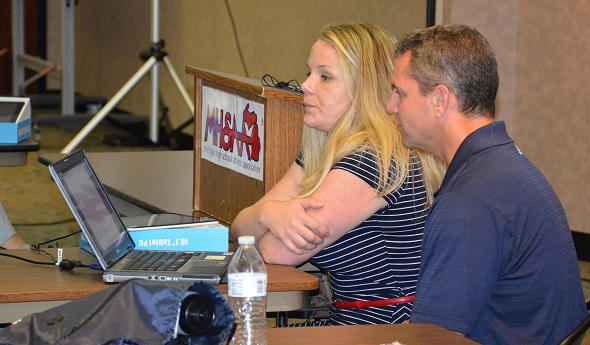
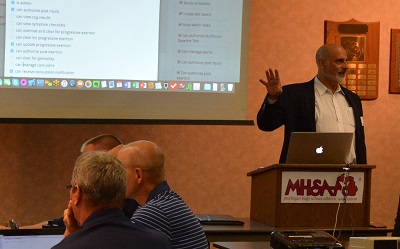
PHOTOS: (Top) Saginaw Heritage athletic director Peter Ryan (right) is administered the King-Devick baseline test by K-D's Samantha Figueroa. (Middle) XLNTbrain Sport creater Dr. Harry Kerasidis provides insight on his program to those being trained to use it Monday.
Mackey Leaving Court with 500+ College Hoops Wins, Many More Lessons Shared
By
Jason Juno
Special for MHSAA.com
July 24, 2026
IRONWOOD — Dennis Mackey made a big impact on generations of athletes at Gogebic Community College, so much so that college officials named the basketball court after him while he was still coaching.
 Mackey retired from coaching in April after 38 years at GCC, 19 with the women and 19 with the men. Even after all of those years, and more than 500 wins, the memories and lessons from his playing days at Ewen-Trout Creek still resonate with him.
He was always doing something athletically, football in the fall, baseball in the summer, track & field in the spring. His home being basketball-centered E-TC – the tiny Upper Peninsula school with nine combined boys and girls MHSAA Finals appearances – hoops was always mixed in.
“Basketball was the winter sport, but no matter the season we always found time to get to the gym and shoot hoops,” Mackey said. “Whether it was during the lunch hour, after school, on weekends, or after practices, we seemed to gravitate to the gym for some action.”
And if they didn’t go to the gym, there were outdoor courts in Ewen, Bruce Crossing and Trout Creek to get shots up.
“Basketball was the main sport in those communities and probably is still to this day,” Mackey said. “Looking back now, I must say the experiences growing up playing basketball at E-TC was awesome.”
Mackey, a 1981 graduate, played on the varsity team all four years of high school. The Panthers lost in the Regional Final at Northern Michigan University’s Hedgcock Fieldhouse both his junior and senior seasons.
“We had deep and talented teams but fell short of our goal of reaching the state finals both years,” Mackey said.
He won the Ed Helakoski Award as the most valuable senior in the Porcupine Mountain Conference. Even though he was a 1,000-point scorer, he took pride in other aspects of the game.
“I played the forward position, oftentimes guarding the opposing team’s best inside player,” Mackey said. “I prided myself on being a hardworking and unselfish player. I really enjoyed passing the ball to teammates for their scoring opportunities.”
Mackey went on to play basketball at Gogebic. After graduating from Northern Michigan University, he eventually got a call about an opening for a part-time business instructor and women’s basketball coach at Ironwood’s college.
He was excited to take over the team heading into the 1988-89 season. Six years into his tenure, he led a balanced Samsons team to the program’s first national tournament. They won another Region 13 title three years later.
Another E-TC graduate, Deke Routheaux, retired as men’s coach after the 2005-06 season. Mackey didn’t make the switch, instead opting to coach his daughter Caitlin in her first season at Gogebic. The job opened up again a year later, and he debuted as men’s coach in for 2007-08. They men won Region 13 championships in both 2011 and 2013, just missing trips to the national tournament both years.
He said the goal was to win more games and Region titles, but his teams usually left it all on the court.
 Mackey finished his tenure with the women with a record of 256-227 and a 277-263 record with the men. “It’s often said that teams tend to take on the identity of their coach,” Mackey said. “As I walk out the door, I’ll leave knowing my teams, like their coach, were known as fierce competitors.”
His signature saying is printed on the Lindquist Center court, “Coach Mackey Court,” — ”Once a Samson, Always a Samson.”
He wants the entire college to succeed, beyond just the basketball program. He took a lot of pride in giving local players a chance to play college basketball. He still supports them after they graduate.
Players came back yearly to play in their main fundraiser, the Spring Thaw Classic.
When GCC named the court after him, many of those he left an impact on filled the Lindquist Center gym on a random Tuesday game night in November.
Many appreciate the impact he had on their lives. He knows the importance of sports, whether it’s at the college level that he’s been at the last nearly 40 years, or at E-TC, where he got his start.
“Participation allows many to express themselves in ways that open doors to other life opportunities,” Mackey said. “High school athletics provide opportunities for youth to develop individual skills while learning life lessons at the same time. No matter the sport, learning to be a great teammate is challenging for most young people. Dedicating one’s time and efforts to improving oneself while also helping the team be better can be difficult. We all strive to be the best and win games, but are we willing to do the work to achieve the desired results? Everyone enjoys receiving the accolades, but many are unwilling to sacrifice the time and energy required to improve and develop individual skills, which enables this to happen.”
All three of wife Andrea (who was a big help to the GCC program as well) and his kids, Caitlin, Jesse and Adam, played high school basketball and then for Gogebic as well. Dennis said Adam was a similar player to him but a better scorer — he’s Ironwood’s all-time leader — who also wanted to get his teammates involved. They all teach at Ironwood now; Adam is the boys varsity basketball coach and Jesse the varsity girls coach.
The Mackeys continue to pass on many life lessons via high school sports.
“The thrill of victory and the agony of defeat not only applies to the games we play but to life in general,” Dennis said. “Success in high school is often measured with wins versus losses, but in the game of life the valuable lessons learned from the sports we play provide a platform for future growth. There are many folks employed in a variety of vocations who often credit their youthful days of playing sports as the impetus for their success later in life. The bonds created with teammates and opponents often last a lifetime. These bonds are immeasurable and help many advance in all facets of life.”
2026 Made In Michigan
July 16: Country Day Two-Time Champ Moore Building Perennial Winner at Harvard - Report
July 9: Multi-Sport Career at TC West Helps Gillis Thrive as Pro in Game She Once Left Behind - Report
July 2: Inspired by Home, Eager to Give Back, Spencer Hosts Hoop City Alumni Games - Report
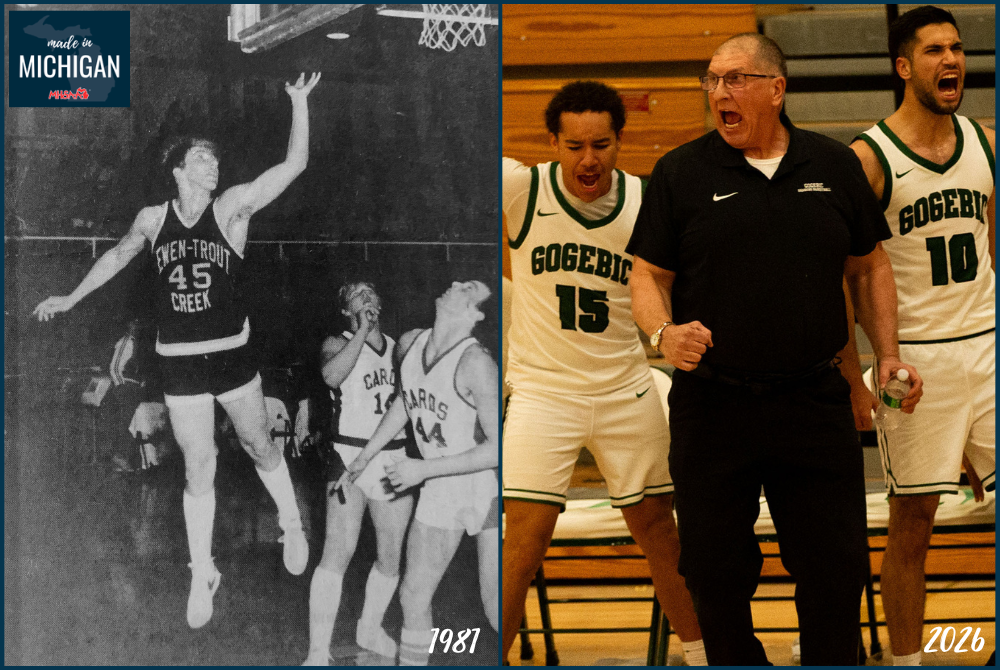
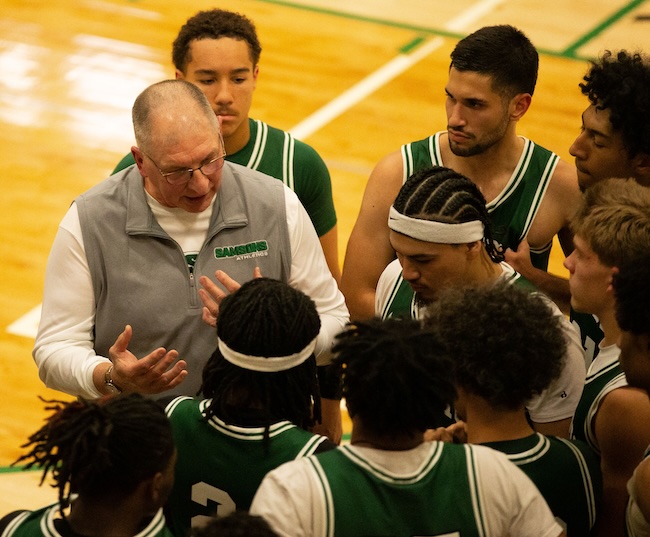
PHOTOS (Top) At left, Dennis Mackey (45) gets up a shot for Ewen-Trout Creek against Wakefield as a senior during the 1980-81 season. At right, Mackey coaches up his Gogebic Community College men’s basketball team this past summer. (Middle) Mackey huddles with his players during a break. (GCC photos by Jason Juno. Ewen-Trout Creek photo courtesy of the Ironwood Daily Globe.)