


Driving Force that Needs to be Re-Routed
November 30, 2015
The MHSAA's Fall issue of benchmarks examined the transfer regulation, including the reasoning behind recent changes. This is the first of four installments that will appear on Second Half this week.
By John E. “Jack” Roberts
MHSAA Executive Director
During the 2014-15 school year, over the course of 12 meetings, the MHSAA Executive Committee considered 467 requests of member schools to waive Handbook rules. Of those, 300 requests were to waive some aspect of the Transfer Regulation.
So an issue of benchmarks which examines the MHSAA transfer rule is well justified. Perhaps overdue.
Over the years, families have moved about and split apart with increasing frequency. Public policymakers have adopted laws that encourage students to move, and to keep moving, until they find a school more to their liking or they graduate, whichever occurs first.
Meanwhile, the profile of competitive sports has blossomed to the point of becoming overblown, the influence of non-school sports has spread and the delusion of college athletic scholarships has infected the brains of more students and parents. All of which increase the likelihood that students will move as much or more often for athletics as for academics and all other factors combined.
Add to this that the United States, and Michigan in particular, has become the favored landing zone for foreign exchange students, and the result is the need for a transfer rule that is like a great outside linebacker – tough, quick and nimble. We need a rule that is tough, acts fast and can keep changing to keep up with the times.
And the MHSAA Survey Says ...
April 2, 2015
By Rob Kaminski
MHSAA benchmarks editor
A survey of MHSAA member schools was conducted in the fall of 2014 aimed to determine opinions for and against a myriad of out-of-season coaching/contact period topics within the school year.
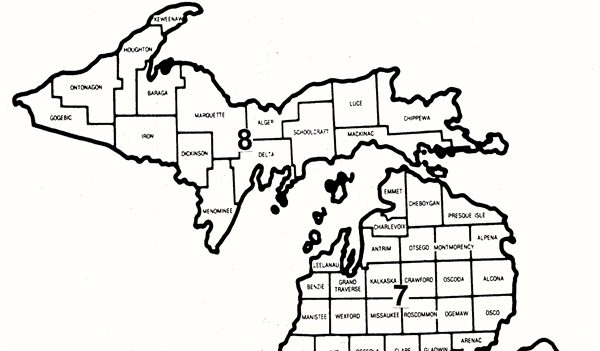
Below are some of the summaries drawn from that survey, plus a map of zones referred to in a number of points.
Survey Summary and Highlights
The larger the school, the higher the percentage of students who are involved in organized non-school sports.
The Detroit metro area (Zone 3) has the highest percentage of respondents in each of two groups in which the highest percentage of students are involved in organized non-school sports ... the 60 to 80% and 40 to 60% groups. The Grand Rapids area (Zone 6) ranks second.
The northern Lower Peninsula (Zone 7) and the Upper Peninsula (Zone 8) have the highest percentage of respondents in the group in which the lowest percentage of students are involved in organized non-school sports . . . the 0 to 20% group. This is also true of Zones 1, 2 and 5, although less dramatically.
In the majority of schools, coaches work with students out of season under the three- or four-player rule for a few weeks just before the season. This is generally true regardless of school classification or geographic zone.
In nearly 80% of schools, the frequency of coaches working with students out of season under the three- or four-player rule is one or two days a week.
100% of schools that sponsor basketball hold open gyms for basketball. Two-thirds of volleyball schools hold volleyball open gyms. Half of lacrosse schools hold lacrosse open gyms. Open gyms in baseball, softball and soccer occur in 40 to 45% of responding schools. Open gyms are less common for other sports.
More than half of all schools conduct open gyms for only a few weeks, just before the season begins.
In 85% of schools, the frequency of open gyms is one or two days a week.
The multi-sport athlete is common in schools of every classification, but more common in Class C and D schools than in Class A and B.
The multi-sport athlete is common in schools of every geographical zone, but more common in Zones 1, 2, 4, 7 and 8 than in Zones 3, 5 and 6.
Two-thirds of schools do not ban athletes from out-of-season workouts while in-season in a different school sport. Permitting weightlifting is most common (84%), then three- or four-player workouts (70%), then conditioning (66%) and open gyms (65%), and finally non-school competitions (57%).
Single-sport coaches are more common in smaller schools than larger (perhaps because fewer sports are sponsored in smaller schools).
For one question, schools were asked to rate ideas from 1 (I like the concept) to 6 (I do not like the concept). Average would be 3.5.
More than 60% of schools favor a no-contact period for all out-of-season sports at the start of every other sport’s season. (Support ranges from 55% for Class A schools to 65% for Class D schools and from 56% for Zones 1 and 3 to 71% for Zone 7.)
More than 72% of schools favor (in conjunction with a no-contact period) a defined contact period out of season. Support ranges from 69% for Class B schools to 76% for Class D schools and from 64% in Zone 6 to 88% in Zone 1.
Two-thirds of schools favor setting a limit on the number of contact days for out-of-season coaching. Support ranges from 63% for Class A schools to 72% for Class C schools and from 50% for Zone 2 to 73% for Zone 1.
More than 68% of schools favor setting a limit on the number of contact days in a week. There’s almost no difference based on school class. Support ranges from 58% in Zone 6 to 76% in Zone 5.
Counting days more than players – that is, allowing practice with any number of students for a defined number of days over a period of time – is favored by more than 72% of schools. Support ranges from 69% for Class D to 76% for Class A and from 59% for Zone 5 to 76.5% for Zone 3.
The least support of any idea surveyed was for allowing scrimmage competition (allowing the coach to coach any number of students from that coach’s school in competition against individuals not enrolled in that school).
More than 62% of schools favor a rule that would allow a school coach to coach a non-school team within a defined contact period; that is, a team with students from the coach’s school (and possibly other schools too), but not supported with school funds, administration, insurance, uniforms, etc. Support ranged from 58% for Class C schools to 68% for Class B schools. Support ranged from 54% for Zone 2 to 69% for Zone 6.
This is the most popular proposal (doesn’t preclude others being approved too): 84% of schools favor removing the phrase “under one roof” from Regulation II, Section 11(H) 2 a (see Tuesday's report). Support ranged from 80% for Class D schools to 86% for Class C schools and from 78% in Zone 2 to 89% for Zone 5.
Removing the portion of Interpretation 237 which prohibits setting up rotations that would allow a coach to work with dozens of players who rotate to his/her direct attention in groups of three or four is favored by 69% of schools, but with a distinct large school vs. small school difference of opinion: Class A (80.5% favorable), Class B (72.9%), Class C (61.3%) and Class D (61.7%).