

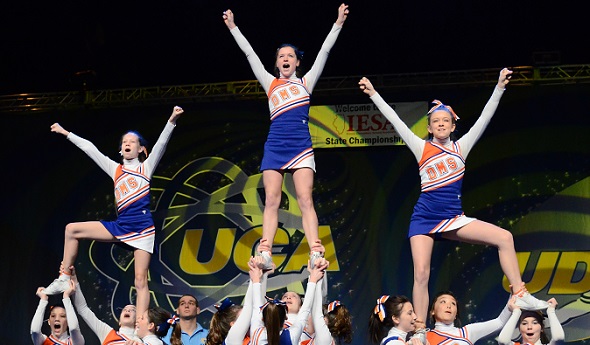
A League of Their Own in Illinois
May 20, 2014
By Rob Kaminski
MHSAA benchmarks editor
Imagine the scene: thousands of spectators roaring their approval as hundreds of cross country runners hit the finish line. A couple thousand others cascade applause on the wrestling mats as referees raise the hands of 19 champions.
Now, here’s the kicker, imagine this is taking place during postseason play for junior high/middle school student-athletes.
Again, that’s postseason, and junior high/middle school.
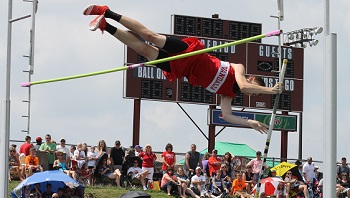
 “I guess when you see a kid cross the finish line in first place and 5,000 people are cheering, or watch a student run a race, throw the shot, or pole vault in front of that many at our track & field series, the proof is in the pudding,” said Steve Endsley, executive director of the Illinois Elementary School Association.
“The environment, the feedback we get; it’s the greatest thing in the world to some who experience our tournaments. But, I temper that in saying this is not the Olympics, the pros, or even high school. Success at our level doesn’t guarantee future success. We want you to do your best, we want to prepare you to do your best, but understand this is junior high.”
If understanding that is difficult for some athletes and parents involved in IESA athletics, it’s also a foreign language to state high school associations across the country. The IESA is the only organization in America which exclusively governs interscholastic activities for grade levels 7-8.
Most states include junior high/middle schools in their rules and regulations, but few, if any, conduct tournaments.
“We’ve been doing it for so long, it’s accepted. Schools know that at the end of the regular season, they enter Regional play. The payoff is we have state series, a culminating activity, and it’s a good thing that’s going on,” Endsley said.
From the organization’s first postseason event in 1930 during which boys basketball tournaments took place in a lightweight (boys less than 100 pounds) and a heavyweight division, the IESA has grown to sponsoring more than 20 boys and girls activities.
 Measures have been taken in recent years to alleviate travel concerns at the end of the season. The IESA has added classifications in some sports, while keeping the number of teams which advance to the Finals the same. So, for instance, where 16 teams might have gone to two different sites in the past, now four different sites host eight schools.
Admittedly, Endsley adds that the tournament series might add to some competitiveness, but since all schools enter the tournament, there might be less emphasis on winning during the regular season, and thus, heightened participation for those of all skill levels.
“If you don’t want the win-at-all-cost mentality, then step up to the plate at your member school and handle it that way,” Endsley said.
The refrain from association leaders around the country is that success in conveying the values and ideals of school sports is totally dependent on those in charge at the local level. Beginning with the 2012-13 school year, the IESA put more of that load squarely on the individual schools by making it a local decision as to whether students could participate with the school team and a club team in the same sport during the same season.
“From an association standpoint, it seemed like only people we were penalizing when had the limitations were the honest schools which self-reported,” Endsley said. “It was difficult to penalize those schools while everyone else knew the school down the street didn’t report.
“In a perfect world, the participation rule would be in place. But, it’s not a perfect world. Club sports schedule in accordance with high school seasons, but disregard our level when it comes to non-school activity. It’s year-round. So it’s practically impossible to equitably enforce it from a state level.”
There are more than 800 member schools in the IESA, which is an affiliate member of the National Federation of State High School Associations, but a separate entity from the Illinois High School Association.
Endsley estimates the IESA comprises 50-60 percent of eligible schools in Illinois, bolstered by unique membership options which differ from the IHSA and many state associations.
“We offer a la carte membership. A school can offer activities and maybe not participate in our state series. It’s only in those activities in which schools participate in the IESA state series that they must abide by our rules and regulations. Schools want some control. I think a la carte way is the way to go.
“If they join the IESA for one sport, they receive all mailings and information, so maybe one sport gets them in, but they may later add activities. If they are not a member, they don’t know about us.”
Yet, while separate bodies, the IESA and IHSA work hand-in-hand in many respects since nearly 100 percent of the IESA’s students will matriculate into IHSA schools.
“We attend the IHSA activity advisory meetings so we can keep a finger on the pulse of topics they are discussing and items they are considering. From the student standpoint, we will take our champions and introduce them in ceremonies at the IHSA Finals when our calendars line up,” Endsley said. “They get tickets, halftime introductions, pictures in the program, and it’s well-received recognition.”
Such activities are possible because the IESA seasons are different than the IHSA’s in some sports, or end sooner. For instance, the IESA plays baseball and softball in the fall, so its champions are recognized at the IHSA Finals in the spring.
“These activities create exposure and help build interests and aspirations for our schools,” Endsley said. “It’s nice P.R. for both associations.”
Whether different seasons or same seasons, the multitude of events throughout Illinois provides ample opportunity for the state’s contest officials as well. That’s another area in which the IESA and IHSA work together.
“We don’t license officials in the IESA, but we require our schools to use IHSA officials,” Endsley said. “We get great cooperation from the IHSA, it’s a good situation for our schools, and it’s a really good thing for officials. There are always plenty of games, and new officials gain valuable experience.”
Now in the midst of its ninth decade, the IESA continues to expand, adding boys and girls bowling and golf to its roster of activities in 2011.
The Association sponsors athletics for 7th- and 8th-graders, but 5th- and 6th-graders enrolled in a member school may participate with 7th-and 8th-grade teams within that building without a waiver. If such students are in an elementary school which feeds a member school, waivers are necessary.
Accomplished College Coach Giving Back to HS Track at Salem
By
Doug Donnelly
Special for MHSAA.com
April 23, 2021
PINCKNEY – John Goodridge has coached athletes of just about every level imaginable.
"My passion for coaching is just as high as ever,” said Goodridge, 72, recently named the head boys track & field coach at Salem High School in Canton. “It’s been fun. You really do come full circle.”
It’s been a tremendous coaching journey over the past 50 years for Goodridge, a New York City native. It was not long after retiring from Eastern Michigan University in the fall that Goodridge got the coaching bug again. It started when he began attending cross country meets in the Ann Arbor area. Soon he realized he wanted to continue coaching and spoke to one of his former EMU athletes who was coaching at Salem and had found out the job as boys track coach was going to be open.
"At some point, late in my career, I had the notion that someday I’d come back and coach high school, where it all started,” Goodridge said. “In the fall, after I retired, an EMU alum who coached at Pinckney High School invited me to his home opening cross country meet.
"It was enough being out there and seeing the young kids that it brought me back to 40-50 years ago. I spent the fall, every week, going to various local cross country meets. Just observing, just to see if I thought it was something I wanted to do.”
Ultimately, Salem athletic director Tim Baechler hired Goodridge, who has an incredible resume as a track & field and cross country coach. From coaching Olympic athletes to the United States team at the World University Cross Country Championships in Austria, Goodridge has coached world class athletes and NCAA championship-level contenders for decades.
High school coaches have always had a special place in Goodridge’s heart. One reason is he interacted with coaches from across the country while recruiting athletes to compete for him at Michigan State University (1979-1982), Wake Forest University (1984-1999) and Eastern Michigan (2001-2020). Another reason is that he started out coaching at that level.
"It’s natural,” he said. “A lot of people think college is a higher level and that kind of stuff, but I’ve always told people that being a high school coach is such an important role and opportunity to work with young people.
"In many cases it’s the most special relationship. A high school coach sets the tone. You are introducing the sport to young kids. That’s quite a responsibility.”
Goodridge graduated from Long Island University in 1972. He and wife Francie (Kraker) met in the northeast while working for a shoe company. They returned to her native Ann Arbor while she was an elite world class athlete. Francie ran on U.S. Olympic teams in 1968 and 1972 and owned a world record in 1967.
While in grad school, Francie was offered the position of track coach at Ann Arbor Huron but couldn’t accept it because she was still an amateur athlete and couldn’t profit from that status and remain eligible for the Olympics.
Instead, she suggested to the Huron athletic director that the school hire her husband. His coaching career was launched.
"We were two young people, trying to get through school on part-time jobs,” Goodridge said. “We didn’t even have a car. (Coaching) was a source of income.”
While coaching high school track, they also coached younger athletes on club squads, before moving to the University of Wisconsin-Milwaukee where they both were hired as coaches – Francie as the women’s track coach and John the men’s. After a short stint there, they returned to Ann Arbor and both took on roles at Ann Arbor Greenhills.
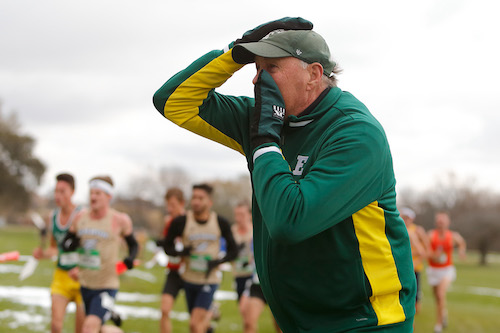
Both coached for years. Goodridge had a long tenure at Wake Forest, coaching both cross country and track & field at a time when the Demon Deacons had unparalleled success in school history with 14 individual Atlantic Coast Conference champions and seven All-Americans. Francie coached at Wake Forest as well.
The couple returned to Michigan in the early 2000s, with Goodridge taking over the Eastern Michigan cross country program and serving as an assistant track coach. He later became the head track coach. During his time at Ypsilanti, he directed numerous Eagles squads in both sports to conference titles. During his distinguished career, he coached conference cross country championship teams in the Mid-American, Big Ten and Atlantic Coast Conferences. He was the MAC Coach of the Year 13 times in cross country and coached 22 NCAA track & field All-Americans.
This season he has more than 100 athletes on the Salem boys track & field team. He’s having a blast with it, especially with the freshmen athletes who are just starting out learning about track.
"Some of them may not be the most talented, natural athletes but they want to be part of the team,” he said. “They might not be able to make another team, but they want to be involved in athletics and be on a team. It’s been very intellectually challenging and inspiring to come up with new things for ninth graders, to make it fun and not let them get discouraged.
"They put a smile on my face just about every day. I hope it’s going to be keep me a young 72 and a young 73 and as long as I keep doing this.”
Goodridge also is building relationships with other area coaches. He’s not been afraid to seek out advice.
It’s been a long time since I designed workouts for the young ones,” he said. “It’s fun to sort it out, to my own approach to training, with that age group. All athletes respond differently to training and intensity and what you give them. The age of the athlete is a factor in that. It’s been a long time since I had experience working with freshmen. That’s been fun.”
 Doug Donnelly has served as a sports and news reporter and city editor over 25 years, writing for the Daily Chief-Union in Upper Sandusky, Ohio from 1992-1995, the Monroe Evening News from 1995-2012 and the Adrian Daily Telegram since 2013. He's also written a book on high school basketball in Monroe County and compiles record books for various schools in southeast Michigan. E-mail him at [email protected] with story ideas for Jackson, Washtenaw, Hillsdale, Lenawee and Monroe counties.
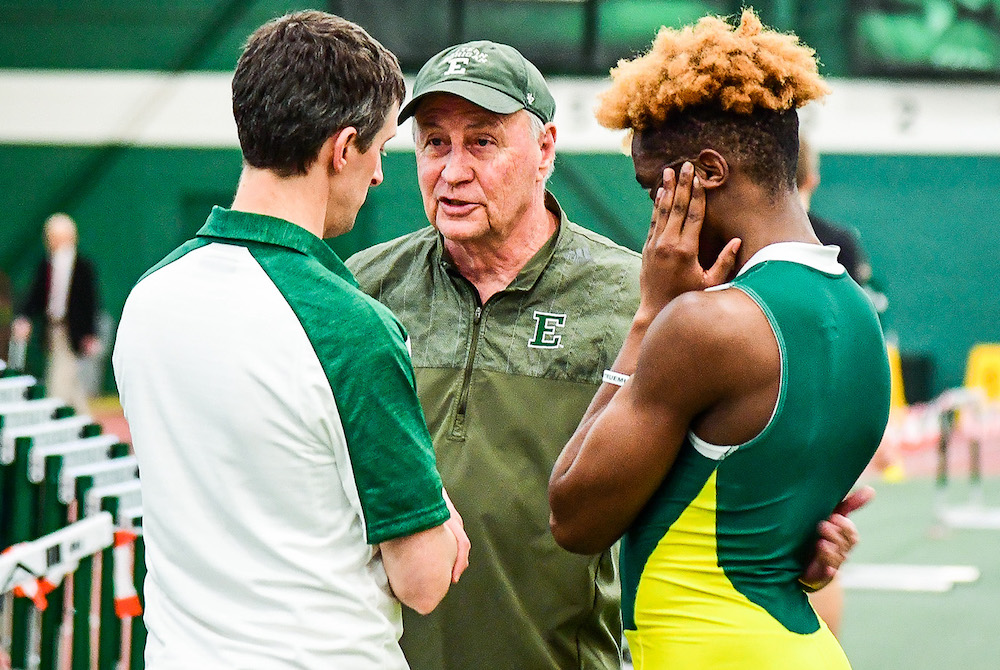
PHOTOS: (Top) John Goodridge, center, retired in the fall from coaching the men’s track & field team at Eastern Michigan University. (Middle) Goodridge also served as coach of the men’s cross country team. (Photos courtesy of the EMU athletic department.)