

A League of Their Own in Illinois
May 20, 2014
By Rob Kaminski
MHSAA benchmarks editor
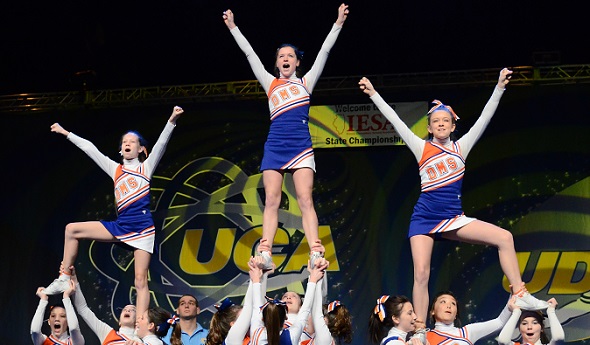
Imagine the scene: thousands of spectators roaring their approval as hundreds of cross country runners hit the finish line. A couple thousand others cascade applause on the wrestling mats as referees raise the hands of 19 champions.
Now, here’s the kicker, imagine this is taking place during postseason play for junior high/middle school student-athletes.
Again, that’s postseason, and junior high/middle school.
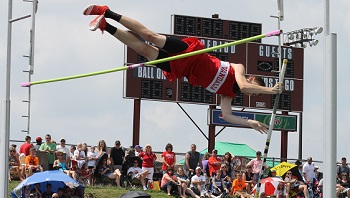
 “I guess when you see a kid cross the finish line in first place and 5,000 people are cheering, or watch a student run a race, throw the shot, or pole vault in front of that many at our track & field series, the proof is in the pudding,” said Steve Endsley, executive director of the Illinois Elementary School Association.
“The environment, the feedback we get; it’s the greatest thing in the world to some who experience our tournaments. But, I temper that in saying this is not the Olympics, the pros, or even high school. Success at our level doesn’t guarantee future success. We want you to do your best, we want to prepare you to do your best, but understand this is junior high.”
If understanding that is difficult for some athletes and parents involved in IESA athletics, it’s also a foreign language to state high school associations across the country. The IESA is the only organization in America which exclusively governs interscholastic activities for grade levels 7-8.
Most states include junior high/middle schools in their rules and regulations, but few, if any, conduct tournaments.
“We’ve been doing it for so long, it’s accepted. Schools know that at the end of the regular season, they enter Regional play. The payoff is we have state series, a culminating activity, and it’s a good thing that’s going on,” Endsley said.
From the organization’s first postseason event in 1930 during which boys basketball tournaments took place in a lightweight (boys less than 100 pounds) and a heavyweight division, the IESA has grown to sponsoring more than 20 boys and girls activities.
 Measures have been taken in recent years to alleviate travel concerns at the end of the season. The IESA has added classifications in some sports, while keeping the number of teams which advance to the Finals the same. So, for instance, where 16 teams might have gone to two different sites in the past, now four different sites host eight schools.
Admittedly, Endsley adds that the tournament series might add to some competitiveness, but since all schools enter the tournament, there might be less emphasis on winning during the regular season, and thus, heightened participation for those of all skill levels.
“If you don’t want the win-at-all-cost mentality, then step up to the plate at your member school and handle it that way,” Endsley said.
The refrain from association leaders around the country is that success in conveying the values and ideals of school sports is totally dependent on those in charge at the local level. Beginning with the 2012-13 school year, the IESA put more of that load squarely on the individual schools by making it a local decision as to whether students could participate with the school team and a club team in the same sport during the same season.
“From an association standpoint, it seemed like only people we were penalizing when had the limitations were the honest schools which self-reported,” Endsley said. “It was difficult to penalize those schools while everyone else knew the school down the street didn’t report.
“In a perfect world, the participation rule would be in place. But, it’s not a perfect world. Club sports schedule in accordance with high school seasons, but disregard our level when it comes to non-school activity. It’s year-round. So it’s practically impossible to equitably enforce it from a state level.”
There are more than 800 member schools in the IESA, which is an affiliate member of the National Federation of State High School Associations, but a separate entity from the Illinois High School Association.
Endsley estimates the IESA comprises 50-60 percent of eligible schools in Illinois, bolstered by unique membership options which differ from the IHSA and many state associations.
“We offer a la carte membership. A school can offer activities and maybe not participate in our state series. It’s only in those activities in which schools participate in the IESA state series that they must abide by our rules and regulations. Schools want some control. I think a la carte way is the way to go.
“If they join the IESA for one sport, they receive all mailings and information, so maybe one sport gets them in, but they may later add activities. If they are not a member, they don’t know about us.”
Yet, while separate bodies, the IESA and IHSA work hand-in-hand in many respects since nearly 100 percent of the IESA’s students will matriculate into IHSA schools.
“We attend the IHSA activity advisory meetings so we can keep a finger on the pulse of topics they are discussing and items they are considering. From the student standpoint, we will take our champions and introduce them in ceremonies at the IHSA Finals when our calendars line up,” Endsley said. “They get tickets, halftime introductions, pictures in the program, and it’s well-received recognition.”
Such activities are possible because the IESA seasons are different than the IHSA’s in some sports, or end sooner. For instance, the IESA plays baseball and softball in the fall, so its champions are recognized at the IHSA Finals in the spring.
“These activities create exposure and help build interests and aspirations for our schools,” Endsley said. “It’s nice P.R. for both associations.”
Whether different seasons or same seasons, the multitude of events throughout Illinois provides ample opportunity for the state’s contest officials as well. That’s another area in which the IESA and IHSA work together.
“We don’t license officials in the IESA, but we require our schools to use IHSA officials,” Endsley said. “We get great cooperation from the IHSA, it’s a good situation for our schools, and it’s a really good thing for officials. There are always plenty of games, and new officials gain valuable experience.”
Now in the midst of its ninth decade, the IESA continues to expand, adding boys and girls bowling and golf to its roster of activities in 2011.
The Association sponsors athletics for 7th- and 8th-graders, but 5th- and 6th-graders enrolled in a member school may participate with 7th-and 8th-grade teams within that building without a waiver. If such students are in an elementary school which feeds a member school, waivers are necessary.
MHSAA Vault: Shooks a Legend as Freshman Coach
By
Geoff Kimmerly
MHSAA.com senior editor
September 4, 2026
The following originally appeared in the Lansing State Journal on Oct. 28, 2004, and was reprinted by the MHSAA that winter.
Wayne Shooks retired from coaching entirely in 2008 and died Tuesday at the age of 84.
Wayne Shooks tried the varsity football thing once. Some time during the late 1980s, longtime DeWitt coach Gail Thornton asked Shooks to be his offensive coordinator.
“I didn't sleep a night. My wife, after three weeks, said, ‘You're going back to freshmen,’” Shooks remembered.
And those three weeks were in the month of June.
But Shooks' wife must have been on to something. Because few, if any, freshman football coaches have accomplished what Shooks finished with one last win last fall.
He ended his 16th and final season as freshman coach with a 135-2-1 record.
Amazing.
“You can't lose a game for him, or you'll feel bad,” DeWitt senior Mat Brynick recalled from his days as a freshman. “Coach never says it, but it's what everyone expects.
“He taught us how to win.”
 Guys like Shooks, 62, usually go unappreciated.
They get the kids fresh to high school, fresh to high school sports, and still learning things like not spiking the ball after a touchdown.
But few freshman football coaches are as legendary as Shooks is in DeWitt. They are so unappreciated that it's impossible to find out if anyone has accomplished what he's done.
Shook is not big on numbers. Never has been during his 41 years teaching in the district, or more than 20 coaching everything from football to basketball to wrestling to tennis. Oh, and track since 1980.
He also coached 8th-grade football for a few years, junior varsity for one season and was a varsity assistant. But he'll be remembered for what he did with the freshmen.
The losses came in 1993 to Mason during a terrible wind storm, and in 2002 to Greenville. That same year, the Panthers tied Haslett, meaning it was the only year during his tenure that DeWitt wasn't sure if it finished first in its league, since league titles aren't handed out at the freshmen level.
“The kids felt bad. They did their best,” Shooks remembered.
But the losses, however few, were more of a relief for Shooks than a letdown.
Don't take that to mean Shooks doesn't like to win.
Sure, he embraced the role of teacher as much as any freshman coach. But as DeWitt varsity coach Rob Zimmerman said, “If he was a 5th-grade coach, he'd be the most competitive 5th-grade coach you've ever seen.”
“I never pointed (our record) out, it was not our goal,” Shooks said. “Our goal was to win the next week. Although the kids knew it. They just assumed we were going to go 9-0, I guess.”
Guess so.
Shooks had more easily-attainable goals:
- Have fun
- Learn fundamentals
- Emphasize the logical stuff, like the importance of bringing equipment to school every day
“He does a really good job teaching expectations about being young men and being great students,” Zimmerman said. “It's gigantic.”
And it kept kids coming back to junior varsity and varsity. You could hear the fun coming out in Brynick's voice.
He was remembering his freshman football experience, remembering his time with perhaps Michigan's most successful coach at that level.
“I remember a few games, we'd find one play that works, and we ran it to death, pounding it and pounding it,” Brynick recalled. “He loves running the same play over and over. If you can do that, march 80 yards down the field, you're doing something right. No one could stop us.”
That was not all Brynick remembered, or didn't.
Shooks almost never yelled. If he did, it meant a kid messed something up over and over and over again.
He has a doctorate in zoology. Education is obviously a big deal. He loves to win, but he loves to teach. And he's hesitant to go looking for any attention for what he's done.
All made him a perfect freshmen football coach.
“Sometimes I don't think people understand about coaches. You think college level, they are coaches first, that's their job, but not at the high school level,” Shooks said.
“It's not what I've done, it's what they've done. I've always believed the focus should be on the kids. My job is a teacher. I coach because I love to coach.”
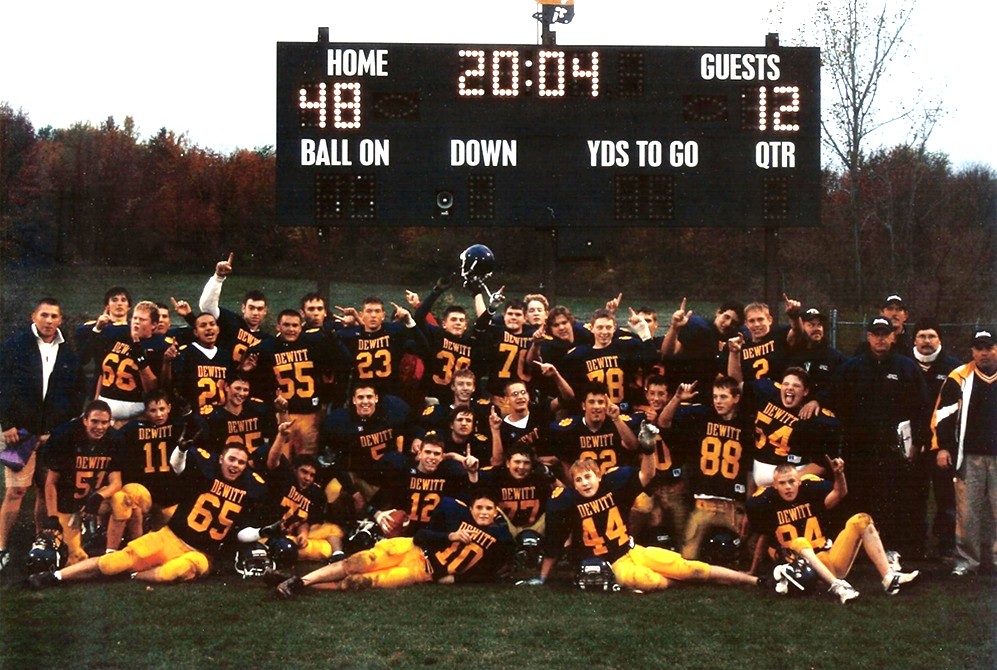
PHOTO DeWitt freshman coach Wayne Shooks, fourth from right, stands for a photo with this final football team in 2004. (Photos courtesy of the DeWitt football program.)