

The More Things Change ...
December 20, 2013
By Rob Kaminski
MHSAA benchmarks editor
As we begin another calendar year, let's take a brief look at how the mission of school sports has (or hasn’t) changed since 1955, when former MHSAA Executive Director Charles E. Forsythe presented this practicum to the University of Michigan.
The following is an excerpt:
Presented by Charles E. Forsythe
Practicum in Physical Education
University of Michigan, Ann Arbor
Tuesday, June 21, 1955
WHY DO WE HAVE INTERSCHOLASTIC ATHLETICS IN OUR SCHOOLS?
 To meet the urge for competition which is a basic American tradition – let’s keep it.
- To provide a “whole school” interest and activity, bring in students other than athletes, enlist many student organizations.
- To teach students habits of health, sanitation, and safety.
- Athletics teach new skills and opportunities to improve those we have; this is basic educationally.
- To provide opportunities for lasting friendships both with teammates and opponents.
- To provide opportunity to exemplify and observe good sportsmanship which is good citizenship.
- Athletics give students a chance to enjoy one of America’s greatest heritages, the right to play and compete.
- One of the best ways to teach that a penalty follows the violation of a rule is through athletics.
- There must be an early understanding by students that participation in athletics is a privilege which carries responsibilities with it. Awarding school letter to a student is the second-highest recognition his school can give him – his diploma at graduation is the highest.
- To consider interscholastic athletic squad as “advanced” classes for the teaching of special skills – similar to bands, orchestras, school play casts, members of debating teams, etc. There is no reason why a reasonable amount of attention should not be given to such groups – as well as to those in the middle and lower quartiles in our schools. Both leaders and followers must be taught.
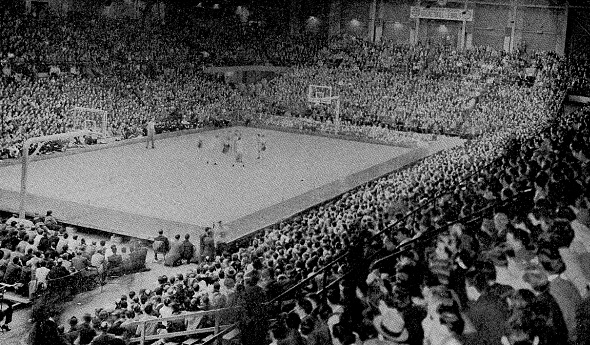
PHOTOS: (Top) Fans filled the arena for this MHSAA boys basketball tournament game. (Middle) Charles Forsythe served as the first executive director of the MHSAA.
Ann Arbor Greenhills Athletics Recognized as 'Exemplary' by NIAAA
By
Geoff Kimmerly
MHSAA.com senior editor
July 29, 2022
Ann Arbor Greenhills’ athletic department has been selected for a Quality Program Award from the National Interscholastic Athletic Administrators Association (NIAAA), becoming the first Michigan school to receive the exemplary-level honor since the QPA was introduced in 2009.
Programs were considered by the NIAAA based on 10 assessment categories that aspire to “encourage measurement, planning and goal setting aimed at continuous improvement of local school athletic programs.” Greenhills will be recognized for the achievement during December’s NIAAA/NFHS National Athletic Directors Conference in Nashville, Tenn.
Greenhills sponsors 21 sports, and 247 of the school’s 355 students during the 2021-22 school year participated on at least one team.
"At Greenhills, we have always prided ourselves on continuous improvement, and aim to provide an exemplary experience for all of our student-athletes,” athletic director Meg Seng said. “The NIAAA Quality Program assessment guided us through a comprehensive examination of our entire athletic program. This exercise affirmed many of our strengths and also highlighted areas in which we can continue to improve.
“We remain motivated to measure, innovate and improve our program to benefit the student experience. While we are extremely grateful and proud for the recognition, the true value came while engaging in a thorough audit and working alongside dedicated colleagues during the process."
Greenhills previously received an Exemplary Athletic Program Award in 2017 from the Michigan Interscholastic Athletic Administrators Association (MIAAA).
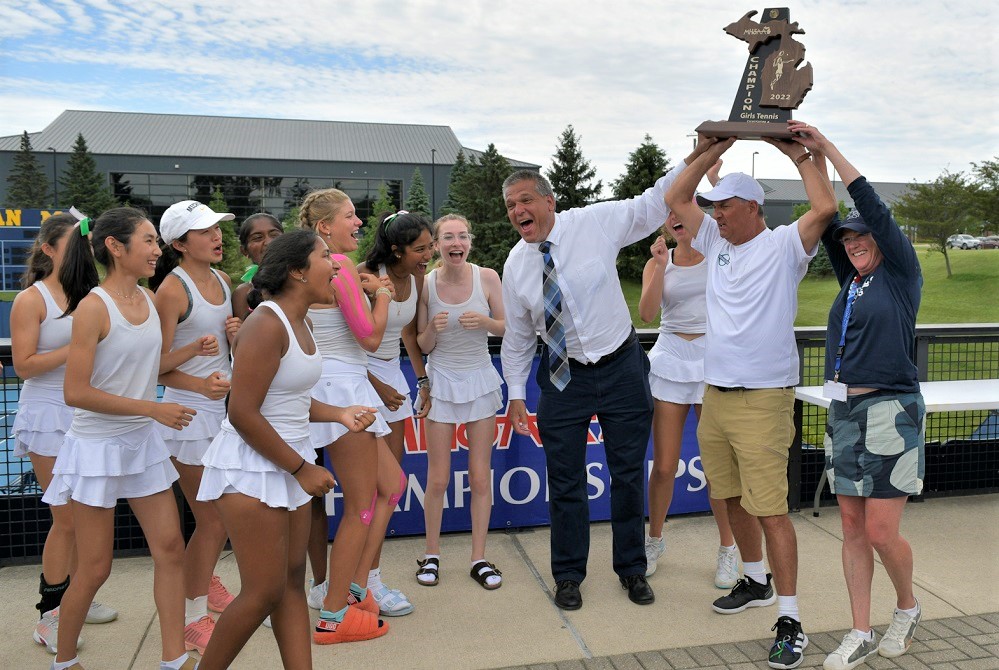
PHOTO The Ann Arbor Greenhills girls tennis team celebrates its Lower Peninsula Division 4 championship won last month. (Click for more from High School Sports Scene.)