

The More Things Change ...
December 20, 2013
By Rob Kaminski
MHSAA benchmarks editor
As we begin another calendar year, let's take a brief look at how the mission of school sports has (or hasn’t) changed since 1955, when former MHSAA Executive Director Charles E. Forsythe presented this practicum to the University of Michigan.
The following is an excerpt:
Presented by Charles E. Forsythe
Practicum in Physical Education
University of Michigan, Ann Arbor
Tuesday, June 21, 1955
WHY DO WE HAVE INTERSCHOLASTIC ATHLETICS IN OUR SCHOOLS?
 To meet the urge for competition which is a basic American tradition – let’s keep it.
- To provide a “whole school” interest and activity, bring in students other than athletes, enlist many student organizations.
- To teach students habits of health, sanitation, and safety.
- Athletics teach new skills and opportunities to improve those we have; this is basic educationally.
- To provide opportunities for lasting friendships both with teammates and opponents.
- To provide opportunity to exemplify and observe good sportsmanship which is good citizenship.
- Athletics give students a chance to enjoy one of America’s greatest heritages, the right to play and compete.
- One of the best ways to teach that a penalty follows the violation of a rule is through athletics.
- There must be an early understanding by students that participation in athletics is a privilege which carries responsibilities with it. Awarding school letter to a student is the second-highest recognition his school can give him – his diploma at graduation is the highest.
- To consider interscholastic athletic squad as “advanced” classes for the teaching of special skills – similar to bands, orchestras, school play casts, members of debating teams, etc. There is no reason why a reasonable amount of attention should not be given to such groups – as well as to those in the middle and lower quartiles in our schools. Both leaders and followers must be taught.
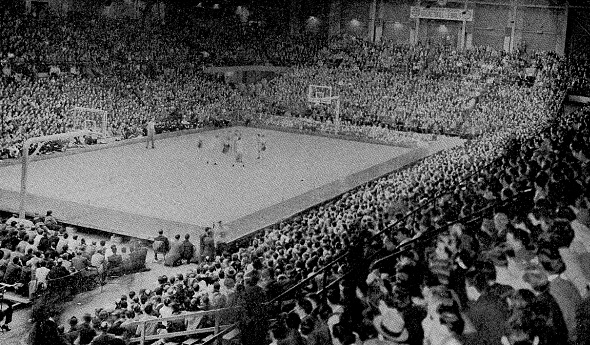
PHOTOS: (Top) Fans filled the arena for this MHSAA boys basketball tournament game. (Middle) Charles Forsythe served as the first executive director of the MHSAA.
Hutcheson Eager to Serve Statewide
April 20, 2016
By Geoff Kimmerly
Second Half editor
On Tuesday, Dan Hutcheson was the public address announcer at a track and field meet. On Wednesday, he spent part of the morning painting a door.
As a teacher, coach, then assistant principal and athletic director, he’s performed in a wide variety of roles for Howell High School over the last two decades.
 This fall, he’ll take on another set of similar but new and wide-ranging responsibilities as an assistant director for the MHSAA.
Hutcheson, who will join the staff in August, will take over administration of wrestling, girls and boys tennis and another sport to be determined. He’ll also contribute to the Coaches Advancement Program and Athletic Directors In-Service program among other duties.
“When I look at each step I’ve taken, it’s been an opportunity to serve more people,” Hutcheson said. “As a classroom teacher and a coach, and then moving up to assistant principal where I was serving more students. And then athletic director, where I was serving more students, and now serving the entire state. It’s pretty remarkable.”
The addition of Hutcheson is one of a few changes coming to the MHSAA staff for the start of the 2016-17 school year. Longtime official Sam Davis will join part-time in September to coordinate an expansion of services and support for officials, including in the key areas of recruitment and retention, while also assisting Hutcheson with wrestling.
Andrea Osters will be promoted in August to assistant director in charge of volleyball and another sport to be determined. Osters, the current social media & brand coordinator for the MHSAA and also the lead administrator for softball the last three years, will with Hutcheson take over most of the duties of current assistant director Gina Mazzolini, who will retire at the end of July.
At Howell, Hutcheson directs 90 athletic teams for grades 7-12. His high school, with more than 2,500 students, is one of the largest in our state. He has served as athletic director for the last decade after two years as an assistant principal, and he also coached the school’s wrestling program for eight seasons while teaching applied technology at the high school and later working for the Howell Recreation Department.
A plea from a professor during his first year as a student at Ferris State University set Hutcheson’s path toward education – although along the way he’s picked up a variety of skills that have benefitted his athletic program and the surrounding sports community as well.
He went to Ferris with thoughts of becoming a graphic designer and going into advertising. But by the end of his first term, as he watched classmates stay up into the morning hours working on projects while he was getting up at 6 a.m. for wrestling practice, he figured that career might not be the best fit.
Hutcheson still remembers the day in class when that instructor remarked that there was a huge need for technical education teachers. Hutcheson, who had always wanted to coach, saw that as his eventual niche.
He graduated with a bachelor’s degree in technical education with an associate’s in graphic arts and printing technology, and later earned a master’s degree in public and educational administration at University of Michigan-Dearborn.
Hutcheson recently was named his region’s Athletic Director of the Year by the Michigan Interscholastic Athletic Administrators Association, and with Davis will bring extensive wrestling experience to the MHSAA. After competing at Howell and then Holt High School as a senior – making the MHSAA Individual Finals and finishing third at his weight as a senior in 1988 – Hutcheson was three-time NCAA Division II wrestling All-American and two-time Academic All-American while at Ferris State, and a three-time Greco-Roman Open All-American at the collegiate and post-graduate senior levels.
Hutcheson served as an assistant wrestling coach at Ferris State during the 1994-95 season and then coached the Michigan Wrestling Club from 1997-2000 guiding athletes in World Team and Olympic Trials competition. He led the Highlanders to the Division 1 Quarterfinals his first season as a high school coach, and currently serves as wrestling commissioner and overall president of the 24-school Kensington Lakes Activities Association and on MHSAA committees for wrestling and lacrosse.
He took over as athletic director at Howell from longtime administrator Doug Paige and has relied in part on work ethic learned from parents Don and Lynne Hutcheson and mentoring from college coach Dr. Jim Miller, who also is a professor of Optometry and with whom Hutcheson remains in regular contact.
Hutcheson has relished opportunities to put on big events, and one of his last as Howell athletic director will be as host of both MHSAA Boys Lacrosse Finals on June 11.
And tapping into those technical and design skills, Hutcheson also serves as webmaster and historian for the KLAA and created one of the most detailed league websites in the state.
“When we were doing (Paige’s) going-away party, I said his were big shoes to fill but my goal wasn't to fill the shoes, but to keep walking in the same direction,” Hutcheson said. “I feel the next person up will have a great foundation that’s here and will take it to the next level.
“I’m very excited about (joining the MHSAA staff). But I’ll probably take the same approach as what I did as athletic director here. Things have been done a certain way for a reason, and then we can look for ways to tweak things, fine-tune things.”
Champions who champion our games
An MHSAA Wrestling Finals individual champion for Lansing Eastern in 1969, Davis went on to wrestle briefly at Michigan State University before an eye injury ended his competitive career in that sport. However, he instead took up judo, winning state championships in 1980 and 1981 and competing at the U.S. Olympic trials. After graduating from MSU with bachelor and master’s degrees in 1974, Davis began his teaching career at Lansing Everett High School. He also coached wrestling and football and later served as an assistant principal at the school before serving as principal at Dwight Rich Middle School and then district athletic director over a 32-year career with Lansing Public Schools that concluded in 2007.
 Davis received the MHSAA’s Vern L. Norris Award in 2015 for his work in officiating, including the mentoring and educating of other officials. He has been an MHSAA registered official for 36 years, working wrestling during the entirety of his career and baseball most of the last decade. Davis has officiated in all but a few of the MHSAA’s annual Wrestling Finals since receiving his first championship-level assignment in 1983. He currently serves as a major with the Ingham County Sheriff’s Office, serving as jail administrator, and will remain employed by the county while joining the MHSAA staff.
 Osters has worked as part of the MHSAA staff since 2005 and has presented multiple times at National Federation annual meetings on her work as a nationally-recognized leader in high school sports association social media. She is a member of the Leadership Council of the NFHS Network, the national digital broadcasting initiative of the National Federation of State High School Associations, and has worked in coordination and planning of the MHSAA’s Captain’s Clinic series and other student leadership programs.
She also launched the “Officials for Kids” statewide fundraising initiative and handles all venue-specific ticketing for MHSAA statewide tournaments.
She was a high school champion as a starter on the Okemos softball team that won the MHSAA Division 1 championship in 1999 and then graduated from Michigan State in 2004 with a bachelor’s degree in communications and concentration in public relations. She served as Okemos’ freshman softball coach for four seasons, from 2002-05, and also wrote a weekly sports column for a local magazine from 2009-11. Osters is a current member of the board of directors for the Michigan Society of Association Executives and was a founding member of the MSAE’s Emerging Professionals Committee.
“Dan Hutcheson, Sam Davis and Andrea Osters are passionate advocates for the values of high school athletics,” MHSAA Executive Director John E. Jack Roberts said. “Dan is one of the most respected athletic administrators in Michigan and brings a collection of experiences and skills that will benefit all of our schools in a variety of areas. Sam has long championed officiating, and we’re excited for the possibilities his experience and abilities bring as we intensify our recruitment of new officials statewide to join the more than 10,000 who annually work our games.
“Andrea has provided the MHSAA with a variety of skills and leadership over more than a decade of service and played a prominent role in the move of the MHSAA Baseball and Softball Finals to Michigan State two years ago. We anticipate she’ll make a smooth transition in taking over new and added responsibilities.”
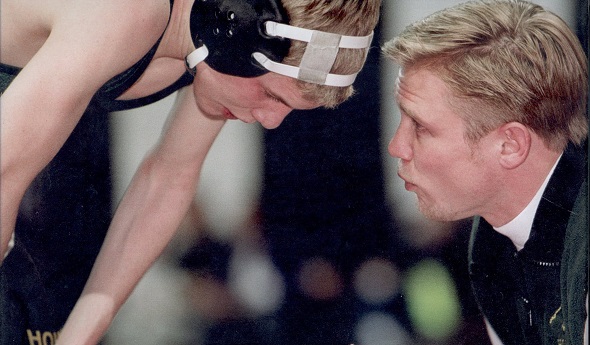
PHOTO: Howell’s Dan Hutcheson coaches one of his wrestlers during his tenure running that program from 1997-2004. (Photo courtesy of Dan Hutcheson.)