

The More Things Change ...
December 20, 2013
By Rob Kaminski
MHSAA benchmarks editor
As we begin another calendar year, let's take a brief look at how the mission of school sports has (or hasn’t) changed since 1955, when former MHSAA Executive Director Charles E. Forsythe presented this practicum to the University of Michigan.
The following is an excerpt:
Presented by Charles E. Forsythe
Practicum in Physical Education
University of Michigan, Ann Arbor
Tuesday, June 21, 1955
WHY DO WE HAVE INTERSCHOLASTIC ATHLETICS IN OUR SCHOOLS?
 To meet the urge for competition which is a basic American tradition – let’s keep it.
- To provide a “whole school” interest and activity, bring in students other than athletes, enlist many student organizations.
- To teach students habits of health, sanitation, and safety.
- Athletics teach new skills and opportunities to improve those we have; this is basic educationally.
- To provide opportunities for lasting friendships both with teammates and opponents.
- To provide opportunity to exemplify and observe good sportsmanship which is good citizenship.
- Athletics give students a chance to enjoy one of America’s greatest heritages, the right to play and compete.
- One of the best ways to teach that a penalty follows the violation of a rule is through athletics.
- There must be an early understanding by students that participation in athletics is a privilege which carries responsibilities with it. Awarding school letter to a student is the second-highest recognition his school can give him – his diploma at graduation is the highest.
- To consider interscholastic athletic squad as “advanced” classes for the teaching of special skills – similar to bands, orchestras, school play casts, members of debating teams, etc. There is no reason why a reasonable amount of attention should not be given to such groups – as well as to those in the middle and lower quartiles in our schools. Both leaders and followers must be taught.
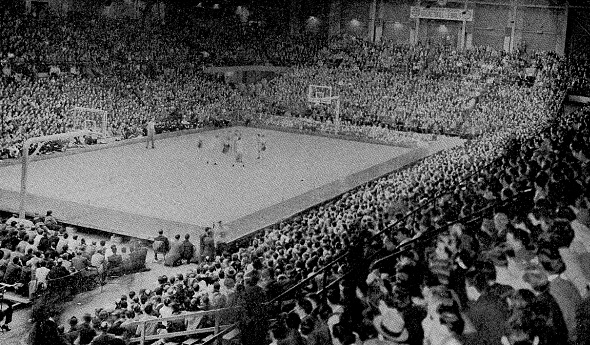
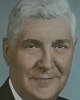
PHOTOS: (Top) Fans filled the arena for this MHSAA boys basketball tournament game. (Middle) Charles Forsythe served as the first executive director of the MHSAA.

Permission to Disagree
February 17, 2015
An organization leader who is doing a good job works hard to provide the organization’s board of directors all the history and detail necessary to make good decisions. Questions and concerns are anticipated, and addressed in advance.
As a result of this good leadership, meetings usually run with efficiency, decisions are made without long discussions, and debate is infrequent and never contentious. Votes usually reflect unanimous agreement.
While these are traits of good organizational leadership, a tradition of great organizational dynamics is disagreement.
If the board is always in total agreement, then management is not bringing the board tough enough topics. The subjects are not serious enough. They are operational more than strategic; they are transactional, not transformational.
Among the current topics of school sports in Michigan are two upon which there is certain to be disagreement: (1) the role of 6th-graders in school sports and the MHSAA; and (2) out-of-season coaching rules. We see the lack of consensus at the local level and the league level and between different coaches associations. And we expect the Representative Council will lack unanimity if these topics ever arrive for the Council’s action.
These are large topics, worthy of our time because of the disagreement, not in spite of it.