

Next Play: Heart of the Matter
June 25, 2015
By Rob Kaminski
MHSAA benchmarks editor
From the retirement of NFL players in their mid-20s fearing long-term disability, to NASCAR drivers suffering injuries against concrete walls when alternative substances are available, to MLB outfielders running into barriers which place aesthetics and tradition over safety, the focus of highlight shows, apps and old-fashioned sports pages is shifting from action inside the lines to the sidelines.
As the reality of human vulnerability continues to invade our favorite escape from reality – athletics – protecting those in the spotlight needs to be Job 1.
While the quest for risk management protocols and health and safety provisions is a never-ending loop, the MHSAA bolted from the starting blocks with a 4H plan (Health Histories, Heads, Heat and Hearts) in the fall of 2009, a mission that enters the fourth turn for the 2015-16 school year.
And, as pulse quickens for the “Heart” stage in the fall, the MHSAA will continue to step up initiatives involving the other three initiatives during the next lap.Think of it as a continuous relay, where the baton is never dropped and fresh runners continue the race.
While organizations at other levels might be asking, “What to do,” the MHSAA is focusing on “What’s next?”
In this playbook the next plays are critical in allowing student-athletes to continue providing their communities with inexpensive and entertaining breaks from reality.
The Heart of the Matter
The 2015-16 school year brings with it an ambitious but paramount stage in the MHSAA’s mission to protect and promote the well being of student-athletes across the state.
Beginning in the fall, all high school varsity coaches will need to have Cardiopulmonary Resuscitation (CPR) certification by established deadlines which correspond to rules meetings.
The requirement is new, and the volume of personnel affected is vast. Yet, plans have been in place during the past few years, and schools in many communities are ahead of the curve.
“We’ve fielded some questions regarding the requirement, but I think that many of our schools already have similar protocols in place,” said MHSAA assistant director Kathy Vruggink Westdorp. “Increasingly, schools have become more prudent with regards to health and safety, and programs which emphasize these initiatives have been well received.”
Pete Ryan, MHSAA Representative Council member and athletic director for Saginaw Township Community Schools, concurs.
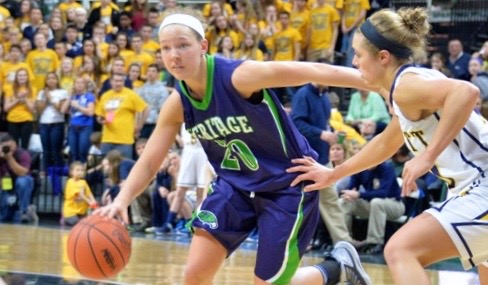
“The CPR requirement will not be a change for Heritage, as we have required CPR for eight years,” Ryan said. “We offer certification through our district nurse at no charge to the coaches and train about 20-30 coaches per year.”
The training vehicle might vary from district to district, but so long as the end result is certification, the coaches are free to take course by any means possible, whether online or in person.
“I think we’ll see a blend of online and classroom delivery,” Westdorp said. “And, I don’t think it will be just the coaches. At the MIAAA Conference (in March), school leaders were proactive in terms of certification for athletic directors, too.”
Mike Bakker, President of the Michigan Interscholastic Athletic Administrators Association and athletic director at Fenton High School, says CPR certification is a must in the risk management plans for all school settings.
“As an educator who has been a CPR and first aid instructor for the American Heart Association for a number of years, I am excited that the MHSAA will require CPR training for varsity coaches,” Bakker said.
“I certainly hope that in the future we will see that all coaches are trained in CPR. There might be a bit of a challenge at first to get our coaches trained, as schools look for the most economical as well as timely way to accomplish this mandate. The biggest hurdle that I can foresee is trying to find qualified trainers in all areas of the state that have multiple training dates available to fit the needs of such diverse coaching staffs.”
Ryan believes there is no substitute for the personal touch.
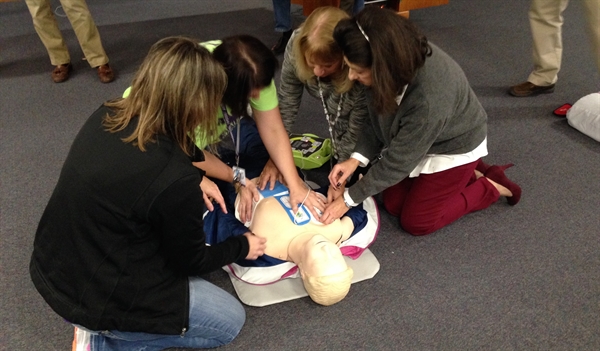
“We are doing in-person training which I feel is better because the individuals have to perform the procedure on the practice dummy," he said. "It’s simply more hands-on training.”
School nurses and trainers will play a substantial role in the certification process, as will community health organizations in many locales.
“In many of our schools, the health educators are certified to conduct CPR courses,” Westdorp said. “We’ve also had numerous calls from non-school entities alerting us to their availability to provide training, such as fire departments and local medical centers.”
Fenton is one such school with the luxury of on-site personnel to train its staff.
“We are fortunate in Fenton that our athletic trainer and athletic director are certified trainers so we can accomplish our training in-house, but I know that not all schools are as fortunate,” Bakker said.
Which is exactly why it’s necessary for coaches to become certified, and ideally not just the head coaches.
“It should be encouraged that all coaching staff become CPR certified so that they are able to take action, especially for schools which do not have an athletic trainer on staff and if the head coach is unavailable or present, in the unfortunate event that a potential cardiac emergency and/or sudden-death incident occurs,” said certified athletic trainer Gretchen Mohney, the Clinical Coordinator and Instructor for Western Michigan University Undergraduate Athletic Training Program.
Mark Mattson, athletic director at Traverse City Central, indicated that while not previously a requirement, the district has been proactive in prepping the coaches.
“From the moment the requirement was announced, we've been out in front of it,” Mattson said. “What’s great is, even though it hasn’t been a requirement for Traverse City Area Public Schools, many coaches are indeed already certified. The district also offers training sessions once a month and those dates are passed on to our coaches. Jason Carmien (AD at Traverse City West) and I have also had conversations about providing training at our preseason coaches meeting for those still in need prior to the start of the fall season.”
Coaches can also count on a familiar training source to come through for certification: the MHSAA Coaches Advancement Program. Westdorp, who heads up the expansive continuing education program for the state’s coaches, envisions coursework at select sites which will build CPR training into the session, giving attendees more added incentive and training opportunities.
CAP has also served as a siren to inform and remind the MHSAA’s constituents about the upcoming regulation.
“In all CAP courses this school year, we’ve been educating the coaches about the CPR requirement,” Westdorp said. “We also can format the courses to include a two-hour block for CPR certification within the CAP training. We could even do it with a league and conference group where we set up rotations, and the CPR aspect would be one of the rotations.”
Westdorp added that many athletic directors currently schedule coaches meetings and additional coursework around CAP training. It’s a perfect fit to deliver pertinent messages while all parties are in one location.
Such gatherings could also provide the opportunity for athletic leaders to share emergency action plans.
Along with the CPR component of the MHSAA’s health mission for the coming school year, schools will be asked to have in place and rehearse emergency action plans involving cardiac and other health-related emergencies.
To assist, schools will receive this summer the “Anyone Can Save a Life” program developed by the Minnesota State High School League and endorsed and delivered nationally by the National Federation of State High School Associations (check back for more on this program later this week).
“The ‘Anyone Can Save A Life’ initiative promotes the need to have and to practice planning for different kinds of emergencies; it involves students as well as adults; and it invites schools to include their previously existing plans,” said MHSAA Executive Director Jack Roberts.
“The result can be a fresh, comprehensive emphasis on preparing for emergencies well before they occur and then responding with more confidence when those emergencies inevitably happen. It is the perfect link between the last two years when we focused on heat illness and the next two years when we focus on sudden cardiac arrest,” Roberts added.
It will also be of primary concern to place automated external defibrillators (AEDs) in all schools and provide training for use of the devices.
The reasoning behind such a full-court press can be backed by simple facts.
- At any one time, an estimated 20 percent of the U.S. population congregates on school grounds, increasing the likelihood of school-based cardiac emergencies.
- Victims of SCA can be brought back to life by providing chest compressions and early defibrillation with an AED.
- Every second counts. When SCA occurs, chest compressions and the use of an AED need to start immediately.
- The AED can only help and will only deliver a shock if it is needed.
- The AED is very easy to use. Just turn it on and follow the voice prompts.
The best way to combat such situations is to create an atmosphere of preparedness; making sure all people in close proximity to potential victims can respond with quickness, confidence and precision to help reduce fatalities.
“In order for best practices to be achieved, it will require coordinated efforts to establish a quality emergency action plan among the entire athletic department staff, which should be practiced annually. This should be viewed as the first line of preparedness and defense in sports safety,” said James Lioy, an adjunct professor in athletic training at WMU who was named Michigan High School Athletic Trainer of the year in 2000-01.
That’s the goal of action plans such as those included in MHSAA CAP Levels and the Anyone Can Save A Life program.
“We've taken the ‘know-how’ out of it. You don't have to know how to perform the medical procedures to be trained and prepared as part of an effective emergency response team,” said Jody Redman, associate director of the Minnesota State High School League and one of the authors of the Anyone Can Save a Life program.
A common refrain in athletics to assign perspective on sport in society is, “It’s just a game; it’s not life or death.”
However, in the most dire of circumstances, participants indeed can be faced with life or death. Knowing how to respond can make all the difference.
Next Play: Action Plans Save Lives
July 2, 2015
By Rob Kaminski
MHSAA benchmarks editor
Without a doubt, questions will enter the minds of many as they attend AED or CPR training sessions, or MHSAA Coaches Advancement Program courses on health and safety:
“Will I ever need any of this?”
“Is this worth my time?”
The answer to the first question is, “Hopefully not.” The answer to the second musing lies in the stories that follow, excerpted from a small sampling of countless situations occurring in school buildings on a regular basis. These had happy endings, thanks to trained, educated individuals who knew how to react. The MHSAA’s mandate for CPR certification in 2015-16 aims to put more school sports personnel into that position.
Roughly 30 months after the tragic death of Wes Leonard, a Fennville High School basketball player who collapsed moments after his shot capped a perfect regular season in 2011, his mother Jocelyn helped to save the life of another Fennville student.
Thanks in large part to her efforts to promote greater presence of Automatic External Defibrillators (AEDs) in high schools across Michigan, and to provide training for such circumstances as the one in which she lost her son, Jocelyn was prepared for such a moment in the school where she serves as a choir teacher.
In October 2013 a Fennville High student collapsed in the middle of a math class prompting an alert being sent to Leonard, who rushed down the hall to the classroom and began CPR. She activated the AED that had been retrieved from the school’s office and used it on the boy, who was resuscitated as emergency responders arrived on the scene.
The Leonard family continues to campaign for mandatory advanced CPR training and practice in schools across the state through the Wes Leonard Heart Foundation, and more can be found by clicking here.
Chess can be a mentally exhausting game. Thinking of your opponent’s moves and the counter moves you can make, often anticipating many moves into the future, can be stressful and draining. Luckily, Andrew Wilson, a sophomore member of the Streamwood (Illinois) High School chess team, used that quick thinking to save a 7-year-old girl’s life in February.
Wilson had just finished a long four-game day at the Illinois High School Association (IHSA) state chess tournament in Peoria, Ill., and was eating dinner with a friend when they heard screams coming from the pool area at the hotel where the team was staying. Initially thinking nothing of it, Wilson and his friend continued eating before the reason for the screaming became known.
“We both agreed it was probably just a bunch of kids playing in the pool,” Wilson said. “After a while, a man came in and said that some girl had a seizure and asked if anyone in the lobby knew CPR.
“I said I did, ran in, gave CPR and revived her.”
Wilson had become certified in CPR less than a year ago as part of the Elgin Explorers Group, which is conducted by the Elgin Police Department for teenagers interested in pursuing a career in law enforcement. There, Wilson learned about being a police officer, just like his father who is on the Elgin Police Force.
“I didn’t expect to have to use [the certification] at all,” Wilson said. “I remember during training, I said, ‘I don’t understand why I’m going to need this.’”
The rest of the weekend in Peoria was uneventful, even with three more chess matches the next day, Wilson said. The Streamwood chess team didn’t win the tournament, but they brought home a hero.
Wilson was recognized at a ceremony in March, where he received a proclamation from Illinois Senator Michael Noland and an award from the police department. Both he and his chess coach, Pat Hanley, won awards from the U46 School District at the ceremony as well.
“While you may not have won the chess tournament, you’re definitely a winner in our eyes,” Board Member Traci O’Neal Ellis said while presenting the certificates of achievement.
(Below by Juli Doshan for NFHS.org)