

NFHS Honors 4 of Michigan's Finest
By
Geoff Kimmerly
MHSAA.com senior editor
January 14, 2015
By Geoff Kimmerly
Second Half editor
Three longtime Michigan high school coaches and one of the state’s most highly-respected athletic directors were recognized Wednesday by the National Federation of State High School Associations Coaches Association.
Leland volleyball coach Laurie Glass, Trenton softball coach John Biedenbach and Traverse City Central boys track and field coach John Lober were named Coaches of the Year in their respective sports. Longtime Troy athletic director Jim Feldkamp – currently an instructor for the MHSAA’s Coaches Advancement Program – was honored as this year’s National Coach Contributor Award winner as an individual “who has gone above and beyond and who exemplifies the highest standards of sportsmanship, ethical conduct and moral character.”
Feldkamp served one year as a teacher and coach of three sports at Romeo in 1970-71 before moving on to New Baltimore Anchor Bay, where he taught, coached varsity boys basketball for 14 years, subvarsity basketball for five seasons and served as athletic director at the high school.
He moved on to West Bloomfield as director of health, physical education and athletics in 1985, then became citywide athletic director for the Troy School District from 1988-2004. Feldkamp consulted at Detroit University Prep from 2007-12, then served as district athletic director of L’Anse Creuse Public Schools during the 2012-13 school year.
Feldkamp received the MHSAA’s Charles E. Forsythe Award in 2005 for his outstanding contributions to the interscholastic athletics community after retiring from the Troy district, where he was responsible for 178 teams, more than 4,800 athletes and 315 coaches. He also received the MHSAA’s Allen W. Bush Award and has served as a CAP instructor for the last decade while co-authoring the program module Administrative Responsibilities of Coaching. He also previously was named Athletic Director of the Year by the Michigan Interscholastic Athletic Administrators Association and received a National Award of Merit from the National Interscholastic Athletic Administrators Association.
“Jim Feldkamp is an outstanding educator who understands and recognizes the qualities of leadership necessary in educational athletics while also appreciating the meaning and applications of the rules,” said MHSAA assistant director Kathy Vruggink Westdorp as part of the association’s nomination of Feldkamp for the award. “He has a great understanding of the coach’s role and has worked with thousands of coaches throughout Michigan in a continued effort to improve the sport experience of participating students.”
The following brief bios on Michigan coaching award winners include excerpts from coaching philosophies they were asked to submit after being identified as candidates:
Laurie Glass this fall led Leland to the Class D Volleyball Final and has taken her program to four MHSAA championships over three tenures stretching 20 seasons. Including four seasons at Traverse City Central, Glass has a 909-302-108 record dating to her first season at Leland in 1990-91.
“Athletics is all about opportunity, both for the athlete and the coach. Opportunity to learn life lessons that will help them as the move on outside of the athletic arena. Opportunity for personal growth. Opportunity to be passionate about something that you are willing to work hard for. … Most importantly, the opportunity to develop young women into strong young women who believe in themselves and value what they have to offer.”
John Biedenbach took over the Trenton softball program in 1975. He has led teams to more than 940 wins and was inducted into the Michigan High School Softball Coaches Association Hall of Fame in 1997. He also coached basketball teams to 445 wins beginning in 1977.
“Building that sense of being a ‘team’ is my most important job as a coach. The team leaves no one out in the cold; each member of the team plays as hard as they can for the sake of their teammates and for the sake of themselves. As coach, I lead by example, always stressing hard work and dedication, long hours practicing and the fundamentals of the game. If I have done my job, my players will start their adult lives stronger and better prepared for the challenges ahead.”
Lober has coached the Traverse City Central boys track and field team since 1977 and also the boys cross country team since 1989. His 1992 track team won the Class A championship, and he has coached 17 individual MHSAA Finals champions. He has built a record of 334-33-3 and was inducted into the Michigan Interscholastic Track Coaches Association Hall of Fame in 2006.
“Athletics are an integral part of the educational setting that should provide experiences through a variety of sports for every student, regardless of ability. While being part of the team, these experiences should foster the qualities of hard work, dependability, fitness and dedication to the team’s goals. Student athletes should be challenged, motivated, counseled and led through activities that develop their mental, social, physical and psychological needs.”
New Field Next Step in Glen Lake Surge
August 31, 2017
By Dennis Chase
Special for Second Half
MAPLE CITY – With school about to begin, Glen Lake will be hosting perhaps its biggest event of the school year tonight.
 Perennial power Traverse City St. Francis heads up to Leelanau County to take on the Lakers in a Week 2 football showdown.
Glen Lake, a 42-20 winner over Kingsley in last week’s season opener, is coming off an 11-3 campaign that ended in the MHSAA Division 6 Final at Ford Field. The Lakers lost the title game to Jackson Lumen Christi 26-14.
St. Francis, a 21-7 victor over Marquette last weekend, finished 11-1 a year ago, losing to eventual Division 7 champion Pewamo-Westphalia 17-14 in the Regional Finals.
“Anytime you play St. Francis – it doesn’t matter if you play them on the beach – it’s a big game,” Lakers coach Jerry Angers said.
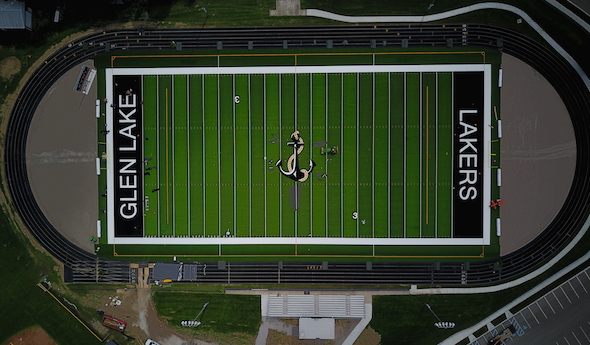
The two teams will not be playing in the sand tonight. They’ll be playing on Glen Lake’s new synthetic field, which workers put the finishing touches on to meet a down-to-the-wire deadline this week.
The field is the latest positive for the Glen Lake program.
The school board considered installing a new natural grass field, but opted for the artificial turf because of its “usability.”
“Once you accept the premise that the football field needed to be replaced, it wasn’t that much of a leap to go to artificial turf (over natural grass) given how much more we can use it,” superintendent Sander Scott said. “Usability – that was the determining factor.”
The field will be used by other sports teams as well as physical education classes.
“That’s the beauty of it,” athletic director Jennifer Johnston added. “Our entire student body and community can reap the benefits of having a field like that.”
 The school board approved spending nearly $850,000 on the surface, but Scott said “it’s looking like it’s going to come in well below that.”
Scott said officials put added emphasis on drainage, an issue that’s plagued Traverse City’s Thirlby Field.
“We’re aware of the challenges Thirlby Field has had (with its synthetic surface), so we really made sure we did not duplicate whatever mistake that was done there,” he said. “We probably overbuilt for drainage.”
The field is not the only new enhancement fans will notice tonight. Officials “beefed up” the wireless network at the field and brought back the berms on the home side for those who prefer lawn seating to bleachers.
The upgrades add to the momentum that’s building in the athletic program. Glen Lake was named the Traverse City Record-Eagle’s School of Year in 2016-17 after the football team reached the MHSAA Finals and the girls basketball team the Semifinals. In addition, Nichole Cox won a third consecutive individual MHSAA Finals golf championship.
“We’re on an upswing,” Angers said. “Everybody is upbeat.
“I know we savored it (last year’s football tournament run). Hopefully, it will fuel us this year – and in years to come.”
Johnston said her message to fall coaches was “keep doing what you’re doing because it’s working.”
“We have a vision and that’s to work hard to improve every day with pride, class and integrity,” she added.
It’s that motto that the school emphasized in ads that ran in the Record-Eagle fall sports tab and in the Leelanau Enterprise.
“We wanted to promote and brand our athletic department,” Johnston said.
Still, Johnston noted, the school has goals other than winning for its student athletes.
“We want to prepare our students to be successful in the real world and contribute to society in a positive way,” she said. “We have high expectations on the playing field, but it starts in the classroom.”
 Speaking of the classroom, Glen Lake is on a roll there, too. The school conducted a search this summer for two secondary math teachers with proven records of increasing student achievement. The school even offered a signing bonus. Forty-six teachers applied, compared to 14 for a similar position at another local high school.
Glen Lake ended up hiring two teachers with more than 20 years of experience.
“The one thing we do that distinguishes us from other schools,” Scott said, “is that we will give teachers credit for all their years. When I was part of other districts, the highest they typically go is six years. If you’re a teacher with 20-plus years, you’re not going to take a huge pay cut to move. We wanted to eliminate that (obstacle). We just posted an elementary opening and had 153 applicants.”
For Johnston, she had another reason to celebrate the 2016-17 sports season. Her father, Roy, who coaches basketball at Beaverton, became the state’s all-time winningest coach in that sport last winter.
“I was really excited for him,” she said. “He’s definitely stood the test of time. He’ll be the first to tell you that you’re not put in that position, to reach a milestone like that, without a lot of good players and without the support of a great community and school. To me, the entire Beaverton community earned that accolade.”
When Glen Lake was making its run to Ford Field last fall, Johnston was quick to mention to Angers that he should enjoy every minute of it.
“I said, ‘Jerry, you have to realize my dad’s been coaching 46 years and the furthest he’s made it is to the Semifinals,” she said. “You never know. (The Finals are) quite an accomplishment. Enjoy it to the fullest.”
One game into the new season, Angers already is raving about the support his team is receiving from the student body and community.
“The crowd we had at Kingsley was unbelievable,” he said. “And I expect it will continue to grow.”
Especially with St. Francis coming to town tonight.
 But for all the good cheer, Glen Lake is also without a familiar face this season. Paul Christiansen stepped down as girls golf coach after last season, ending a coaching career that started at the school in 1973.
“I texted him after our coaches meeting in August,” Johnston said. “I said, ‘It was sure weird not having you at that coaches meeting.’ He texted me back and said, ‘Trust me, it was sure weird not being there.’”
When Christiansen started in the fall of 1973, he was an assistant varsity football coach and boys JV basketball coach. By the next year, he had become the head football and boys varsity track coach, in addition to coaching JV basketball for his close friend Don Miller.
“After the second year, our superintendent said three (coaching jobs) is too many, especially with two as a head coach at the varsity level,” Christiansen recalled. “He said, ‘I don’t care which ones you do, but pick two. I think you’ll be better off.’”
Christiansen gave up football. But he later picked up a third sport again when he coached girls middle school basketball. He would end up coaching boys JV basketball for 25 years and boys and girls varsity track 20 years apiece. In all, he coached 92 sports seasons at Glen Lake.
“It’s an odd feeling after 44 years,” Christiansen said. “It’s like, ‘Whoa!’ But it was time to move on.”
Christiansen went out on a high note after Cox became just the third girl in MHSAA history to win three consecutive individual golf titles. She’s now at Bowling Green University.
“I didn’t script it that way, but if you were to script it, going out with an individual or team championship would be the way,” he said.
Glen Lake had just three golfers last season, not enough to compete as a team. The school dropped the sport this season.
“For Glen Lake to allow us to keep competing (last season), even though we didn’t have a full complement of players to count as a team score, I was really thankful for that,” Christiansen said. “And Nichole was especially thankful.”
Cox’s title was part of a “wave of success” that highlighted the last school year.
But this is a new year. New teams. New challenges.
Angers, for one, is hoping to keep that momentum rolling, although he lost some talented players to graduation, including eight defensive starters.
“The key is you want to retool (not rebuild) every year and I think that’s where we are right now with the program,” he said.
St. Francis will be a good test.
 Dennis Chase worked 32 years as a sportswriter at the Traverse City Record-Eagle, including as sports editor from 2000-14. He can be reached at [email protected] with story ideas for Manistee, Wexford, Missaukee, Roscommon, Ogemaw, Iosco, Alcona, Oscoda, Crawford, Kalkaska, Grand Traverse, Benzie, Leelanau, Antrim, Otsego, Montmorency, Alpena, Presque Isle, Cheboygan, Charlevoix and Emmet counties.
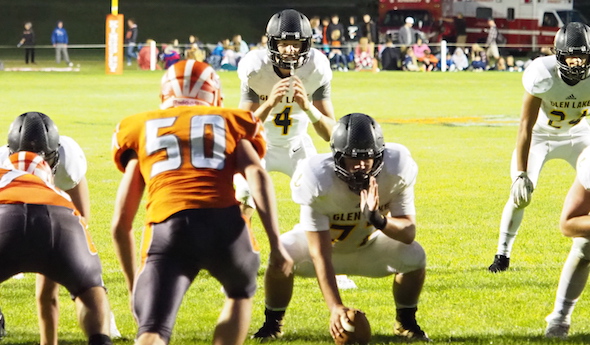
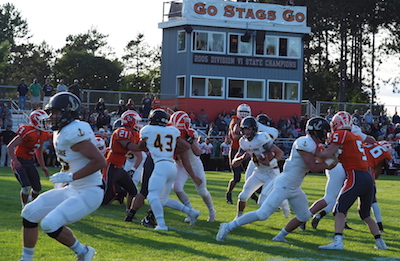
PHOTOS: (Top) Maple City Glen Lake quarterback Cade Peterson prepares to take a snap last season. (Middle top) A drone's view of the new artificial turf field at Glen Lake, set to debut Friday. (Middle below) Peterson breaks through a hole following a block by teammate Max Guilbeau (43). (Below) Recently retired coach Paul Christiansen. (Photos courtesy of Greg Guilbeau [action] Scott Jozwiak [drone] and Don Miller [Christiansen].)