

NFHS Voice: Find Answers at Youth Level
November 13, 2019
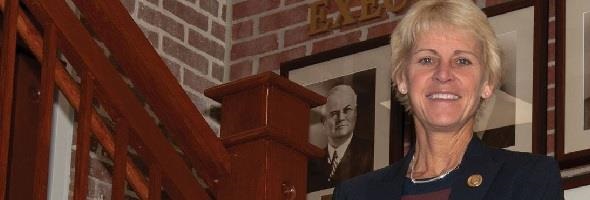
By Karissa Niehoff
NFHS Executive Director
Are there long-term solutions to increasing the number of participants in high school sports and improving parental behavior at high school contests? The answer to both questions might start at the youth sports level.
The NFHS hosted a first-ever meeting of about 25 leaders of National Governing Bodies and the U.S. Olympic & Paralympic Committee last week to discuss common concerns and opportunities to align and work together.
Within the youth areas of these organizations, the issues are familiar ones to high school leaders – decline in participation, parent behavior, coaches education and minimizing the injury risk. Clearly, however, reaching parents with appropriate educational messages on sportsmanship, injury risk and the values of participation is a top priority for leaders at all levels – youth, middle school and high school sports.
Recently, the NFHS formed a Middle School Committee in an effort to build interest in education-based sports at that level and to share the proper messages with parents before their kids reach high school. However, as we learned last week, middle school may even be too late!
Those educational messages will be enhanced if the process starts in out-of-school youth sports. If messages about the values of multi-sport participation, playing for the love of the game, and limiting contact in sports like football are consistently shared and demonstrated at the youth level, the education-based concept should be firmly in place by the time students reach high school.
Coaches education is another common concern. While the NFHS has created an outstanding online education program for interscholastic coaches through the NFHS Learning Center (www.NFHSLearn.com), there is no standard requirement to coach at the youth level. There should be some type of required certification for anyone to walk onto a field or court to coach. And while knowledge about teaching the proper tackling form in football or the proper defensive positioning in basketball is important, those are not the most important prerequisites for coaching.
Similar to the NFHS’ online Fundamentals of Coaching course, youth coaches should be required to take courses that help them learn how to coach the kids more so than the sport. And since many of the coaches at this level are parents of players on the team, these individuals – and all youth parents – should be presented materials similar to what is presented at preseason meetings at the high school level. This would include, among other things, the non-negotiable requirement to positively support their child while letting the coaches coach, and the officials officiate.
Lofty goals, for sure, without a collective governing organization over youth sports. However, these concepts can be endorsed and promoted within the youth areas of sport-specific NGBs. These fundamentals of education-based athletics are essential for the 2-3 percent who play sports beyond high school as well as the majority who apply the values learned in high school sports in their chosen careers.
The skills will eventually fade – even for those individuals who play sports beyond high school – but the values learned from playing sports, beginning at the youth sports level, will last a lifetime.
Dr. Karissa L. Niehoff is in her second year as executive director of the National Federation of State High School Associations (NFHS) in Indianapolis, Indiana. She is the first female to head the national leadership organization for high school athletics and performing arts activities and the sixth full-time executive director of the NFHS, which celebrated its 100th year of service during the 2018-19 school year. She previously was executive director of the Connecticut Association of Schools-Connecticut Interscholastic Athletic Conference for seven years.
Armada's Fredette Receives NFHS Honor
January 16, 2020
By Geoff Kimmerly
Second Half editor
Longtime Armada tennis coach David Fredette has been named one of 23 National Coaches of the Year for 2018-19 by the National Federation of State High School Associations (NHFS) Coaches Association.
Fredette was selected first at the state level and then from among the eight sections that make up the NFHS – Michigan is part of Section 4 with Illinois, Indiana, Iowa and Wisconsin.
The following brief bio includes an excerpt from Fredette’s coaching philosophy, which nominees were asked to submit after being identified as candidates for the awards.
 David Fredette began Armada’s tennis program in 1966 and coached the boys team through the 2018 season. He led more than half his teams over the years to the MHSAA Finals, and 17 to top-10 finishes at the championship meet – including four straight from 2009-12. He also was a major contributor during the early days of the Michigan High School Tennis Coaches Association, and began serving on its board in 1982. Four times he was selected MHSTeCA state Coach of the Year: in Class C-D in 1982, Class B in 1992, and as one of two selections in Division 4 in both 1998 and 2018. Fredette was inducted into the MHSTeCA Hall of Fame in 1988. Armada’s tennis courts are named for him.
Fredette played tennis at Dowagiac High School and then Benton Harbor Community College. He also coached basketball and football during his time at Armada.
“Athletics give students a chance to become student-athletes, which means athletics teach athletes discipline, a strong work ethic, and cooperation with others. Athletics teach athletes how to not only compete, but how to handle both winning and losing. … I know that students who play sports upon graduation are more prepared to face the challenges that life presents them. While I always expected my players to work hard, I wanted my athletes to enjoy the experiences on and off the courts. My former players tell me how much they enjoyed competing, but also how much fun they had on the trips we went on together, whether it was to play top competition across the state of Michigan or on the Florida trips I took my boys teams on over Easter vacation from 1989 through 2001 to practice and bond as a team. Athletes learn how to compete, but they also gain friendships that last a lifetime, if only in their memories.”
Four more Michigan coaches earned honors in Section 4. Brighton girls swimming & diving coach Jason Black led the Bulldogs to a Lower Peninsula Division 1 Finals runner-up finish in Fall 2018, its best placing in program history. Dexter boys swimming & diving coach Michael McHugh was selected for the second-straight year as a Section 4 winner after leading his team to its fourth-straight Lower Peninsula Division 2 championship last winter. Battle Creek St. Philip volleyball coach Vicky Groat at one point guided the Tigers to nine Class D championships in 10 seasons from 2005-14 and is the sixth-winningest coach in MHSAA volleyball history with a record of 1,154-262-93. Bloomfield Hills Academy of the Sacred Heart co-coach Judy Hehs helped lead that program to its second-straight Lower Peninsula Division 4 championship this past fall, its sixth title in eight seasons, in her final tournament before retirement. She previously was named NFHS Coaches Association National Coach of the Year for girls tennis in 2016.
The NFHS has been recognizing coaches through an awards program since 1982. Winners of NFHS awards must be active coaches during the year for which they receive their award.