


NFHS Voice: Find Answers at Youth Level
November 13, 2019
By Karissa Niehoff
NFHS Executive Director
Are there long-term solutions to increasing the number of participants in high school sports and improving parental behavior at high school contests? The answer to both questions might start at the youth sports level.
The NFHS hosted a first-ever meeting of about 25 leaders of National Governing Bodies and the U.S. Olympic & Paralympic Committee last week to discuss common concerns and opportunities to align and work together.
Within the youth areas of these organizations, the issues are familiar ones to high school leaders – decline in participation, parent behavior, coaches education and minimizing the injury risk. Clearly, however, reaching parents with appropriate educational messages on sportsmanship, injury risk and the values of participation is a top priority for leaders at all levels – youth, middle school and high school sports.
Recently, the NFHS formed a Middle School Committee in an effort to build interest in education-based sports at that level and to share the proper messages with parents before their kids reach high school. However, as we learned last week, middle school may even be too late!
Those educational messages will be enhanced if the process starts in out-of-school youth sports. If messages about the values of multi-sport participation, playing for the love of the game, and limiting contact in sports like football are consistently shared and demonstrated at the youth level, the education-based concept should be firmly in place by the time students reach high school.
Coaches education is another common concern. While the NFHS has created an outstanding online education program for interscholastic coaches through the NFHS Learning Center (www.NFHSLearn.com), there is no standard requirement to coach at the youth level. There should be some type of required certification for anyone to walk onto a field or court to coach. And while knowledge about teaching the proper tackling form in football or the proper defensive positioning in basketball is important, those are not the most important prerequisites for coaching.
Similar to the NFHS’ online Fundamentals of Coaching course, youth coaches should be required to take courses that help them learn how to coach the kids more so than the sport. And since many of the coaches at this level are parents of players on the team, these individuals – and all youth parents – should be presented materials similar to what is presented at preseason meetings at the high school level. This would include, among other things, the non-negotiable requirement to positively support their child while letting the coaches coach, and the officials officiate.
Lofty goals, for sure, without a collective governing organization over youth sports. However, these concepts can be endorsed and promoted within the youth areas of sport-specific NGBs. These fundamentals of education-based athletics are essential for the 2-3 percent who play sports beyond high school as well as the majority who apply the values learned in high school sports in their chosen careers.
The skills will eventually fade – even for those individuals who play sports beyond high school – but the values learned from playing sports, beginning at the youth sports level, will last a lifetime.
Dr. Karissa L. Niehoff is in her second year as executive director of the National Federation of State High School Associations (NFHS) in Indianapolis, Indiana. She is the first female to head the national leadership organization for high school athletics and performing arts activities and the sixth full-time executive director of the NFHS, which celebrated its 100th year of service during the 2018-19 school year. She previously was executive director of the Connecticut Association of Schools-Connecticut Interscholastic Athletic Conference for seven years.
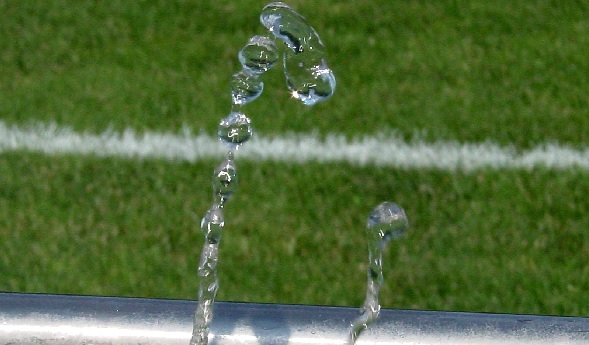
Athletes: Prepare to Beat the Heat
August 4, 2014
By Geoff Kimmerly
Second Half editor
Despite unseasonably cool temperatures this summer in Michigan, high school athletes should prepare for the heat that usually accompanies August and the beginning of Michigan High School Athletic Association fall practices as they kick off next week.
Each year, the MHSAA provides information to its member schools to help them prepare for hot weather practice and game conditions in the late summer and early fall. Football practice can begin August 11, followed by first practices for all other fall sports August 13.
The topic of heat-related injuries receives a lot of attention at this time of year, especially when deaths at the professional, collegiate and interscholastic levels of sport occur, and especially since they are preventable in most cases with the proper precautions. In football, data from the National Federation of State High School Associations shows that nationally 41 high school players died from heat stroke between 1995 and 2013.
Many MHSAA schools this fall are expected to again follow the MHSAA’s Model Policy for Managing Heat & Humidity that directs schools to monitor heat index prior to and during activity and recommends actions based on those readings.
Also this school year, for the first time, the MHSAA is requiring all assistant and subvarsity coaches at the high school level to complete the same rules and risk minimization meeting requirement as high school varsity head coaches, or, in the alternative, one of several online courses designated for this purpose on MHSAA.com.
“It’s not an accident that causes severe heat illness and death. It’s a lack of attention to what should’ve been taking place, a lack of preparation,” said John E. “Jack” Roberts, executive director of the MHSAA. “We’re trying to communicate to our constituents that if we make the precautions that we should, plan as we should, we will have none of these tragedies in school sports.”
The MHSAA Representative Council adopted in 2013 the Model Policy for Managing Heat & Humidity that, while not mandated for member schools, has been adopted by many at the local level. The plan directs schools to begin monitoring the heat index at the activity site once the air temperature reaches 80 degrees and provides recommendations when the heat index reaches certain points, including ceasing activities when it rises above 104 degrees.
The model policy is outlined in a number of places, including the publication Heat Ways, which is available for download from the MHSAA Website. Heat Ways not only provides the model policy, but addresses the need for proper acclimatization in hot weather.
Heat, hydration and acclimatization also are again focuses of the MHSAA’s required preseason rules meetings for coaches and officials. The online presentation discusses the need for good hydration in sports, regardless of the activity or time of year.
The Health & Safety Resources page of the MHSAA Website has a number of links to different publications and information and a free online presentation from the National Federation of State High School Associations. Visit MHSAA.com, click on “Schools” and then on “Health & Safety Resources” to find the information.
Roberts said the first days of formal practices in hot weather should be more for heat acclimatization than the conditioning of athletes, and that practices in such conditions need planning to become longer and more strenuous over a gradual progression of time.
He added schools also must consider moving practices to different times of day, different locations, or change practice plans to include different activities depending on the conditions.
“I think all schools need to prepare themselves in these ways,” Roberts said. “They need to educate participants, parents and coaches about proper hydration and the dangers of practicing and competing when the heat and humidity are too high.”