


Sorting It Out
February 4, 2014
The MHSAA has a good relationship with the high school coaches associations of Michigan in spite of the fact that the MHSAA sometimes befuddles and frustrates some associations’ leaders and members. This occurs, for example, when a coaches association’s board of directors votes unanimously in support of a change in policy or procedure which fails to be adopted by the MHSAA Representative Council. Every so often over the past 25 years, I’ve had to provide reminders of why this occurs – in fact, why it must occur.
First, a coaches association is just that – an association of coaches; and coaches are but one of the many important voices to whom the MHSAA pays regular attention. The MHSAA also must hear the opinions of athletic directors, principals, superintendents, boards of education, contest officials and others. Typically, coaches desire more of everything: contests, classifications, trophies and medals. Just as predictably, most administrators seek reasonable limits on such things and can often be heard to say, “Enough is enough.”
Second, the makeup of many of our state’s high school coaches associations’ boards of directors, and even the associations’ members, do not reflect the MHSAA’s full membership. Understandably, many coaches associations’ board members are disproportionately from large schools in the southern or even southeastern part of Michigan.
And third, by their nature, coaches associations advance proposals for a single sport, which could impact other sports positively or negatively. There is no question that if one sport “gets” something, like another tournament classification or division, other sports will seek the same consideration which may or may not be practical for or beneficial to other sports.
When considering a proposal from a coaches association, MHSAA Representative Council members will almost always ask themselves: “Who’s not in the room? Who are we not hearing from? Is there another side of the issue? How does this play out among small schools, or urban schools, or northern schools? How will this affect other sports?”
We look to coaches associations for sport-specific advice; and we urge them to seek input from a constituency that is as large and diverse as possible. We look to other stakeholders to add their advice and counsel to the process; and we depend on the Representative Council to sort it out and seek the proper balance.
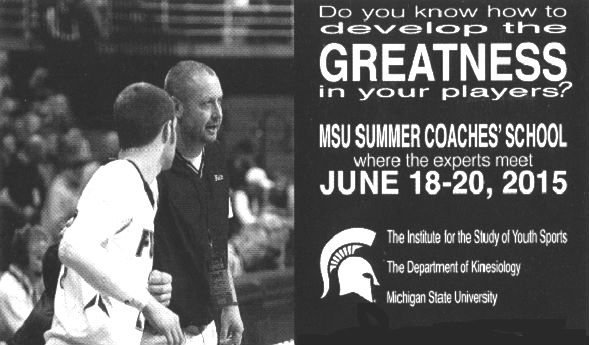
MSU to Host Inagurual Coaches School
May 27, 2015
By Geoff Kimmerly
Second Half editor
The Michigan State University Department of Kinesiology and the Institute for the Study of Youth Sports are inviting coaches and sport leaders to their inaugural MSU Summer Coaches’ School, to be conducted June 18-20.
Coaches and sport leaders will gain knowledge, build networks, and learn experientially through hands-on lessons outside the classroom. Subjects include:
- Program-Building
- Culture Change
- Team Chemistry
- Nutrition
- Concussions
- Training
- Parental Relations
- Performing Under Pressure
Sessions begin at 9 a.m. June 18, 8:30 on June 19 and run 8 a.m. – 12:30 p.m. on June 20. Packages are available for single days, conferences-only or all-inclusive with meals and lodging for those traveling from abroad.
For details or to register, click summercoach.msu.edu or contact Dr. Andy Driska (event coordinator) at [email protected] or (517) 432-8399.
The MSU Department of Kinesiology and the Institute for the Study of Youth Sports share a long history of scientifically studying the benefits and detriments of sport participation for young people, along with outreach to help coaches and sport leaders use scientific information in their day-to-day practice. The Institute is a major contributor to MHSAA leadership and student services efforts including Captains Clinics and Sportsmanship Summits.