


Teaching ABC's of Pressure Situations
October 30, 2013
 By Eric Martin
MSU Institute for the Study of Youth Sports
Coaches have seen the signs: Athletes having too much or not enough energy prior to a game, quickening breathing, sweating more than usual, being unable to focus on important details, and having their minds wander from the present to “what if” scenarios and past mistakes.
Athletes deal with pressure in many ways. Although some handle it well, many do not have the tools to perform to their full abilities in these situations. Most athletes place a high importance on succeeding in sport, and when athletes reach regional, district, or state championships, the pressure they feel may become overwhelming.
How athletes handle this increased pressure can often mean the difference between winning and losing. Therefore, helping athletes deal with it is something coaches should consider prior to athletes encountering these high-stakes situations.
Unfortunately, there is no magic elixir for helping your athletes work under pressure. But if these ABC’s of pressure situations are followed, your athletes will be much better equipped to cope, and the chances of their performance levels dropping significantly will be reduced.
1. Act the Part
How you as coaches act influences your athletes. For better or worse, athletes notice your emotions in response to these situations and take cues from how you handle pressure.
You are a demand on your players’ attention – you can add or reduce your players’ perceived stress by how you act. Understanding the demand you place on players requires self-awareness. How do you respond when a key call goes against you? Do you have nervous habits that athletes may notice? What messages are you providing to your athletes – both verbally and non-verbally? Athletes pick up on these non-verbal cues, so you must be aware of how you respond to these situations.
It is important to remember emotions are not always negative – rather acting differently than normal can be a signal to your athletes that you are stressed. Strive to be consistent in your actions – whether you are coaching during a preseason match or championship contest. These situations are stressful for you too, but you need to be the constant your athletes look to for stability.
2. Breathing – Remember to do it
It seems like a simple thing, but when athletes’ emotions are running high, they forget how to breathe – or, at least, forget how to breathe properly. Worse, they often think they are breathing normally but don’t notice breaths are becoming shorter and shallower. Teaching athletes to breathe properly when not in pressure situations will help them have the tools to rely on when they encounter more intense scenarios.
For proper breathing, athletes need to do so from the belly and not the chest. The pace of this breathing should be 6-2-7; that is, have athletes take a deep breath from the abdomen for six seconds, hold for two seconds, and then finally slowly exhale completely for seven seconds. This breathing strategy is ideal for pregame situations to quiet nerves and help athletes get ready to play, but a condensed version (3-2-3) can also be used for quick breaks in the action like a timeout or court change.
3. Control the controllables
During times of high pressure, athletes sometimes feel they do not have control over their own performances. It is important to help athletes focus on things they can control and not worry about those that cannot be changed or are outside their influence.
Instead of athletes dwelling on aspects that are out of their control like unusual game times for championship finals or a referee’s bad call, help them focus on completing their warm-up preparations and how they can respond to poor calls. Helping focus athletes’ attention on things they can control will help them better handle pressure situations and leave them feeling less helpless
Athletes’ emotions are typically out of their control, but how they view them and respond to these emotions are under their control. Author and preacher Charles R. Swindoll said, “Life is 10 percent what happens to you and 90 percent how you react to it!” Be sure your athletes know how to respond when difficult situations arise.
Conclusion: Fearlessness is an assembly
Not all athletes react to pressure situations in the same manner, but all athletes can benefit from these simple suggestions. Remember to ACT THE PART of how you want your athletes to act, teach your athletes proper BREATHING techniques, and help athletes focus on CONTROLLING THE CONTROLLABLES.
Good preparation is the key to performance. Increase self-monitoring and give athletes the tools to succeed in pressure situations; they, in turn, can be in a better position to succeed. However, like any skills, they must be practiced accordingly, and one session will not solve all issues. Devote the time to train athletes in these skills, and when the need arises they will have them ready to use.
Good luck this season!
Martin is a third-year doctoral student in the Institute for the Study of Youth Sports at Michigan State University. His research interests include athlete motivation and development of passion in youth, sport specialization, and coaches’ perspectives on working with the millennial athlete. He has led many sessions of the MHSAA Captains Leadership Clinic and consulted with junior high, high school, and collegiate athletes. If you have questions or comments, contact him at [email protected].
Hackett Mentor's Care Sparked Lifetime in Hoops for BCAM President White
By
Pam Shebest
Special for MHSAA.com
July 24, 2026
KALAMAZOO — When Kevin White counsels an unruly student, he usually understands what’s going on.
 At one time, he was that student.
For the dean of students at Kalamazoo Hackett Catholic Prep, White’s life has come full circle.
He thrived while attending St. Monica Elementary School as a child, but after his father Damon passed away in 1989, the family moved to Portage and he changed schools.
“Eighth and ninth grades there was a change in behavior and grade point average,” White said. “Right about Christmas break, I had three gentlemen in my living room.
“Mike Smith, Shawn Potts and Nib Reisterer were having a conversation with my mom. They were worried about the direction I was headed and I think somehow those three came up with a plan to get me back (to Hackett).
He soon realized he needed the structure, discipline and smaller class sizes available there. But the worst part of transferring to Hackett was that he had to sit out the upcoming basketball season.
“I was not allowed to play right away because they decided my grades weren’t good enough to play, only to practice,” he recalled. “To sit on the bench as a high school kid with a bad GPA, and (bad attitude), it was like when I was little. If I wanted to do things, I had to do them the right way.”
At Hackett, he was reunited with Reisterer, his mentor who put him through some tough workouts.
“They were some of the hardest workouts I ever had because I had to go back to changing some bad habits, which changed pretty quickly,” White said.
He also had to face the players he idolized as a child when they asked why he wasn’t playing.
“That’s when I knew I had to kick it into gear because I didn’t want to let those guys down,” White said. “They said, ‘You wanted to wear that jersey since you were in fifth grade.’ My mom says peer pressure is the best pressure.”
Learning from the best
White first encountered Reisterer, who changed his life, during elementary school.
After losing his father, White would have to remain at school until his mother, Sheila, who was a police officer, picked him up.
“This gym teacher was, ‘Hey, do you want to hang out in the gym?’ Then he said he had basketball practice at 5 and did I want to come with him to practice? And he’s been stuck with me ever since,” White recalled. “It turned into ‘can I come to practice’ to ‘can I go to a couple games?’ Then I got to ride the bus. Then the Reisterer vacations at the lake became ‘Kevin’s coming too.’ There was a time when the Reisterers became my extended family, and within that came a basketball family.”
Reisterer, who was physical education teacher at St. Monica, said he knew White’s situation and wanted to help.
“My son Ryan was only a couple years younger than Kevin,” he said. “Ryan just adored him, and Kevin became my second son.”
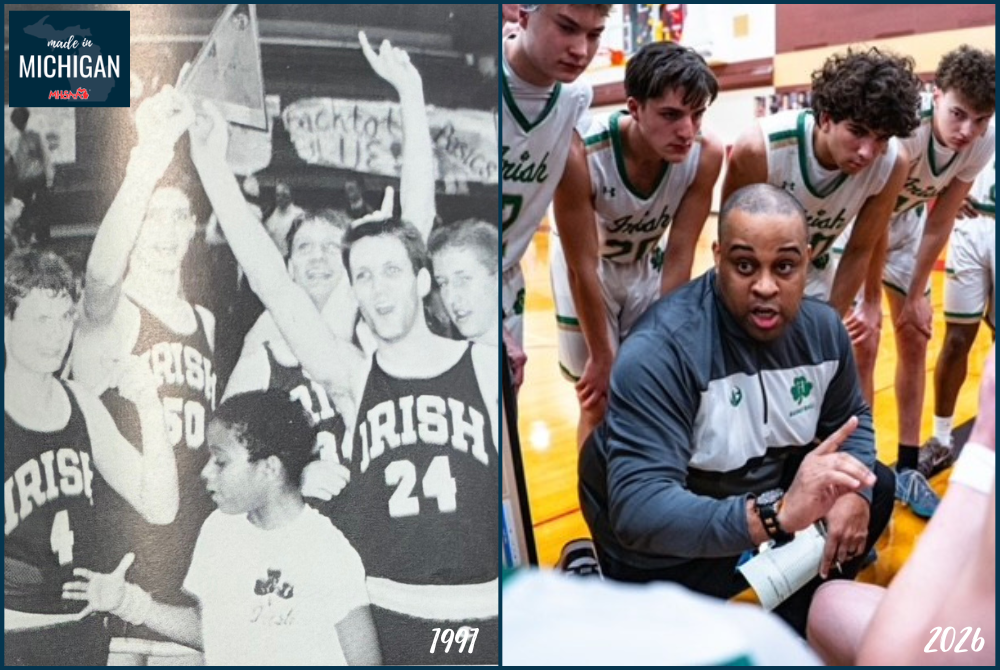
 Reisterer, who was also Hackett’s head boys basketball coach, noted, “Kevin became my ball boy. He came to every practice and did all the drills with the kids. He led the team in warmups before the game and became quite a celebrity himself.”
The highlight of his younger years was riding the bus with the Irish players, White said.
“Doing my third-grade homework with them showing me how to do the math problems and arguing about giving me the answers or not giving me the answers,” White laughed.
“The reward was, if you behaved in school you got to go to the games. So it was real easy to behave because I wanted to hang out with the high school guys and be on the bench.”
That sparked his love of basketball.
White graduated from Hackett in 1998 and then played at Glen Oaks Community College. With thoughts of prolonging his career in basketball after college – he went on to graduate from Western Michigan University – White remembered words he heard in passing.
“The guy said, ‘You might be able to play for a long time, but you’ll coach a lot longer than you’ll play if you start coaching right away,’” White said. “As a young guy, you hear it but you don’t think about it.
“Then you get into coaching and start working camps and going to the Final Fours and start networking. I like playing, but I love teaching the game. It’s been fun doing it that way.”
Reisterer said White wasn’t going to “set the world on fire” as a basketball player, but he worked his way through the coaching ranks, from instructing young kids and contributing at summer camps to filling roles at the high school and college levels, learning at each stop.
“He has quite a network of coaches and a lot of experience,” Reisterer added.
Prioritizing family life
As an assistant coach at Kalamazoo College, White met athletic trainer Kathleen O’Farrell and was immediately smitten. He credits her with making him more detailed and organized.
They eventually married and have two children – Vincent, 7, and Riley, 3.
“Vincent is at the age where he wants to come to practice with dad,” White said. “People ask if he’s going to play basketball.
“Right now he loves to swim, loves to play soccer. I love that because I can just sit there and be Dad.”
Vincent not only goes to practice with his dad, but has his own whistle, his own spot in the locker room and his own practice plan.
“He’s in charge of the clock,” White added. “I make him sweep the floor because I had to sweep the floor when I was young. If he decides to coach, I wouldn’t be upset.”
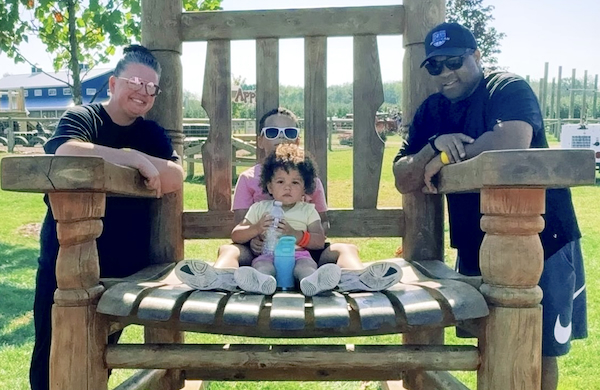 White called his daughter a “mini-me.”
“She will say hello to anyone,” he said. “She’s got confidence, she will speak up. If she doesn’t like something, she will tell you.”
White honed his coaching skills as an assistant to several college and high school coaches, including at Hackett last season, and discovered that working at the same school where he coaches is special.
“I will tell any young coach, if you can get a high school job in today’s age and work in the school, that’s a win-win,” White noted. “The relationship with players is an advantage of working in the school because you’re with them during the day and after school, a lot of times more than they’re with their parents.”
White is running the summer basketball program at Hackett, but that’s not all the gregarious coach is doing.
As the current president of the Basketball Coaches Association of Michigan (BCAM), “We run an event called Reaching Higher,” he said. “High school teams are selected from all over the state and they come for two days to play at Grand Valley University.
“It’s open to college coaches all over the country to watch the top high school players from the state.”
He was also involved in Midwest Live where 20-40 Michigan teams compete against teams from Ohio, West Virginia and Pennsylvania at Cedar Point.
But next month, White will be back at Hackett, working to keep students on task.
“I see a lot of my classmates and myself in students today,” White said. “Yes, times have changed, but kids still want to be taken care of and want to be treated well and have support. Yes, some discipline comes with my job, but it’s also built on relationship and trust.
“I want (alumni) to come back and tell current kids that yes, Mr. White was hard on me about x, y and z, but when I needed something, he was there for me and if I didn’t follow through, he made sure I did.”
2026 Made In Michigan
July 24: Mackey Leaving Court with 500+ College Hoops Wins, Many More Lessons Shared - Report
July 16: Country Day Two-Time Champ Moore Building Perennial Winner at Harvard - Report
July 9: Multi-Sport Career at TC West Helps Gillis Thrive as Pro in Game She Once Left Behind - Report
July 2: Inspired by Home, Eager to Give Back, Spencer Hosts Hoop City Alumni Games - Report
PHOTOS (Top) At left, fifth-grader Kevin White celebrates with the Hackett boys basketball team in 1991. At right, White huddles with his players this past season while serving as an assistant with the Irish varsity. (Middle) White stands for a photo with BCAM Executive Director Dan Young. (Below) White poses with wife Kathleen and children Vincent and Riley. (Photos provided by Kevin White.)