


Teaching ABC's of Pressure Situations
October 30, 2013
 By Eric Martin
MSU Institute for the Study of Youth Sports
Coaches have seen the signs: Athletes having too much or not enough energy prior to a game, quickening breathing, sweating more than usual, being unable to focus on important details, and having their minds wander from the present to “what if” scenarios and past mistakes.
Athletes deal with pressure in many ways. Although some handle it well, many do not have the tools to perform to their full abilities in these situations. Most athletes place a high importance on succeeding in sport, and when athletes reach regional, district, or state championships, the pressure they feel may become overwhelming.
How athletes handle this increased pressure can often mean the difference between winning and losing. Therefore, helping athletes deal with it is something coaches should consider prior to athletes encountering these high-stakes situations.
Unfortunately, there is no magic elixir for helping your athletes work under pressure. But if these ABC’s of pressure situations are followed, your athletes will be much better equipped to cope, and the chances of their performance levels dropping significantly will be reduced.
1. Act the Part
How you as coaches act influences your athletes. For better or worse, athletes notice your emotions in response to these situations and take cues from how you handle pressure.
You are a demand on your players’ attention – you can add or reduce your players’ perceived stress by how you act. Understanding the demand you place on players requires self-awareness. How do you respond when a key call goes against you? Do you have nervous habits that athletes may notice? What messages are you providing to your athletes – both verbally and non-verbally? Athletes pick up on these non-verbal cues, so you must be aware of how you respond to these situations.
It is important to remember emotions are not always negative – rather acting differently than normal can be a signal to your athletes that you are stressed. Strive to be consistent in your actions – whether you are coaching during a preseason match or championship contest. These situations are stressful for you too, but you need to be the constant your athletes look to for stability.
2. Breathing – Remember to do it
It seems like a simple thing, but when athletes’ emotions are running high, they forget how to breathe – or, at least, forget how to breathe properly. Worse, they often think they are breathing normally but don’t notice breaths are becoming shorter and shallower. Teaching athletes to breathe properly when not in pressure situations will help them have the tools to rely on when they encounter more intense scenarios.
For proper breathing, athletes need to do so from the belly and not the chest. The pace of this breathing should be 6-2-7; that is, have athletes take a deep breath from the abdomen for six seconds, hold for two seconds, and then finally slowly exhale completely for seven seconds. This breathing strategy is ideal for pregame situations to quiet nerves and help athletes get ready to play, but a condensed version (3-2-3) can also be used for quick breaks in the action like a timeout or court change.
3. Control the controllables
During times of high pressure, athletes sometimes feel they do not have control over their own performances. It is important to help athletes focus on things they can control and not worry about those that cannot be changed or are outside their influence.
Instead of athletes dwelling on aspects that are out of their control like unusual game times for championship finals or a referee’s bad call, help them focus on completing their warm-up preparations and how they can respond to poor calls. Helping focus athletes’ attention on things they can control will help them better handle pressure situations and leave them feeling less helpless
Athletes’ emotions are typically out of their control, but how they view them and respond to these emotions are under their control. Author and preacher Charles R. Swindoll said, “Life is 10 percent what happens to you and 90 percent how you react to it!” Be sure your athletes know how to respond when difficult situations arise.
Conclusion: Fearlessness is an assembly
Not all athletes react to pressure situations in the same manner, but all athletes can benefit from these simple suggestions. Remember to ACT THE PART of how you want your athletes to act, teach your athletes proper BREATHING techniques, and help athletes focus on CONTROLLING THE CONTROLLABLES.
Good preparation is the key to performance. Increase self-monitoring and give athletes the tools to succeed in pressure situations; they, in turn, can be in a better position to succeed. However, like any skills, they must be practiced accordingly, and one session will not solve all issues. Devote the time to train athletes in these skills, and when the need arises they will have them ready to use.
Good luck this season!
Martin is a third-year doctoral student in the Institute for the Study of Youth Sports at Michigan State University. His research interests include athlete motivation and development of passion in youth, sport specialization, and coaches’ perspectives on working with the millennial athlete. He has led many sessions of the MHSAA Captains Leadership Clinic and consulted with junior high, high school, and collegiate athletes. If you have questions or comments, contact him at [email protected].
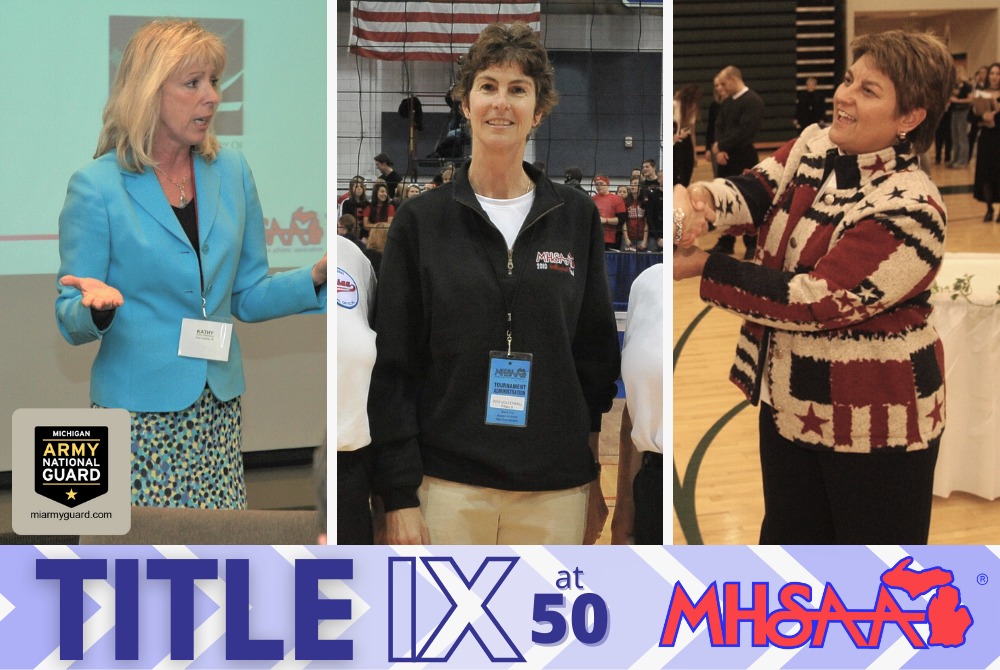
Title IX at 50: Assistant Directors Have Been Difference Makers
By
Geoff Kimmerly
MHSAA.com senior editor
June 21, 2022
The MHSAA has been fortunate to follow leadership from a number of impactful women over the last 50 years. Many have been members of the Representative Council, or various sport committees and task forces asked to address specific issues in educational athletics.
But day in, day out, and often behind the scenes where most administration is done, three longtime MHSAA assistant directors have provided leadership and advocacy for females in athletics that continues to be transformative in our state, even after two have retired.
► Suzanne Martin joined the MHSAA staff in 1977 and created a pair of programs that have helped make Michigan a national leader in girls high school athletics. A former teacher, coach and cheerleading advisor at Mt. Morris High School, Martin directed the launch of competitive cheer as an MHSAA-sponsored sport with its first championships awarded during the 1993-94 school year. Over the last decade, an average of 6,800 athletes have participated in that sport annually. Also under Martin’s direction, the MHSAA’s Women In Sports Leadership Conference made its debut in 1989, and with attendance of upwards of 500 students, the every-other-year event remains the largest and longest-running conference promoting the roles of females in interscholastic athletics – not only as athletes, but as future administrators, coaches and officials. Martin administrated a number of other sports for the MHSAA and served on several National Federation of State High School Associations (NFHS) committees. Martin retired in December 2002.
► Gina Mazzolini came to the MHSAA in 1993 from the University Interscholastic League in Texas, where she served 11 years including five as an assistant director for the service organization to high school activities in that state. Mazzolini spent the majority of her MHSAA career as the administrator for girls volleyball, swimming & diving, alpine skiing and tennis and as the point person for foreign exchange and international student issues while also handling sanctioning of out-of-state competitions that included MHSAA member schools. She had a significant presence on the national level as well, serving on various NFHS rules and advisory committees, including as the chairperson of the volleyball rules committee. Mazzolini received a Citation from the NFHS in 2016, and also that year became the first woman to receive the MHSAA’s Charles E. Forsythe Award, which recognizes outstanding contributions to the interscholastic athletics community. She retired at the end of that July.
► Kathy Vruggink Westdorp came to the MHSAA as an assistant director during the 2003-04 school year after more than two decades serving as a teacher, coach and administrator in Grand Rapids-area schools. Westdorp received an NFHS Citation in 2021, and was named NFHS Coach Educator of the Year in 2015 for her work directing the MHSAA Coaches Advancement Program, an eight-level education program that has seen more than 16,000 coaches complete the first-level unit alone. Westdorp also guided the addition of girls lacrosse as an MHSAA-sponsored sport in 2005 and remains its administrator – and she has served as the NFHS Education Committee and Girls Lacrosse Rules Committee chairpersons among other national roles. She also serves as the MHSAA’s lead administrator of competitive cheer and gymnastics. Under her leadership, the WISL Conference has continued to thrive welcoming and training high school female student leaders from all over the state, and the Competitive Cheer Finals have ranked among the most highly-attended championship events offered by the MHSAA.
Second Half's weekly Title IX Celebration posts are sponsored by Michigan Army National Guard.
Previous Title IX at 50 Spotlights
June 14: Girls Lacrosse Finals Officials Set Empowering Example - Read
June 7: From Gymnastics to Wrestling, Girls Opportunities Continue to Grow - Read
May 31: Mumford Sprinter's Magnificent 2006 Final Remains Unmatched - Read
May 24: Scane, Whiteside Alone on 400-Goal, 500-Point Girls Lacrosse Lists - Read
May 17: Over 8 Days in 1988, Pair of Champs Set No. 1 Singles Standard - Read
May 10: Portage Central's Tarpley Scores as State's Superstar, U.S. Soccer Hero - Read
May 3: Prychitko 'Legend In Her Own Time,' Legend for All Time - Read
April 26: Braddock vs. Verdun Still Striding Among All-Time Sprint Matchups - Read
April 19: Holmes' Strikeout Record Rarely Approached, May Be Unbreakable - Read
April 12: Anticipation High as 45,000 Girls Return to Spring Sports - Read
April 5: Regina's Laffey Retiring as Definition of Legendary - Read
March 29: Edison's Whitehorn named 2022 Miss Basketball - Read
March 22: Carney-Nadeau Sets Girls Hoops Standard with 78-Win Streak - Read
March 15: Binder Among Voices Telling Our Story on MHSAA Network - Read
March 8: 28 Years, Thousands of Cheers - Read
March 1: Kearsley Rolls On Among Girls Bowling's Early Successes - Read
Feb. 22: Marquette Ties Record for Swim & Dive Finals Success - Read
Feb. 15: Jaeger's 2004 Winter Run Created Lasting Connection - Read
Feb. 8: Marian's Cicerone to Finish Among All-Time Elite - Read
Feb. 1: WISL Award Honors Builders of State's Girls Sports Tradition - Read
Jan. 25: Decades Later, Edwards' Legend Continues to Grow - Read
Jan. 18: Iron Mountain Completes Championship Climb - Read
Jan. 11: Harrold's Achievement Heralds Growth of Girls Wrestling - Read
Dec. 20: Competitive Cheer Gives Michigan Plenty to Cheer About - Read
Dec. 14: Evelyn's Game Had Plenty of Magic - Read
Dec. 7: Council Term Ends, But Leinaar Leaves Lasting Impact - Read
Nov. 30: Basketball Season Ready to Add to Rich Tradition - Read
Nov. 23: Marysville Builds Winning Streak Yet to be Challenged - Read
Nov. 16: Wroubel Has Championed Girls School Sports from Their Start - Read
Nov. 9: Pioneer's Joyce Legendary in Michigan, National Swim History - Read
Nov. 2: Royal Oak's Finch Leading Way on Football Field - Read
Oct. 26: Coach Clegg Sets Championship Standard at Grand Blanc - Read
Oct. 19: Rockford Girls Set Pace, Hundreds After Have Continued to Chase - Read
Oct. 12: Bedford Volleyball Pioneer Continues Blazing Record-Setting Trail - Read
Oct. 5: Warner Paved Way to Legend Status with Record Rounds - Read
Sept. 28: Taylor Kennedy Gymnasts Earn Fame as 1st Champions - Read
Sept. 21: Portage Northern Star Byington Becomes Play-by-Play Pioneer - Read
Sept. 14: Guerra/Groat Legacy Continues to Serve St. Philip Well - Read
Sept. 7: Best-Ever Conversation Must Include Leland's Glass - Read
Aug. 31: We Will Celebrate Many Who Paved the Way - Read
PHOTO From left, Kathy Vruggink Westdorp, Gina Mazzolini and Suzanne Martin (MHSAA file photos.)