


Teaching ABC's of Pressure Situations
October 30, 2013
 By Eric Martin
MSU Institute for the Study of Youth Sports
Coaches have seen the signs: Athletes having too much or not enough energy prior to a game, quickening breathing, sweating more than usual, being unable to focus on important details, and having their minds wander from the present to “what if” scenarios and past mistakes.
Athletes deal with pressure in many ways. Although some handle it well, many do not have the tools to perform to their full abilities in these situations. Most athletes place a high importance on succeeding in sport, and when athletes reach regional, district, or state championships, the pressure they feel may become overwhelming.
How athletes handle this increased pressure can often mean the difference between winning and losing. Therefore, helping athletes deal with it is something coaches should consider prior to athletes encountering these high-stakes situations.
Unfortunately, there is no magic elixir for helping your athletes work under pressure. But if these ABC’s of pressure situations are followed, your athletes will be much better equipped to cope, and the chances of their performance levels dropping significantly will be reduced.
1. Act the Part
How you as coaches act influences your athletes. For better or worse, athletes notice your emotions in response to these situations and take cues from how you handle pressure.
You are a demand on your players’ attention – you can add or reduce your players’ perceived stress by how you act. Understanding the demand you place on players requires self-awareness. How do you respond when a key call goes against you? Do you have nervous habits that athletes may notice? What messages are you providing to your athletes – both verbally and non-verbally? Athletes pick up on these non-verbal cues, so you must be aware of how you respond to these situations.
It is important to remember emotions are not always negative – rather acting differently than normal can be a signal to your athletes that you are stressed. Strive to be consistent in your actions – whether you are coaching during a preseason match or championship contest. These situations are stressful for you too, but you need to be the constant your athletes look to for stability.
2. Breathing – Remember to do it
It seems like a simple thing, but when athletes’ emotions are running high, they forget how to breathe – or, at least, forget how to breathe properly. Worse, they often think they are breathing normally but don’t notice breaths are becoming shorter and shallower. Teaching athletes to breathe properly when not in pressure situations will help them have the tools to rely on when they encounter more intense scenarios.
For proper breathing, athletes need to do so from the belly and not the chest. The pace of this breathing should be 6-2-7; that is, have athletes take a deep breath from the abdomen for six seconds, hold for two seconds, and then finally slowly exhale completely for seven seconds. This breathing strategy is ideal for pregame situations to quiet nerves and help athletes get ready to play, but a condensed version (3-2-3) can also be used for quick breaks in the action like a timeout or court change.
3. Control the controllables
During times of high pressure, athletes sometimes feel they do not have control over their own performances. It is important to help athletes focus on things they can control and not worry about those that cannot be changed or are outside their influence.
Instead of athletes dwelling on aspects that are out of their control like unusual game times for championship finals or a referee’s bad call, help them focus on completing their warm-up preparations and how they can respond to poor calls. Helping focus athletes’ attention on things they can control will help them better handle pressure situations and leave them feeling less helpless
Athletes’ emotions are typically out of their control, but how they view them and respond to these emotions are under their control. Author and preacher Charles R. Swindoll said, “Life is 10 percent what happens to you and 90 percent how you react to it!” Be sure your athletes know how to respond when difficult situations arise.
Conclusion: Fearlessness is an assembly
Not all athletes react to pressure situations in the same manner, but all athletes can benefit from these simple suggestions. Remember to ACT THE PART of how you want your athletes to act, teach your athletes proper BREATHING techniques, and help athletes focus on CONTROLLING THE CONTROLLABLES.
Good preparation is the key to performance. Increase self-monitoring and give athletes the tools to succeed in pressure situations; they, in turn, can be in a better position to succeed. However, like any skills, they must be practiced accordingly, and one session will not solve all issues. Devote the time to train athletes in these skills, and when the need arises they will have them ready to use.
Good luck this season!
Martin is a third-year doctoral student in the Institute for the Study of Youth Sports at Michigan State University. His research interests include athlete motivation and development of passion in youth, sport specialization, and coaches’ perspectives on working with the millennial athlete. He has led many sessions of the MHSAA Captains Leadership Clinic and consulted with junior high, high school, and collegiate athletes. If you have questions or comments, contact him at [email protected].
Expert Teammates Fill Health Roster
January 2, 2020
By Rob Kaminski
MHSAA benchmarks editor
Teamwork is a necessity in athletics. The MHSAA has put together the beginnings of a solid roster to combat mental health ailments throughout schools in the state.
Among the experts listed on the MHSAA Mental Health Speakers Bureau are Christy Buck, executive director, and Cat Lanting, program coordinator at the Mental Health Foundation of West Michigan; and Brooke Buys, mental and behavioral health specialist and founder of BLND Health. They already are serving MHSAA schools in various capacities.
Through personal appearances, promotional videos and staff availability, both organizations emphasize the same strategy when tackling mental health issues: recognition and treatment from within the school buildings and districts.
“We wanted to create self-starting kits that anyone in the district can implement,” said Lanting. “We have in-person trainings and opportunities for students to get together – students talking to students – for high schools and for middle schools.”
Lanting coordinates the be nice.® Action Plan, founded by Buck. The plan calls for people to “notice, invite, challenge and empower” when recognizing changes in those close to them.
“It’s an attractive statement, but the key to the action plan is that it’s transferable. It can work from the pre-K level to senior citizens,” she said. “We want people to notice change, invite people into the conversation, challenge stigmas, and empower themselves with knowledge surrounding mental health.”
Buys, meanwhile, is one of a team of behavioral health specialists delivering messages to student-athletes around the state. Many of her associates in BLND (pronounced “blend”) not only talk the talk, but have walked the walk as collegiate athletes.
“The best course of action for administrators, teachers, coaches is to strive to build and maintain trust with the student-athlete; have genuine, non-judgmental conversations to include open-ended questions and authentic concern,” said Buys, who played soccer at Kalamazoo College.
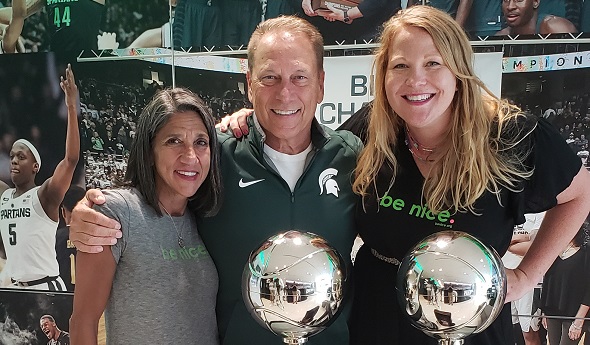
Both be nice.® and BLND staff members made appearances at schools this year to assist in promoting recognition. A 90-second video produced by be nice.® was included in all MHSAA online rules meetings this year, featuring endorsements from University of Michigan coaches Jim Harbaugh and Carol Hutchins and Michigan State University coaches Mark Dantonio and Tom Izzo.
“When our team met with Mark (Uyl) and some athletic directors in Spring 2019, the room was filled with people who have just started to recognize mental health as an issue. The challenge was to deliver a 90-second video promoting the be nice.® Action Plan with a quick turnaround so it was ready for the fall rules meetings,” said Lanting.
She encourages people to visit be nice.org and “take the be nice.® pledge.”
“be nice.® started in 2010, and when people first see it they think, ‘bullying prevention,’ but really it is an action plan that is evidence-based,” Lanting said. “The be nice.® Action Plan can be used anywhere – in the workplace, community organizations – but schools is where we started and where we are currently having the most impact.”
 Connecting with the most people possible is the goal across the board. Buys encourages schools to utilize the “one-stop shopping method” in the BLND programming.
“An external referral service that is qualified, efficient, dynamic, and integrated in nature – like BLND – helps provide a one-stop shop for student-athletes and parents to receive the support they need,” said Buys.
Lanting agrees, stating, “The more students and parents become familiar with some of the signs and symptoms, the better. Coaches and teammates might be the first to notice a change in someone’s behavior whether through daily interaction or social media activity.”
Buys and company have noticed a few recent trends leading to school-aged anxiety and stress, and have people in place to visit groups and lead discussions.
“The signs and symptoms can be very individualized, but some general factors may include isolation, irritability, drastic changes to an individual’s common mood or behavior,” noted Buys. “Students can also be affected by major life changes such as parent divorce, break-up with significant other, changing schools, things of that nature.”
When Lanting receives inquiries from individual coaches regarding the be nice.® program, she encourages them to get entire teams or districts involved, because, “it’s a K-12 initiative, and sports is really a great place to start.”
Sport participation offers a different set of variables. Student-athletes enjoy additional support and guidance, but there is a flip side.
“Student-athletes do have access to more adult guidance through coaches, and certainly enjoy inclusion as part of a team, but they also tend to be more at risk for anxiety,” Lanting said.
Buys points out several reasons for this, including added expectations – whether from within or from peers, parents and coaches. They are also busier than many others.
“Time management is an issue for all of us, but student-athletes can have difficulties finding that rhythm,” Buys said. “This can cause a lot of anxiety if an area of the athlete’s life that they value is perceived as not getting the attention it needs.”
Another source of stress more likely to affect athletes is injuries.
“One of the biggest challenges in the athlete population dealing with stress and anxiety is the strong relationship between stress and injury,” said Buys. “Susceptibility to injury as well as the length of time for recovery are affected by stress.”
Identifying physical conditions is much simpler than recognizing behavioral ailments. That’s why it’s important for groups like BLND and be nice.® to teach the school population to self-diagnose.
Lanting coordinated a be nice.® football game between Holland/Zeeland-area high schools last fall, and is planning a similar event during a Fennville-Saugatuck boys basketball game this winter.
“We see all the ‘pink-out’ games and events for other causes, and that’s great,” Lanting said. “But a person in high school is so much more likely to be affected by mental health than suffer a physical ailment. That’s why the student-led part of this is so important; they tell us when things happen that might trigger certain behaviors.”
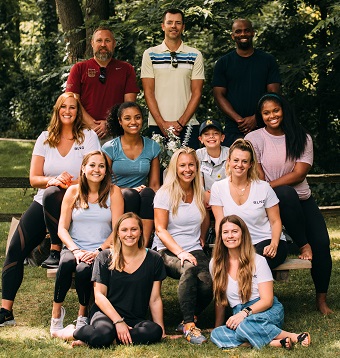
PHOTOS: (Top) be nice. founder Christy Buck (left) and program coordinator Cat Lanting pose with MSU men’s basketball coach Tom Izzo during production of a promotional video this summer. (Middle) The BLND Health Detroit Metro Team, including founder Brooke Buys (seated middle, second row from bottom.)