


Teaching ABC's of Pressure Situations
October 30, 2013
 By Eric Martin
MSU Institute for the Study of Youth Sports
Coaches have seen the signs: Athletes having too much or not enough energy prior to a game, quickening breathing, sweating more than usual, being unable to focus on important details, and having their minds wander from the present to “what if” scenarios and past mistakes.
Athletes deal with pressure in many ways. Although some handle it well, many do not have the tools to perform to their full abilities in these situations. Most athletes place a high importance on succeeding in sport, and when athletes reach regional, district, or state championships, the pressure they feel may become overwhelming.
How athletes handle this increased pressure can often mean the difference between winning and losing. Therefore, helping athletes deal with it is something coaches should consider prior to athletes encountering these high-stakes situations.
Unfortunately, there is no magic elixir for helping your athletes work under pressure. But if these ABC’s of pressure situations are followed, your athletes will be much better equipped to cope, and the chances of their performance levels dropping significantly will be reduced.
1. Act the Part
How you as coaches act influences your athletes. For better or worse, athletes notice your emotions in response to these situations and take cues from how you handle pressure.
You are a demand on your players’ attention – you can add or reduce your players’ perceived stress by how you act. Understanding the demand you place on players requires self-awareness. How do you respond when a key call goes against you? Do you have nervous habits that athletes may notice? What messages are you providing to your athletes – both verbally and non-verbally? Athletes pick up on these non-verbal cues, so you must be aware of how you respond to these situations.
It is important to remember emotions are not always negative – rather acting differently than normal can be a signal to your athletes that you are stressed. Strive to be consistent in your actions – whether you are coaching during a preseason match or championship contest. These situations are stressful for you too, but you need to be the constant your athletes look to for stability.
2. Breathing – Remember to do it
It seems like a simple thing, but when athletes’ emotions are running high, they forget how to breathe – or, at least, forget how to breathe properly. Worse, they often think they are breathing normally but don’t notice breaths are becoming shorter and shallower. Teaching athletes to breathe properly when not in pressure situations will help them have the tools to rely on when they encounter more intense scenarios.
For proper breathing, athletes need to do so from the belly and not the chest. The pace of this breathing should be 6-2-7; that is, have athletes take a deep breath from the abdomen for six seconds, hold for two seconds, and then finally slowly exhale completely for seven seconds. This breathing strategy is ideal for pregame situations to quiet nerves and help athletes get ready to play, but a condensed version (3-2-3) can also be used for quick breaks in the action like a timeout or court change.
3. Control the controllables
During times of high pressure, athletes sometimes feel they do not have control over their own performances. It is important to help athletes focus on things they can control and not worry about those that cannot be changed or are outside their influence.
Instead of athletes dwelling on aspects that are out of their control like unusual game times for championship finals or a referee’s bad call, help them focus on completing their warm-up preparations and how they can respond to poor calls. Helping focus athletes’ attention on things they can control will help them better handle pressure situations and leave them feeling less helpless
Athletes’ emotions are typically out of their control, but how they view them and respond to these emotions are under their control. Author and preacher Charles R. Swindoll said, “Life is 10 percent what happens to you and 90 percent how you react to it!” Be sure your athletes know how to respond when difficult situations arise.
Conclusion: Fearlessness is an assembly
Not all athletes react to pressure situations in the same manner, but all athletes can benefit from these simple suggestions. Remember to ACT THE PART of how you want your athletes to act, teach your athletes proper BREATHING techniques, and help athletes focus on CONTROLLING THE CONTROLLABLES.
Good preparation is the key to performance. Increase self-monitoring and give athletes the tools to succeed in pressure situations; they, in turn, can be in a better position to succeed. However, like any skills, they must be practiced accordingly, and one session will not solve all issues. Devote the time to train athletes in these skills, and when the need arises they will have them ready to use.
Good luck this season!
Martin is a third-year doctoral student in the Institute for the Study of Youth Sports at Michigan State University. His research interests include athlete motivation and development of passion in youth, sport specialization, and coaches’ perspectives on working with the millennial athlete. He has led many sessions of the MHSAA Captains Leadership Clinic and consulted with junior high, high school, and collegiate athletes. If you have questions or comments, contact him at [email protected].
Built Right, No Rebuild Needed: Cornelius Taking Gull Lake Back to Tennis Finals
By
Pam Shebest
Special for MHSAA.com
October 21, 2025
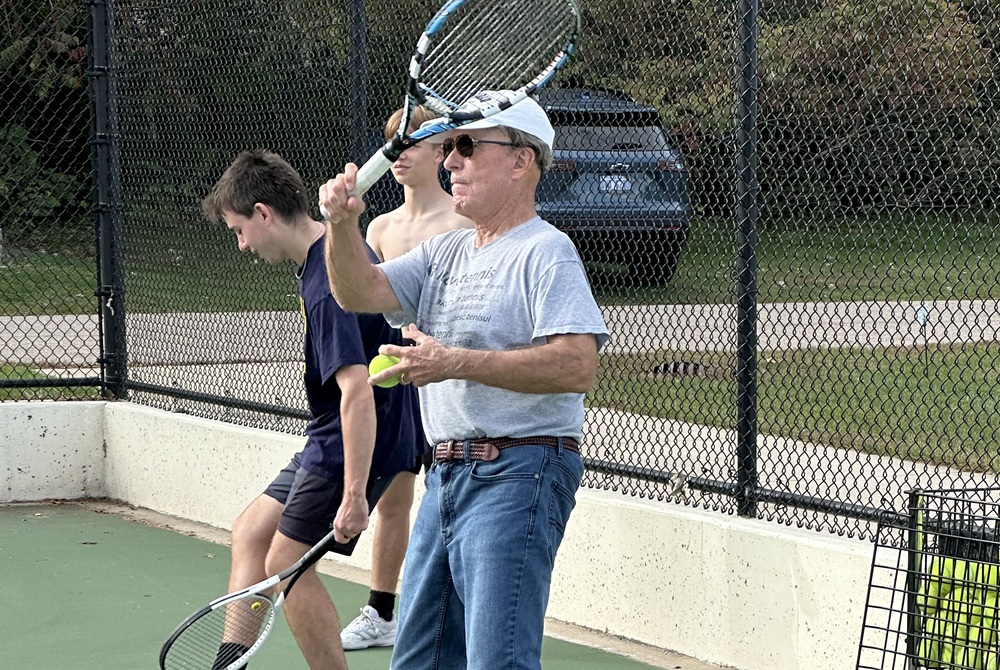
RICHLAND – Once the boys season ends later this week, Roger Cornelius will begin preparing for his 50th year as varsity girls tennis coach at Gull Lake High School.
 That tenure may have been cut short at 22 years, if not for the Gull Lake tennis community.
In January 1998, Cornelius’ 16-year-old daughter, Lindsay, died as a result of a winter car crash.
He had recently ended the fall season with the girls team and “I didn’t know if I could (coach) the boys that spring,” he said, still emotional when talking about the tragedy.
One of his former students, Jason Ryan, now a vascular surgeon at Beacon Kalamazoo Hospital, contacted Cornelius.
“He and one or two other guys talked with me and, if not for them, I would have quit tennis,” Cornelius said. “I decided to continue with tennis, and I’m glad I did. I found out that God was going to carry me through the toughest time of my life. The tennis community was really big for me back then. Richland, especially, came beside me and lifted me up.”
Although tennis is his sport of choice, Cornelius played football at Western Michigan University and was first hired at Gull Lake in 1975 to help with the football program. He jumped at the chance to coach the tennis team that spring and has coached either the boys or girls, and sometimes both, every year since.
He has been named Regional Coach of the Year several times and was enshrined in the Michigan High School Tennis Coaches Association (MHSTeCA) Hall of Fame in 2018.
Cornelius will lead the boys (12-2-1) to the MHSAA Lower Peninsula Division 3 Finals this Friday and Saturday at Midland Tennis Center. The Blue Devils finished 10th the last two years, earning eight points both times.
In a rebuilding year after losing all four singles and two doubles players to graduation, Cornelius was surprised and thrilled that this year’s team earned 20 points at its Regional, finishing second to St. Joseph and qualifying for the Finals.
At the beginning of the season, senior Peyton Orley said he wasn’t sure how good the team would be.
“Last year at the beginning of the season, we could tell we had a really good team,” Orley said. "This year, we lost a lot of our seniors and it didn’t look promising for states.
“Everyone on the team was mission-motivated to get to the state tournament.”
 Orley pairs with senior Sullivan Abegg at No 1 singles and the pair did their part, winning their Regional flight. For Abegg, it was a three-peat after taking the title at No. 3 doubles two years ago and No. 2 doubles last year.
The Blue Devils are led at No. 1 singles by freshman Kade DeMaagd, whose father also played for Cornelius.
“Kade’s got the best strokes on the team,” the coach said.
Lucas Nichols, at No. 4 doubles, is the other freshman in the lineup. The other three seniors are Max Uppal (No 3 singles) and Dylan Piwko and Evan McCann, both doubles players. Three juniors, who all play doubles, are Jaden Jones, Jackson McDermott and McGuire Abegg. Two sophomores round out the singles flights: Jake Worgess at No. 2 and Jacob Nichols at No. 4.
Comparing old & new
Cornelius said there isn’t much difference between the tennis players today compared to those 50 years ago.
“I think what’s changed the most is today’s athletes have so many different options, so many different interest areas,” he said. “A lot of the kids have early college classes, some of them have to come to practice from off site and so many things are happening, whether it’s the Model United Nations or tutoring someone at the high school or DECA. I think that’s the biggest difference.”
While the boys are competing in Division 3, the girls are in Division 2, a more difficult road to the Finals, Cornelius said.
“It does make it pretty tough for the girls to make it out of Division 2 with the Mattawans, Portage Central, St. Joe, Battle Creek Lakeview,” he said.
Orley’s sister, Ava, a junior who plays at No. 1 doubles, said the girls team has already bonded.
“We build our team off loving each other,” she said. “It’s not everyone out for themselves, it’s all of us (working together). We focus on being a good role model.
"We’ve had coaches tell us how we played with class and how it’s an honor to play us because we learned from (Cornelius) that you always want to be a good sport.”
Competitive, compassionate
Cornelius, who taught French at the high school for 32 years, currently tutors French-speaking African and Haitian families for the district.
“I tutor the kids and work with the families,” he said. “It’s vastly different than what I did in the classroom. The greatest thing that’s ever happened to me in my nearly 50 years working with Gull Lake schools was working with a little African boy who was blind.”
Cornelius and some friends pooled money to take the boy to a specialist in Grand Rapids. The specialist asked Cornelius to translate for the mother that he thought he could help the young boy regain some sight.
“The two surgeries were successful,” said Cornelius, choking up a bit with emotion. "He has to wear glasses, but he can see. It’s the high watermark of my life.”
That compassion is visible on the tennis courts, said retired Allegan coach Gary Ellis, now a volunteer assistant tennis coach at the school.
 “I’ve known Roger since 1977,” Ellis said. “We started competing against each other when he started coaching the boys.”
He said that although Cornelius wants to win and likes to compete, “at the same time, he’s got a good perspective on the whole thing and the value of high school sports, and tennis in particular. He’s very positive, both with his team and with the opponents.”
Cornelius was so supportive of opponents that one year Ellis’ girls team invited the Gull Lake coach to their awards banquet at the end of the season.
“He had a conflict and couldn’t attend, but he sent a really nice letter to the girls,” Ellis said.
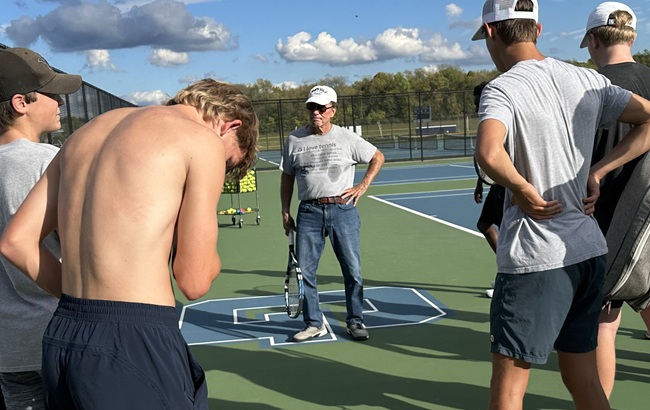
Cornelius makes it a point to talk with opponents, both coaches and players.
“I love to get to talk to the kids that I would never get to talk with,” he said. “My favorite is Battle Creek Central because they have struggles that most of us at Gull Lake don’t know about.
“For them to commit their spring or their fall to tennis, that’s a major decision. I want to make darn sure that after the match, I get to meet every one of them, talk with them, talk with their coach.”
Cornelius doesn’t expect this to be his last season.
“I will step down when the good Lord says, ‘I think it’s time,’” he said. “And I don’t think it’s time quite yet.
“I wouldn’t mind if they put on my gravestone ‘Loved God, Loved People.’”
 Pam Shebest served as a sportswriter at the Kalamazoo Gazette from 1985-2009 after 11 years part-time with the Gazette while teaching French and English at White Pigeon High School. She can be reached at [email protected] with story ideas for Calhoun, Kalamazoo and Van Buren counties.
PHOTOS (Top) Richland Gull Lake tennis coach Roger Cornelius hits with his players during practice this season. (Middle) Clockwise from top left: Cornelius, assistant Gary Ellis, junior Ava Orley and senior Peyton Orley. (Below) Cornelius talks things over with his team. (Photos by Pam Shebest.)