

Traverse City Athletes Taking LEAP into Coaching, Officiating
By
Tom Spencer
Special for MHSAA.com
March 18, 2022
Set. Spike. Jump – rather maybe leap?
 Nothing new to many female high school student-athletes.
But this spring, Abigail Hicks, Keira Castle, Madeline Bildeaux and Honorae Shore made THE LEAP — as in Learning, Enrichment and Athletic Programs (LEAP). They actually leaped into coaching and officiating roles.
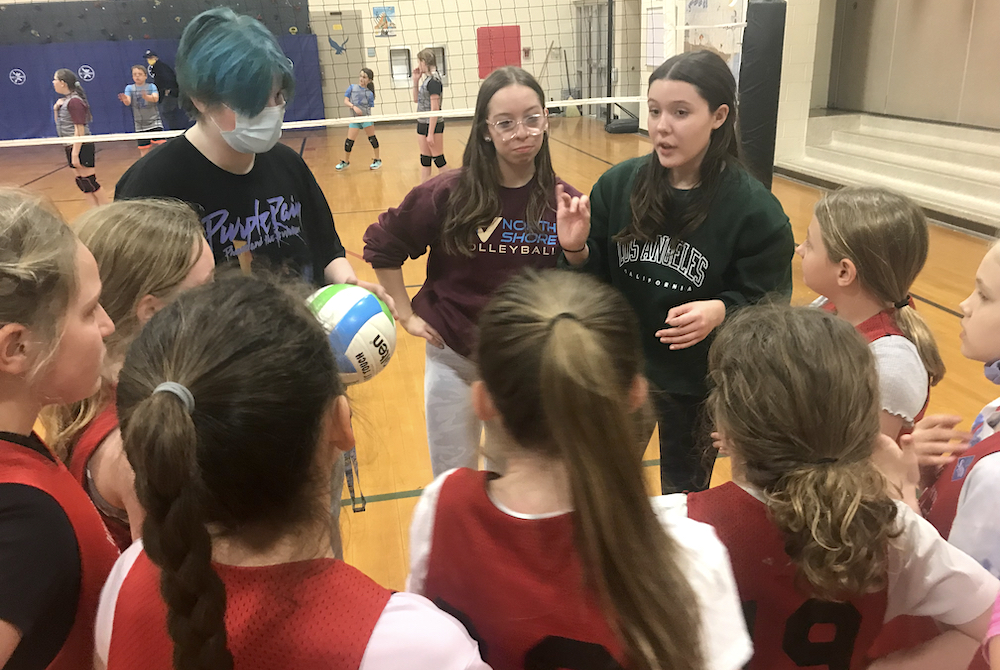
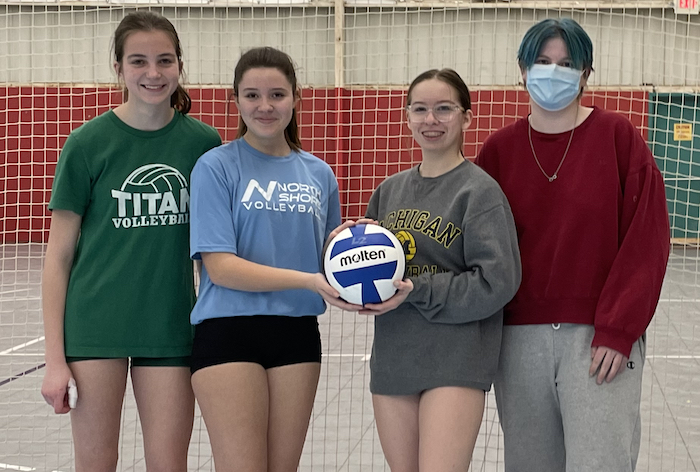
Hicks, Castle and Shore stepped into LEAP as coaches for Willow Hill Elementary School’s volleyball team. Bildeaux became a referee for LEAP’s 4th and 5th grade volleyball program.
All four girls are part of the North Shore traveling volleyball club. And, all four are a part of Future Coaches, its 4-year-old program preparing athletes to become effective coaches through LEAP, which is operated through Traverse City Area Public Schools.
Bildeaux and Castle played their first high school volleyball seasons last fall at Traverse City West. Hicks did the same at Traverse City St. Francis. Shore attends Greenspire, a Grand Valley State University-sponsored charter school located in Traverse City.
Parents, grandparents and school administrators love having the high school girls on the sidelines. The girls may love it even more though.
“The most rewarding aspect of teaching young girls is seeing the excitement they get when they get the hang of playing or when they win a game,” noted Castle, who started with the coaching program as an eighth grader. “I also love knowing that I've helped some of these girls fall in love with a sport.”
There may not be anyone more thrilled with the girls taking the leap than David Payne, elementary sports manager for LEAP. The student coaches help LEAP meet its vision of providing preschool through 12th-grade students with increased opportunities for engagement beyond the school day with activities to improve learning, health and wellness.
“The high school girls have a love and knowledge of the game that they share with the elementary kids,” Payne said. “Parents that were not comfortable or able to coach are finding the excitement and interaction between the high school girls and the elementary kids is very positive.
“At times the high school coaches look like cheerleaders on the sidelines,” he continued. “They keep the energy level high while supporting their team.”
The four ninth graders are the latest to make the “leap.” Jordan Bates, founder of the Future Coaches program, first connected the players as coaches with LEAP as COVD-19 shortened the 2020 season. The very first high school volleyball player to make the leap was Phoebe Humphrey, now a Traverse City Central sophomore. Humphrey coached Cherry Knoll as an eighth grader during the 2020 brief season. She is now coaching Eastern Elementary.
The pandemic also resulted in the cancellation of the 2021 elementary season. This season will conclude next week.
“The opportunities for these athletes to coach their own teams is extraordinary,” Bates said. “It would not have happened without David Payne.
 “His support, scheduling acumen, and love of sports has made this program pretty amazing.”
Veronika Caughran, who plays for Traverse City Central, is helping Cherry Knoll Elementary in Traverse City. Anissa Wille, Suttons Bay High School; Jenna Flick, TC West; and TC Central’s Natalie Bourdo and Lily Briggs have coached North Shore travel teams. Briggs, Bourdo and Humphrey have been coaching in North Shore’s beach program for the past three years.
Hicks, who recalls Gladiators varsity players helping coach her in volleyball as a fifth grader, said the girls can’t go it alone. She’s found the Willow Hill school community to be extremely supportive.
“We have received lots of positive feedback from parents, our coaches, our team, and other LEAP coaches,” she said. “All the parents have been very kind and grateful and always willing to support the team by bringing in snacks for after the game — not only for our players but for the opposing team — along with being willing to help line judge and run the scoreboard.”
The high school players-turning-coaches have been attending classes with Bates and guest coaches mostly from the North Shore club. Topics covered include coaching philosophy, how to be a great referee, practice planning, tournament preparation and health and wellness.
Bates said the program benefits go beyond the participants.
“Perhaps the biggest struggle is for athletes and parents to realize how valuable coaching is to an athlete,” he said. “It not only helps them with communication, structure, planning, and strategizing, but also it makes them better athletes earlier in their journey.”
Adding fun too is important, Hicks noted.
“I hope I help make practices a fun environment and for them not to worry about making mistakes and helping them know that not everything is their fault,” she said. “And … how to learn from their mistakes.”
Castle, who started playing volleyball as a fourth grader at Willow Hill, agreed. She recalls fondly the difference past coaches have made in her life, including Bates.
“While I've been coaching I've also noticed how (Willow Hill players) interact with each other and cheer each other on, and it's been such a great experience,” she said.
“I remember the feeling I felt when a coach made me love volleyball, and from coaching these girls I'm starting to see what that's like from a coaching point of view.”
Bates created the program with interscholastic competition and the student-athlete in mind.
“There is also the coaching shortage, so creating opportunities for these athletes to coach, and ref, just made sense,” Bates said.
Castle is preparing to meet the growing needs.
“I plan to continue coaching volleyball until the end of high school,” Castle said. “In a year or two, I want to start coaching middle school volleyball.
“When I get to college I plan to either continue coaching or find a job as a ref.”
Hicks indicated her experience has increased her love for the game of volleyball and respect for coaches.
“I learned that coaching is a little more complex than it looks, and you have to plan practice and be prepared for them to have a bad attitude or unfocused after a long day of school,” she said. “You, as the coach, have to have a good attitude, have lots of patience, be ready to problem solve and get them back on track.”
Teamwork, sportsmanship and the value of hard work are among the strengths Castle and the other future coaches bring to the table.
“We had our girls practice sportsmanship by saying ‘good game’ and waving to the other team,” Castle said. “In practice, we have taught them to work as a team and to always give it your all.”
Hicks recommends coaching to all high school athletes.
“I’ve learned a lot,” she said, “and this has been a positive, fun experience that I definitely recommend.”
 Tom Spencer is a longtime MHSAA-registered basketball and soccer official, and former softball and baseball official, and he also has coached in the northern Lower Peninsula area. He previously has written for the Saginaw News, Bay County Sports Page and Midland Daily News. He can be reached at [email protected] with story ideas for Manistee, Wexford, Missaukee, Roscommon, Ogemaw, Iosco, Alcona, Oscoda, Crawford, Kalkaska, Grand Traverse, Benzie, Leelanau, Antrim, Otsego, Montmorency, Alpena, Presque Isle, Cheboygan, Charlevoix and Emmet counties.
PHOTOS (Top) From left, Honorae Shore, Abigail Hicks and Kiera Castle coach their Willow Hill elementary volleyball team this season. (Middle) Madeline Bildeaux, far left, also has joined Castle, Hicks and Shore as part of the LEAP coaching and officiating program. (Top photo by Tom Spencer, middle photo courtesy of Allie Walters.)

Be the Referee: Defensive Holding
By
Paige Winne
MHSAA Director of Brand Management
October 6, 2026
Be The Referee is a series of short messages designed to help educate people on the rules of different sports, to help them better understand the art of officiating, and to recruit officials.
Below is this week's segment – Defensive Holding - Listen
Team A has the ball on their own 20-yard line and its 4th-and-15. They decide to go for it. The quarterback drops back to pass and is sacked at his 15-yard line, a five-yard loss.
But during the play, Team B – the defense – is flagged for holding an eligible wide receiver.
How is the penalty administered?
- Is it 4th-and-5 from Team A’s 30?
- Is it 4th-and-10 from Team A’s 25?
- Is it 1st-and-10 from Team A’s 30?
- Or is it 1st-and-10 from Team A’s 25?
If you said it is 4th-and-5 from Team A’s 30 – you are correct.
Defensive holding is a 10-yard penalty from the previous spot – which was the 20-yard line. Team A now has possession at the 30, needing to get to the 35 for first down.
Previous 2026-27 editions
Sept. 29: Minimum Number of Volleyball Players - Listen
Sept 22: Soccer Changes - Listen
Sept: 15: Dead Ball Penalty - Listen
Sept. 8: Libero Ejected - Listen
Sept. 1: Soccer Foul After Shot on Goal - Listen
Aug. 25: Fumble Out of Bounds - Listen