


Using Heads in the Heat of Competition
December 20, 2013
By Rob Kaminski
MHSAA benchmarks editor
With so much recent attention to the risks and recognition of concussions in collision sports, athletic leaders have put their heads together to address far more common – but often overlooked – threats to the health of our student-athletes: heat and sudden cardiac arrest.
The No. 1 killer of young athletes is sudden cardiac arrest, while heat stroke victims can surpass that during the year’s hottest months. While the moment of impact leading to a concussion is totally unpredictable, athletic trainers, coaches and administrators have the ability to diminish the occurrences of cardiac arrest and heatstroke. Typically, there is a pre-existing condition, or family history suggesting probabilities for sudden cardiac arrest, which can be treated when detected. And, the perils associated with hot weather – heat stroke, prostration – are almost always completely preventable.
The MHSAA has addressed both issues recently. With assistance from numerous medical governing bodies, the annual pre-participation physical form was revamped and expanded prior to the 2011-12 school year to include comprehensive information regarding participants’ medical history.
In May, the Representative Council adopted a Model Policy for Managing Heat & Humidity (see below), a plan many schools have since adopted at the local level. The plan directs schools to monitor the heat index at an activity site once the air temperature reaches 80 degrees and provides recommendations when the heat index reaches certain levels, including ceasing activities when it rises above 104 degrees.
The topic of heat-related illnesses receives a lot of attention at the start of fall when deaths at the professional, collegiate and interscholastic levels of sport occur, especially since they are preventable in most cases with the proper precautions. In football, data from the National Federation of State High School Associations shows 41 high school players died from heat stroke between 1995 and 2012.
“We know now more than we ever have about when the risk is high and who is most at risk, and we’re now able to communicate that information better than ever before to administrators, coaches, athletes and parents," said Jack Roberts, executive director of the MHSAA. “Heat stroke is almost always preventable, and we encourage everyone to avail themselves of the information on our website.
“Schools need to be vigilant about providing water during practices, making sure that students are partaking of water and educating their teams about the need for good hydration practices.”
All of which is not to say concussions aren’t a serious matter; they are. In fact, leaders in sport safety can take advantage of the concussion spotlight to illuminate these additional health threats.
A recent New York Times story (May 2013) by Bill Pennington featured a February 2013 gathering in Washington organized by the National Athletic Trainers Association. In the article, Dr. Douglas J. Casa, professor of kinesiology at the University of Connecticut and Chief Operating Officer of the Korey Stringer Institute (founded in the late NFL offensive lineman’s name to promote prevention of sudden death in sport), suggests just that.
“All the talk about head injuries can be a gateway for telling people about the other things they need to know about, like cardiac events and heat illness,” said Casa in the article. “It doesn’t really matter how we get through to people as long as we continue to make sports safer.”
Education and prevention methods need to find a permanent place in school programs if those programs are to thrive and avoid becoming targets at which special interest groups can aim budgetary arrows.
Dr. Jonathan Drezner, the president of the American Medical Society for Sports Medicine, said in the New York Times piece that sudden cardiac arrest is “so incredibly tragic and stunning that people aren’t comfortable putting it into the everyday conversation. I do wish, to some extent, it was something people talked more about because we are getting to a place where we could prevent many of these deaths.”
When it comes to heat-related deaths or illnesses, the prevention efforts can be even more successful by educating the masses. And, these efforts can be done at minimal cost to schools.
“That’s the thing about curtailing exertional heat illness: it’s 100 percent preventable, and unlike other health threats to athletes, the solutions can be very low-tech and inexpensive,” said Dr. Michael F. Bergeron, the director of the National Institute for Athletic Health & Performance at the University of South Dakota’s Sanford Medical Center, in the New York Times story.
To assist with cost and data maintenance, the MHSAA has teamed with Sports Health to provide schools with psychrometers (heat measurement instruments) at a discounted rate, and has built online tools to track heat and humidity conditions.
Managing heat and humidity policy
- Thirty minutes prior to the start of an activity, and again 60 minutes after the start of that activity, take temperature and humidity readings at the site of the activity. Using a digital sling psychrometer is recommended. Record the readings in writing and maintain the information in files of school administration. Each school is to designate whose duties these are: generally the athletic director, head coach or certified athletic trainer.
- Factor the temperature and humidity into a Heat Index Calculator and Chart to determine the Heat Index. If a digital sling psychrometer is being used, the calculation is automatic.
If the Heat Index is below 95 degrees:
All Sports
- Provide ample amounts of water. This means that water should always be available and athletes should be able to take in as much water as they desire.
- Optional water breaks every 30 minutes for 10 minutes in duration.
- Ice-down towels for cooling.
- Watch/monitor athletes carefully for necessary action.
If the Heat Index is 95 degrees to 99 degrees:
All Sports
- Provide ample amounts of water. This means that water should always be available and athletes should be able to take in as much water as they desire.
- Optional water breaks every 30 minutes for 10 minutes in duration.
- Ice-down towels for cooling.
- Watch/monitor athletes carefully for necessary action.
Contact sports and activities with additional equipment:
- Helmets and other possible equipment removed while not involved in contact.
- Reduce time of outside activity. Consider postponing practice to later in the day.
- Recheck temperature and humidity every 30 minutes to monitor for increased Heat Index.
If the Heat Index is above 99 degrees to 104 degrees:
All Sports
- Provide ample amounts of water. This means that water should always be available and athletes should be able to take in as much water as they desire.
- Mandatory water breaks every 30 minutes for 10 minutes in duration.
- Ice-down towels for cooling.
- Watch/monitor athletes carefully for necessary action.
- Alter uniform by removing items if possible.
- Allow for changes to dry T-shirts and shorts.
- Reduce time of outside activity as well as indoor activity if air conditioning is unavailable.
- Postpone practice to later in the day.
Contact sports and activities with additional equipment
- Helmets and other possible equipment removed if not involved in contact or necessary for safety.
- If necessary for safety, suspend activity.
Recheck temperature and humidity every 30 minutes to monitor for increased Heat Index.
If the Heat Index is above 104 degrees:
All sports
- Stop all outside activity in practice and/or play, and stop all inside activity if air conditioning is unavailable.
Note: When the temperature is below 80 degrees there is no combination of heat and humidity that will result in need to curtail activity.
PHOTO: The Shepherd volleyball team includes hydration during a timeout in a match this fall.
Fund Helps Love for Comstock Live On
By
Pam Shebest
Special for MHSAA.com
August 21, 2018
COMSTOCK TOWNSHIP — Several years ago, Josh Whitfield and his sister, Mandy Hanson, were sitting around a bonfire just chatting when they touched on a subject that fired up the normally easy-going Comstock High School graduate.
 Whitfield had started helping coach the girls soccer team and realized that to be involved in sports, Comstock athletes had to “pay to play.”
“It takes a lot to get him riled up, to get him angry or upset,” Hanson said. “He was talking about, ‘Can you believe it? You have to pay to play sports at Comstock.’
“I was like, that’s crazy. He was getting so upset talking about it. Some of these girls paid to play but then couldn’t afford the right equipment.”
Whitfield, a 2000 grad and four-year multi-sport athlete at Comstock, said he wished he had enough money to help out.
That opportunity would come out of the saddest of circumstances. But as his loved ones continue to heal from Whitfield’s untimely death in 2015, they’ve created an opportunity for his memory to impact the Comstock athletic community for years to come.
That May, while playing golf with friends, including Hanson’s husband Mike, Whitfield said he did not feel well and left the group on the second hole.
“Of course, the guys razzed him about it because it wasn’t like Josh to leave in the middle of a round of golf,” his sister said.
When Whitfield’s mother, Becky, called him at home later, he told her he was having trouble breathing. He called 9-1-1 and his dad, Vic, drove to his son’s house just as the EMTs arrived.
Whitfield did not survive, dying from a double lung collapse. He was just 33 years old.
Two of his buddies, Eric Stewart and Chad Howard, wanted to do something to keep Whitfield’s memory alive.
“We were all struggling a lot,” Stewart said. “Josh had an extremely tight-knit group of friends. It was really hard for a lot of us. We were talking about ways to spin positive out of grief.
“We were like, ‘What can we do to honor his memory, to keep his name alive?’
We thought it would mean something to his family. We knew it would mean something to Comstock, because Comstock is in a tough place right now.”
The buddies had the idea for a fundraiser to help a few Comstock athletes pay to play. They were hoping to raise at least $1,500 through an alumni soccer game.
They were stunned to raise $5,000.
‘Spinning positive out of grief’
Over three years, the group – which has gone from the two friends to a committee of 14 – has raised more than $52,000 and so far donated more than $27,000 of it to various athletic causes in Comstock.
 “It started with Eric and Chad, who asked how they could help and wanted to set up an alumni soccer game to help offset the pay-to-play fees,” Comstock athletic director Justin Ansel said. “Initially, I wasn’t sure how big this would be or how sustainable this would be.
“Unfortunately, this entire thing was started by a tragedy. It’s a testament how, at Josh’s young age, how people rallied around him for this. It’s just special how the community comes together to remember Josh. We are thankful for what this organization does for our student-athletes.”
The fund has supplied about $5,000 for pay-to-play scholarships, helping more than 350 middle and high school athletes with activity fees and physical exam fees. But those have not been the group’s only focus.
“For example, someone might say I can’t pay the $75 for Rocket Football,” Stewart said. “We will approve that and send the check in to Rocket Football.
“We also do grants to teams and organizations focused on Comstock. We did Eastwood Little League through a $5,000 grant last year. We’re really excited to sponsor the First Day Shoe Fund. We bought all the kids in Comstock shoes. We know that a healthy lifestyle, teamwork, all are bred through athletics.”
This year, the group will have extra money available.
“As it happens, Comstock has a new superintendent this year in Jeff Thoenes,” Ansel said. “One of his first actions as superintendent was to remove our activity fee barrier so we no longer have this fee for the start of the 2018-19 school year.
“They still plan to fund things like athlete equipment, needs like shoes or shin guards along with a variety of other things.”
Without the pay-to-play expenditures, Stewart said, “Our goal now is to really push toward those youth athletic programs: AYSO, Little League, youth football, youth golf camps, soccer camps. We’re creating feeders to the high school that otherwise don’t really exist at Comstock.”
With Comstock’s entry a few years ago into the Berrien-Cass-St. Joseph Conference, teams travel more than 40 miles to many games. At first, the school transported athletes to the games, but parents took them home.
“Now the fund pays to bring kids home,” Stewart said. “Parents in poverty can’t drive that far to pick up their kids. That’s not OK, and we wanted to fix that.”
Continuing to grow
Once the original fund hit $5,000, Stewart and Howard did not want the sole responsibility of doling out the money.
“We said we need to vet this through a group of people,” Stewart said.
So they formed the non-profit Josh Whitfield Memorial Athletic Fund.
The board of directors is made up of Josh’s friends and family, and funds are distributed through the Comstock Community Center.
The committee sponsors three fundraisers each year: a golf outing, an alumni soccer game and a holiday party in December. It also accepts donations through its website (www.jwmaf.org).
The golf outing in June includes about “a quarter of the field with Whitfields,” Stewart said. “It’s always bittersweet when we get together for that reason, but I think it’s a good avenue to go through some of those things. Oftentimes it’s like a support group.”
 The soccer tournament is set for Sept. 21 at the school.
“It started out as an alumni soccer game, and then we had people who weren’t alumni that wanted to play,” Hanson said. “We said of course.
“It’s just getting out there and having fun. Last year, the oldest was mid-40s and the youngest just graduated.”
Said Stewart: “We usually get about 50 who sign up. It’s a hoot. It’s a good time. Everybody’s getting older, but it’s fun to relive the glory days.”
The holiday party last December was held at Kalamazoo’s Tibbs Brewing Company, which donated a portion of the sales to the fund.
Hanson and brother Matt Whitfield are members of the committee, which meets once a month to review applications.
“A couple committee members work in Comstock schools, so they see what’s going on and they see a need,” Hanson said. “The committee generally takes a vote. If the applicant meets what we’ve set forth in the guidelines, then we do grant them the money.”
Applicants also can apply through the website, but must be connected to Comstock athletics.
All committee members are volunteers, with 100 percent of any money raised going into the fund.
Besides Stewart, Howard, Hanson and Matt Whitfield, board members are
Sara Howard, Alyssa Stewart, Rolly Taylor, Travis and Marie Law, Tyler and Shannon Howard, Loreen Hospodar, Katy Seward and Mason Everett.
“It is amazing,” Hanson said. “It’s truly an honor. I think to myself, my gosh, Josh would be so humbled to know that this is happening because of him.
“I think secretly he’s laughin’ and lovin’ it up there.”
 Pam Shebest served as a sportswriter at the Kalamazoo Gazette from 1985-2009 after 11 years part-time with the Gazette while teaching French and English at White Pigeon High School. She can be reached at [email protected] with story ideas for Calhoun, Kalamazoo and Van Buren counties.
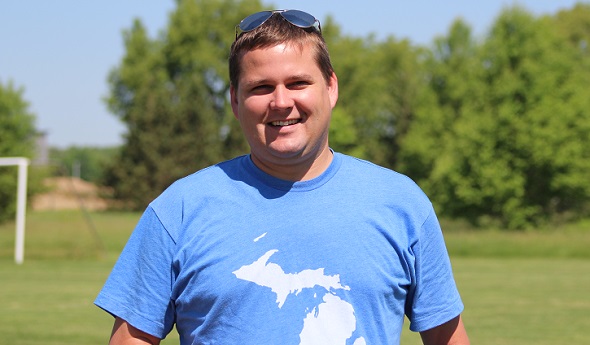
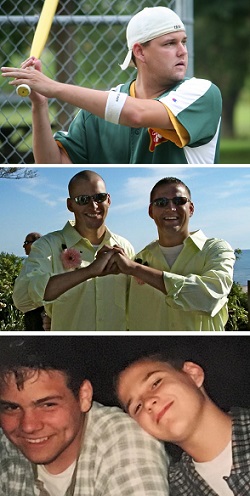
PHOTOS: (Top) Josh Whitfield in 2015, shortly before his death. (Top middle) Friend Eric Stewart, left, and Comstock athletic director Justin Ansel. (Middle) From top, Josh Whitfield playing wiffle ball, Josh and brother Matt Whitfield, and Josh and Stewart. (Below) Mandy Hanson, right, with daughter Madi. (Hanson photo by Pam Shebest; other photos submitted by Eric Stewart or Mandy Hanson.)