

Using Heads in the Heat of Competition
December 20, 2013
By Rob Kaminski
MHSAA benchmarks editor
With so much recent attention to the risks and recognition of concussions in collision sports, athletic leaders have put their heads together to address far more common – but often overlooked – threats to the health of our student-athletes: heat and sudden cardiac arrest.
The No. 1 killer of young athletes is sudden cardiac arrest, while heat stroke victims can surpass that during the year’s hottest months. While the moment of impact leading to a concussion is totally unpredictable, athletic trainers, coaches and administrators have the ability to diminish the occurrences of cardiac arrest and heatstroke. Typically, there is a pre-existing condition, or family history suggesting probabilities for sudden cardiac arrest, which can be treated when detected. And, the perils associated with hot weather – heat stroke, prostration – are almost always completely preventable.
The MHSAA has addressed both issues recently. With assistance from numerous medical governing bodies, the annual pre-participation physical form was revamped and expanded prior to the 2011-12 school year to include comprehensive information regarding participants’ medical history.
In May, the Representative Council adopted a Model Policy for Managing Heat & Humidity (see below), a plan many schools have since adopted at the local level. The plan directs schools to monitor the heat index at an activity site once the air temperature reaches 80 degrees and provides recommendations when the heat index reaches certain levels, including ceasing activities when it rises above 104 degrees.
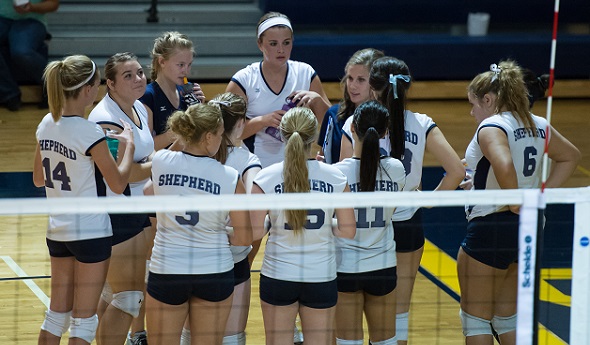
The topic of heat-related illnesses receives a lot of attention at the start of fall when deaths at the professional, collegiate and interscholastic levels of sport occur, especially since they are preventable in most cases with the proper precautions. In football, data from the National Federation of State High School Associations shows 41 high school players died from heat stroke between 1995 and 2012.
“We know now more than we ever have about when the risk is high and who is most at risk, and we’re now able to communicate that information better than ever before to administrators, coaches, athletes and parents," said Jack Roberts, executive director of the MHSAA. “Heat stroke is almost always preventable, and we encourage everyone to avail themselves of the information on our website.
“Schools need to be vigilant about providing water during practices, making sure that students are partaking of water and educating their teams about the need for good hydration practices.”
All of which is not to say concussions aren’t a serious matter; they are. In fact, leaders in sport safety can take advantage of the concussion spotlight to illuminate these additional health threats.
A recent New York Times story (May 2013) by Bill Pennington featured a February 2013 gathering in Washington organized by the National Athletic Trainers Association. In the article, Dr. Douglas J. Casa, professor of kinesiology at the University of Connecticut and Chief Operating Officer of the Korey Stringer Institute (founded in the late NFL offensive lineman’s name to promote prevention of sudden death in sport), suggests just that.
“All the talk about head injuries can be a gateway for telling people about the other things they need to know about, like cardiac events and heat illness,” said Casa in the article. “It doesn’t really matter how we get through to people as long as we continue to make sports safer.”
Education and prevention methods need to find a permanent place in school programs if those programs are to thrive and avoid becoming targets at which special interest groups can aim budgetary arrows.
Dr. Jonathan Drezner, the president of the American Medical Society for Sports Medicine, said in the New York Times piece that sudden cardiac arrest is “so incredibly tragic and stunning that people aren’t comfortable putting it into the everyday conversation. I do wish, to some extent, it was something people talked more about because we are getting to a place where we could prevent many of these deaths.”
When it comes to heat-related deaths or illnesses, the prevention efforts can be even more successful by educating the masses. And, these efforts can be done at minimal cost to schools.
“That’s the thing about curtailing exertional heat illness: it’s 100 percent preventable, and unlike other health threats to athletes, the solutions can be very low-tech and inexpensive,” said Dr. Michael F. Bergeron, the director of the National Institute for Athletic Health & Performance at the University of South Dakota’s Sanford Medical Center, in the New York Times story.
To assist with cost and data maintenance, the MHSAA has teamed with Sports Health to provide schools with psychrometers (heat measurement instruments) at a discounted rate, and has built online tools to track heat and humidity conditions.
Managing heat and humidity policy
- Thirty minutes prior to the start of an activity, and again 60 minutes after the start of that activity, take temperature and humidity readings at the site of the activity. Using a digital sling psychrometer is recommended. Record the readings in writing and maintain the information in files of school administration. Each school is to designate whose duties these are: generally the athletic director, head coach or certified athletic trainer.
- Factor the temperature and humidity into a Heat Index Calculator and Chart to determine the Heat Index. If a digital sling psychrometer is being used, the calculation is automatic.
If the Heat Index is below 95 degrees:
All Sports
- Provide ample amounts of water. This means that water should always be available and athletes should be able to take in as much water as they desire.
- Optional water breaks every 30 minutes for 10 minutes in duration.
- Ice-down towels for cooling.
- Watch/monitor athletes carefully for necessary action.
If the Heat Index is 95 degrees to 99 degrees:
All Sports
- Provide ample amounts of water. This means that water should always be available and athletes should be able to take in as much water as they desire.
- Optional water breaks every 30 minutes for 10 minutes in duration.
- Ice-down towels for cooling.
- Watch/monitor athletes carefully for necessary action.
Contact sports and activities with additional equipment:
- Helmets and other possible equipment removed while not involved in contact.
- Reduce time of outside activity. Consider postponing practice to later in the day.
- Recheck temperature and humidity every 30 minutes to monitor for increased Heat Index.
If the Heat Index is above 99 degrees to 104 degrees:
All Sports
- Provide ample amounts of water. This means that water should always be available and athletes should be able to take in as much water as they desire.
- Mandatory water breaks every 30 minutes for 10 minutes in duration.
- Ice-down towels for cooling.
- Watch/monitor athletes carefully for necessary action.
- Alter uniform by removing items if possible.
- Allow for changes to dry T-shirts and shorts.
- Reduce time of outside activity as well as indoor activity if air conditioning is unavailable.
- Postpone practice to later in the day.
Contact sports and activities with additional equipment
- Helmets and other possible equipment removed if not involved in contact or necessary for safety.
- If necessary for safety, suspend activity.
Recheck temperature and humidity every 30 minutes to monitor for increased Heat Index.
If the Heat Index is above 104 degrees:
All sports
- Stop all outside activity in practice and/or play, and stop all inside activity if air conditioning is unavailable.
Note: When the temperature is below 80 degrees there is no combination of heat and humidity that will result in need to curtail activity.
PHOTO: The Shepherd volleyball team includes hydration during a timeout in a match this fall.
Hice, Mazzolini Named Forsythe Winners
March 14, 2016
By Geoff Kimmerly
Second Half editor
Gary Hice's first job in education was as a study hall monitor. But he also got a chance to coach that year at Charlevoix, and that made all the difference.
"I don't know why I came to love it," Hice said of a career in high school athletics that didn't come to an end until nearly 40 years later. "That first job I had as study hall supervisor was not much fun. But I enjoyed working with kids ... and that spurred me to get into education. I think that's the most awesome animal on the face of the Earth, the high school student."
Gina Mazzolini, meanwhile, was a former high school and college star who came off the court as an athlete but returned almost immediately as a coach before rising to administrator with influence at the statewide and national levels – and a similar passion for giving back to the high school game.
“It’s one of those things where I’ve worked in this position because I loved doing it,” Mazzolini said. “I enjoyed working with the adult coaches and adult officials, and then the student-athletes."
Both have served Michigan high school student-athletes for more than 30 years in ways that will continue to impact schools and athletes for years to come.
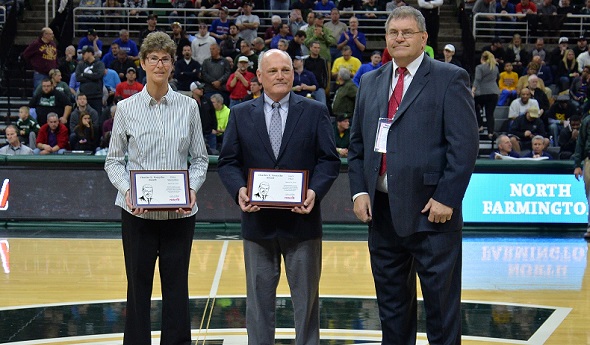
In recognition of their efforts, they have been named the 2016 recipients of the Michigan High School Athletic Association’s Charles E. Forsythe Award.
The annual award is in its 39th year and named after former MHSAA Executive Director Charles E. Forsythe, the Association's first full-time and longest-serving chief executive. Forsythe Award recipients are selected each year by the MHSAA Representative Council, based on an individual's outstanding contribution to the interscholastic athletics community. Hice and Mazzolini will receive their honors during the break after the first quarter of the MHSAA Class A Boys Basketball Final on March 26 at the Breslin Student Events Center in East Lansing.
Hice retired in 2014 after 30 years as Petoskey’s athletic director overseeing one of the most successful programs in northern Michigan that regularly produced contenders for championships statewide. Under his leadership, Petoskey added five sports, revamped its facilities and became a founding member of the Big North Conference after Hice contributed to its creation.
Mazzolini has served the MHSAA since 1993 and is the administrator for girls volleyball, swimming and diving, alpine skiing and tennis. She also handles the sanctioning of out-of-state competitions and serves as the MHSAA’s point person on foreign exchange and international student issues. Mazzolini will receive a Citation from the National Federation of State High School Associations this summer and was the 2010 recipient of the MHSAA’s Women in Sports Leadership Award.
“Gary Hice and Gina Mazzolini have contributed to Michigan high school athletics on a variety of levels providing vision, leadership and dedication,” MHSAA Executive Director John E. “Jack” Roberts said. “Gary Hice served as a leader of leaders in northern Michigan and provided an example to be followed statewide, while Gina Mazzolini has shaped rules and policies that have impacted programs not only in our state, but nationally as well. We’re proud to honor Gary Hice and Gina Mazzolini with Forsythe Awards.”
 After his year at Charlevoix, Hice taught social studies and physical education and coached for one year at Petoskey before spending five years as director of parks and recreation and harbormaster for the City of Petoskey. He returned to the high school as athletic director in 1984.
During his tenure, Petoskey added girls golf, girls soccer, girls bowling, boys bowling and ice hockey programs. Petoskey teams won MHSAA Finals championships in boys skiing, girls skiing, wrestling, boys soccer and boys tennis, and the girls cross country and track and field teams were among those that earned runner-up finishes. The Petoskey girls ski team won four straight titles from 1991-94, and the boys ski team started a championship streak that last month reached six straight seasons. Hice also led the construction in 2000 of a $6-million gymnasium, weight room, wrestling practice area and indoor track at Petoskey High School, and initiated the school’s athletic Hall of Fame.
Hice is a member of both the Michigan Interscholastic Athletic Administrators Association and National Interscholastic Athletic Administrators Association. He was named state Athletic Director of the Year by the MIAAA in 2011 after receiving its George Lovich Award of Merit in 2008. He also was honored with the MHSAA’s Allen W. Bush Award in 2002 for his often-unseen contributions to high school athletics.
“When you’re in the heat of the battle, you don’t think on those terms,” Hice said of his many contributions and their lasting effects locally and beyond. “But toward the end of my career, I would relish the times when I could help young ADs, new ADs, people who didn’t have a lot of experience. In fact, I miss that today.”
Hice is a longtime member of Kiwanis Clubs, first of Petoskey and currently of Little Traverse Bay, and also has served with the Petoskey Education Foundation, Jeffrey P. Bodzick Memorial Scholarship Foundation and Beyond the Scoreboard initiative that promotes positive character and sportsmanship in northern Michigan’s youth and interscholastic athletics.
 After standout basketball and volleyball careers at St. Johns High School and Central Michigan University, Mazzolini taught and coached multiple sports during the 1979-80 school year at Ovid-Elsie High School. She then spent two years teaching and serving as an assistant volleyball coach at Michigan State University, where she also earned her master’s degree in physical education. Mazzolini then left to teach and serve as assistant volleyball coach and interim women’s Sports Information Director at the University of Texas.
In 1982, Mazzolini became an activities director with the University Interscholastic League, the service organization to high school activities in Texas. She became an assistant athletic director at the UIL in 1988, and five years later she returned to Michigan as a member of the MHSAA staff.
"To be recognized by my peers for this award … I’m appreciative and humbled," Mazzolini said. "You do those things because you enjoy them.”
In addition to her work at the MHSAA, Mazzolini has provided a long list of contributions at the national level. She has served as the NFHS representative on the board for the Council on Standards for International Educational Travel, which identifies, promotes and supports international youth exchange programs, and has sat on several CSIET committees. She’s currently serving on the NFHS Annual Meeting Planning Committee and also has served on NFHS rules committees for soccer, swimming and diving, and volleyball (chairing that sport’s rules committee from 2004-08), and on NFHS advisory committees for athletic directors and sports medicine.
She recently was inducted into the Michigan High School Ski Coaches Association Hall of Fame and has served as a voter for the Greater Lansing Sports Hall of Fame.
Mazzolini graduated from St. Johns High School in 1974 after an accomplished career that included leading the Redwings to a District title in the first MHSAA Girls Basketball Tournament in 1973. She went on to star in both basketball and volleyball at CMU; she graduated in 1978 as the leading scorer, rebounder and shot-blocker in CMU history and still ranks among the Chippewas’ leaders in multiple statistical categories. She was inducted into the CMU Athletic Hall of Fame in 1992.
Hice graduated from Ann Arbor Huron High School in 1970. He earned his bachelor’s degree at Eastern Michigan University in 1974 and his master’s at CMU in 1989, and received Certified Athletic Administrator certification from the NIAAA in 1994.
Past recipients
1978 - Brick Fowler, Port Huron; Paul Smarks, Warren
1979 - Earl Messner, Reed City; Howard Beatty, Saginaw
1980 - Max Carey, Freesoil
1981 - Steven Sluka, Grand Haven; Samuel Madden, Detroit
1982 - Ernest Buckholz, Mt. Clemens; T. Arthur Treloar, Petoskey
1983 - Leroy Dues, Detroit; Richard Maher, Sturgis
1984 - William Hart, Marquette; Donald Stamats, Caro
1985 - John Cotton, Farmington; Robert James, Warren
1986 - William Robinson, Detroit; Irving Soderland, Norway
1987 - Jack Streidl, Plainwell; Wayne Hellenga, Decatur
1988 - Jack Johnson, Dearborn; Alan Williams, North Adams
1989 - Walter Bazylewicz, Berkley; Dennis Kiley, Jackson
1990 - Webster Morrison, Pickford; Herbert Quade, Benton Harbor
1991 - Clifford Buckmaster, Petoskey; Donald Domke, Northville
1992 - William Maskill, Kalamazoo; Thomas G. McShannock, Muskegon
1993 - Roy A. Allen Jr., Detroit; John Duncan, Cedarville
1994 - Kermit Ambrose, Royal Oak
1995 - Bob Perry, Lowell
1996 - Charles H. Jones, Royal Oak
1997 - Michael A. Foster, Richland; Robert G. Grimes, Battle Creek
1998 - Lofton C. Greene, River Rouge; Joseph J. Todey, Essexville
1999 - Bernie Larson, Battle Creek
2000 - Blake Hagman, Kalamazoo; Jerry Cvengros, Escanaba
2001 - Norm Johnson, Bangor; George Lovich, Canton
2002 - John Fundukian, Novi
2003 - Ken Semelsberger, Port Huron
2004 - Marco Marcet, Frankenmuth
2005 - Jim Feldkamp, Troy
2006 - Dan McShannock, Midland; Dail Prucka, Monroe
2007 - Keith Eldred, Williamston; Tom Hickman, Spring Lake
2008 - Jamie Gent, Haslett; William Newkirk, Sanford-Meridian
2009 - Paul Ellinger, Cheboygan
2010 - Rudy Godefroidt, Hemlock; Mike Boyd, Waterford
2011 - Eric C. Federico, Trenton
2012 - Bill Mick, Midland
2013 - Jim Gilmore, Tecumseh; Dave Hutton, Grandville
2014 - Dan Flynn, Escanaba
2015 – Hugh Matson, Saginaw
PHOTO: From left, Gina Mazzolini and Gary Hice receive Forsythe Awards on March 26 from Benton Harbor athletic director Fred Smith.