

Using Heads in the Heat of Competition
December 20, 2013
By Rob Kaminski
MHSAA benchmarks editor
With so much recent attention to the risks and recognition of concussions in collision sports, athletic leaders have put their heads together to address far more common – but often overlooked – threats to the health of our student-athletes: heat and sudden cardiac arrest.
The No. 1 killer of young athletes is sudden cardiac arrest, while heat stroke victims can surpass that during the year’s hottest months. While the moment of impact leading to a concussion is totally unpredictable, athletic trainers, coaches and administrators have the ability to diminish the occurrences of cardiac arrest and heatstroke. Typically, there is a pre-existing condition, or family history suggesting probabilities for sudden cardiac arrest, which can be treated when detected. And, the perils associated with hot weather – heat stroke, prostration – are almost always completely preventable.
The MHSAA has addressed both issues recently. With assistance from numerous medical governing bodies, the annual pre-participation physical form was revamped and expanded prior to the 2011-12 school year to include comprehensive information regarding participants’ medical history.
In May, the Representative Council adopted a Model Policy for Managing Heat & Humidity (see below), a plan many schools have since adopted at the local level. The plan directs schools to monitor the heat index at an activity site once the air temperature reaches 80 degrees and provides recommendations when the heat index reaches certain levels, including ceasing activities when it rises above 104 degrees.
The topic of heat-related illnesses receives a lot of attention at the start of fall when deaths at the professional, collegiate and interscholastic levels of sport occur, especially since they are preventable in most cases with the proper precautions. In football, data from the National Federation of State High School Associations shows 41 high school players died from heat stroke between 1995 and 2012.
“We know now more than we ever have about when the risk is high and who is most at risk, and we’re now able to communicate that information better than ever before to administrators, coaches, athletes and parents," said Jack Roberts, executive director of the MHSAA. “Heat stroke is almost always preventable, and we encourage everyone to avail themselves of the information on our website.
“Schools need to be vigilant about providing water during practices, making sure that students are partaking of water and educating their teams about the need for good hydration practices.”
All of which is not to say concussions aren’t a serious matter; they are. In fact, leaders in sport safety can take advantage of the concussion spotlight to illuminate these additional health threats.
A recent New York Times story (May 2013) by Bill Pennington featured a February 2013 gathering in Washington organized by the National Athletic Trainers Association. In the article, Dr. Douglas J. Casa, professor of kinesiology at the University of Connecticut and Chief Operating Officer of the Korey Stringer Institute (founded in the late NFL offensive lineman’s name to promote prevention of sudden death in sport), suggests just that.
“All the talk about head injuries can be a gateway for telling people about the other things they need to know about, like cardiac events and heat illness,” said Casa in the article. “It doesn’t really matter how we get through to people as long as we continue to make sports safer.”
Education and prevention methods need to find a permanent place in school programs if those programs are to thrive and avoid becoming targets at which special interest groups can aim budgetary arrows.
Dr. Jonathan Drezner, the president of the American Medical Society for Sports Medicine, said in the New York Times piece that sudden cardiac arrest is “so incredibly tragic and stunning that people aren’t comfortable putting it into the everyday conversation. I do wish, to some extent, it was something people talked more about because we are getting to a place where we could prevent many of these deaths.”
When it comes to heat-related deaths or illnesses, the prevention efforts can be even more successful by educating the masses. And, these efforts can be done at minimal cost to schools.
“That’s the thing about curtailing exertional heat illness: it’s 100 percent preventable, and unlike other health threats to athletes, the solutions can be very low-tech and inexpensive,” said Dr. Michael F. Bergeron, the director of the National Institute for Athletic Health & Performance at the University of South Dakota’s Sanford Medical Center, in the New York Times story.
To assist with cost and data maintenance, the MHSAA has teamed with Sports Health to provide schools with psychrometers (heat measurement instruments) at a discounted rate, and has built online tools to track heat and humidity conditions.
Managing heat and humidity policy
- Thirty minutes prior to the start of an activity, and again 60 minutes after the start of that activity, take temperature and humidity readings at the site of the activity. Using a digital sling psychrometer is recommended. Record the readings in writing and maintain the information in files of school administration. Each school is to designate whose duties these are: generally the athletic director, head coach or certified athletic trainer.
- Factor the temperature and humidity into a Heat Index Calculator and Chart to determine the Heat Index. If a digital sling psychrometer is being used, the calculation is automatic.
If the Heat Index is below 95 degrees:
All Sports
- Provide ample amounts of water. This means that water should always be available and athletes should be able to take in as much water as they desire.
- Optional water breaks every 30 minutes for 10 minutes in duration.
- Ice-down towels for cooling.
- Watch/monitor athletes carefully for necessary action.
If the Heat Index is 95 degrees to 99 degrees:
All Sports
- Provide ample amounts of water. This means that water should always be available and athletes should be able to take in as much water as they desire.
- Optional water breaks every 30 minutes for 10 minutes in duration.
- Ice-down towels for cooling.
- Watch/monitor athletes carefully for necessary action.
Contact sports and activities with additional equipment:
- Helmets and other possible equipment removed while not involved in contact.
- Reduce time of outside activity. Consider postponing practice to later in the day.
- Recheck temperature and humidity every 30 minutes to monitor for increased Heat Index.
If the Heat Index is above 99 degrees to 104 degrees:
All Sports
- Provide ample amounts of water. This means that water should always be available and athletes should be able to take in as much water as they desire.
- Mandatory water breaks every 30 minutes for 10 minutes in duration.
- Ice-down towels for cooling.
- Watch/monitor athletes carefully for necessary action.
- Alter uniform by removing items if possible.
- Allow for changes to dry T-shirts and shorts.
- Reduce time of outside activity as well as indoor activity if air conditioning is unavailable.
- Postpone practice to later in the day.
Contact sports and activities with additional equipment
- Helmets and other possible equipment removed if not involved in contact or necessary for safety.
- If necessary for safety, suspend activity.
Recheck temperature and humidity every 30 minutes to monitor for increased Heat Index.
If the Heat Index is above 104 degrees:
All sports
- Stop all outside activity in practice and/or play, and stop all inside activity if air conditioning is unavailable.
Note: When the temperature is below 80 degrees there is no combination of heat and humidity that will result in need to curtail activity.
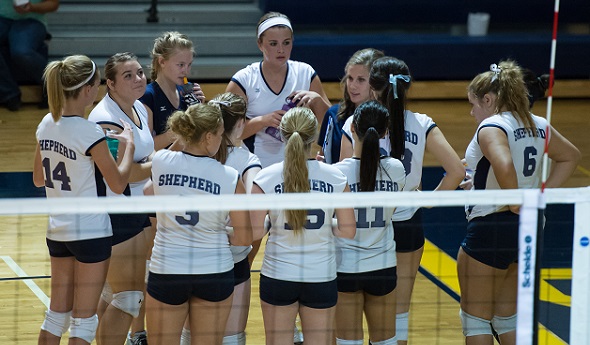
PHOTO: The Shepherd volleyball team includes hydration during a timeout in a match this fall.
High School a Time for Plays of All Kinds
April 2, 2015
By Jack Roberts
MHSAA executive director
At end of season or school year banquets attended by student-athletes and their parents, I often tell this short story about my mother that never fails to get a good laugh, especially from mothers:
“At the end of my junior year of high school I attended the graduation ceremony for the senior class on a hot and humid early June evening in our stuffy high school gymnasium. The bleachers on each side were filled to capacity, as were several hundred folding chairs placed on the gymnasium floor.
“The public address system, which was wonderful for announcing at basketball games or wrestling meets, was awful for graduation speeches. Person after person spoke, and the huge audience wondered what they had to say.
“I was present because I was the junior class president; and as part of the ceremony, the senior class president handed me a small shovel. It had something to do with accepting responsibility or carrying on tradition.
“In any event, the senior class president spoke briefly; and then it was my turn. I stepped to the podium, pushed the microphone to the side, and spoke in a voice that was heard and understood in every corner of the gymnasium.
“Whereupon my mother, sitting in one of the folding chairs, positioned right in front of my basketball coach – who had benched me for staying out too late on the night before a game, because I had to attend a required school play rehearsal – my mother turned around, pointed her finger at the coach and said, ‘See there? That’s what he learned at play practice!’
“And she was heard in every corner of the gymnasium too.
“But my mother knew – she just knew – that for me, play practice was as important as basketball practice. And she was absolutely correct.”
This old but true story about in-season demands of school sports actually raises two of the key issues of the debate about out-of-season coaching rules.
One is that we are not talking only about sports. School policies should not only protect and promote opportunities for students to participate in more than one sport; they should also allow for opportunities for students to participate in the non-athletic activities that comprehensive, full-service schools provide.
This is because surveys consistently link student achievement in school as well as success in later life with participation in both the athletic and non-athletic activities of schools. Proper policies permit students time to study, time to practice and play sports and time to be engaged in other school activities that provide opportunities to learn and grow as human beings.
A second issue the story presents is that parents have opinions about what is best for their children. In fact, they feel even more entitled to express those opinions today than my mother did almost 50 years ago. In fact, today, parents believe they are uniquely entitled to make the decisions that affect their children. And often they take the attitude that everyone else should butt out of their business!
The MHSAA knows from direct experience that while school administrators want tighter controls on what coaches and students do out of season, and that most student-athletes and coaches will at least tolerate the imposed limits, parents will be highly and emotionally critical of rules that interfere with how they raise their children.
No matter the cost in time or money to join elite teams, take private lessons, travel to far-away practices and further-away tournaments, no matter how unlikely any of this provides the college athletic scholarship return on investment that parents foolishly pursue, those parents believe they have every right to raise their own children their own way and that it’s not the MHSAA’s business to interfere.
It is for this very reason that MHSAA rules have little to say about what students can and can’t do out of season. Instead, the rules advise member schools and their employees what schools themselves have agreed should be the limits. The rules do this to promote competitive balance. They do this in order to avoid never-ending escalating expense of time and money to keep up on the competitive playing field, court, pool, etc.
Every example we have of organized competitive sports is that, in the absence of limits, some people push the boundaries as far as they can for their advantage, which forces other people to go beyond what they believe is right in order to keep up.
If, during the discussions on out-of-season rules, someone suggests that certain policies be eliminated, thinking people will pause to ask what life would be like without those rules.
Our outcome cannot be mere elimination of regulation, which invites chaos; the objective must be shaping a different future.
A good start would be simpler, more understandable and enforceable rules. A bad ending would be if it forces more student-athletes and school coaches to focus on a single sport year-round.