

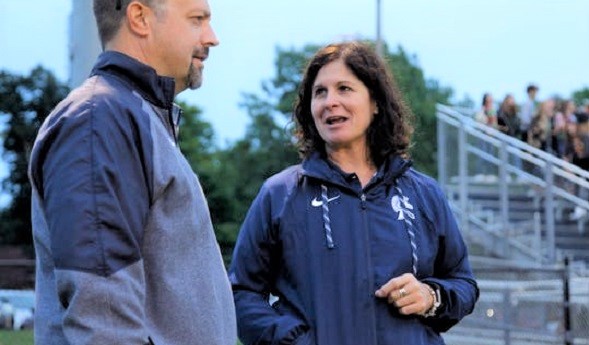
WISL Honoree Leads by Making Connections
By
Geoff Kimmerly
MHSAA.com senior editor
January 29, 2020
Nikki Norris received her life’s education from professional educators. Her father Howes Smith served as an assistant principal and then principal at Ithaca High School, and her mother Maple was a teacher. Howes’ mom also taught.
Their influence and example certainly rubbed off on Nikki and her siblings. Norris has worked in education for more than 30 years, while her sister is a school guidance counselor and their brother a college professor.
In fact, Norris has impacted educational athletics in nearly every role possible as a teacher and athletic director at multiple schools, coach at various levels and game official. She is in her second year as athletic director at East Lansing High School after eight in that position for Corunna Public Schools. She previously taught for six years at Carson City-Crystal and then 11 at Corunna before taking over the Cavaliers’ athletic department during the summer of 2010.
She also coached volleyball at multiple levels over more than 15 years including Corunna’s varsity from 1999-2002 and 2006-09, and coached high school basketball for a combined eight years during her time at the two schools where she taught. Before and between her volleyball coaching stints, Norris also has served as an MHSAA registered volleyball official for a total of 12 years.
Norris’ many and continuing contributions will be celebrated Sunday, Feb. 2, when she receives the Michigan High School Athletic Association’s 33rd Women In Sports Leadership Award during the WISL Banquet at the Crowne Plaza Lansing West.
“I try to connect with all students, athletes or not, because there are so many kids who just need a connection," Norris said. "And if we can find it through sports, or through clubs, or teaching – I do look at them all as my own children, to a certain extent. We used to say in Corunna, 'They're all our kids.' And I want them to be successful in whatever it is they want. And if I can help them, that's what I'm there for.
“So many people did it for me. Coming from a family of educators, and my dad an administrator, I knew what that entailed as far as how they get into your heart. I want to do that for kids.”
Each year, the MHSAA Representative Council considers the achievements of women coaches, officials and athletic administrators affiliated with the MHSAA who show exemplary leadership capabilities and positive contributions to athletics.
Those who wrote letters recommending Norris for this year’s WISL Award especially noted that personal impact she has on students, staff and colleagues.
Fowlerville athletic director Brian Osborn – one of her former coaches – wrote of how Norris goes above and beyond to care for and connect with her student-athletes. Owosso athletic director Dallas Lintner wrote of Norris’ dedication to children’s safety and educational values. Fenton athletic director Mike Bakker noted how fortunate her students are that Norris made the decision to leave coaching for administration, where she can have an even larger impact.
“Someone asked me once, why do you want to be an athletic director? Well, I can go from impacting 100 kids a day, at that time (as a coach and teacher), to maybe 600 kids a day, to now 1,200 kids a day (at East Lansing),” Norris said, then quipping, “Well, maybe (not all) 1,200 every day.”
But she does continue to lead on wide-ranging levels, both at her much larger school and beyond.
 While at Corunna, Norris served as master scheduler and part of the constitution committee for the Genesee Area Conference. Her schools have hosted various MHSAA Tournament events in multiple sports, in addition to local invitationals and conference meets. She’s served on every type of MHSAA Committee, providing input on a variety of sports, site selection, officials selection and the Scholar-Athlete Award. She also annually volunteers as a tournament administrator at the MHSAA’s Volleyball Finals in November and Baseball/Softball/Girls Soccer Finals in June.
A certified Red Cross instructor, Norris has provided CPR/AED training to coaches, bus drivers and staff members. Corunna in multiple years received the state’s HEARTSafe School designation recognizing preparedness to respond to cardiac emergencies.
As a member of the Michigan Interscholastic Athletic Administrators Association (MIAAA), she has facilitated sessions and presented at its conferences and served on the newsletter committee.
She was named the MIAAA’s Region 7 “Athletic Director of the Year” in 2016. She also has received “Certified Athletic Administrator” designation from the National Interscholastic Athletic Administrators Association (NIAAA).
“Nikki is one of the most genuine, caring and hard-working people I’ve ever met in athletics,” MHSAA Executive Director Mark Uyl said. “She has worked extremely hard in both Corunna and East Lansing to develop a first-class program that produced high-character people. Nikki is truly a role model to everyone in the world of athletic administration.”
A 1987 graduate of Ithaca High School, Norris received her bachelor’s degree in biology with a minor in exercise health science from Alma College – where she also competed as a runner and thrower in track & field – and then earned master’s degrees in biological sciences from Michigan State University and educational leadership from American College of Education.
Norris lives in Bancroft and is the mother to two daughters, Meredith and Elizabeth Norris. Neither is planning to go into education – but sports is a big part of both their current lives and likely futures, and no doubt the impact of growing up in a sports family has played a significant part. (Their dad, Dr. Robert Norris, played basketball at Alma College and serves as physician for the MSU hockey, volleyball and baseball programs and Lansing Lugnuts.)
Meredith was named the state’s Miss Volleyball Award winner in 2017 as a senior at Corunna and plays currently at Michigan State. Elizabeth is a senior at Corunna and was a finalist for the same award this past fall, and will continue her academic and volleyball careers at University of North Dakota. Meredith is majoring in kinesiology, and Elizabeth is planning on orthopedic surgery.
“I look at the names that are on the (WISL Award) list, and there are so many deserving women who over my career I've looked up to and aspired to be like when I 'grow up,'" Norris said. "So to even be considered in that group is amazing, humbling. It's an honor."
Past recipients of the Women In Sports Leadership Award
1990 – Carol Seavoy, L’Anse
1991 – Diane Laffey, Harper Woods
1992 – Patricia Ashby, Scotts
1993 – Jo Lake, Grosse Pointe
1994 – Brenda Gatlin, Detroit
1995 – Jane Bennett, Ann Arbor
1996 – Cheryl Amos-Helmicki, Huntington Woods
1997 – Delores L. Elswick, Detroit
1998 – Karen S. Leinaar, Delton
1999 – Kathy McGee, Flint
2000 – Pat Richardson, Grass Lake
2001 – Suzanne Martin, East Lansing
2002 – Susan Barthold, Kentwood
2003 – Nancy Clark, Flint
2004 – Kathy Vruggink Westdorp, Grand Rapids
2005 – Barbara Redding, Capac
2006 – Melanie Miller, Lansing
2007 – Jan Sander, Warren Woods
2008 – Jane Bos, Grand Rapids
2009 – Gail Ganakas, Flint; Deb VanKuiken, Holly
2010 – Gina Mazzolini, Lansing
2011 – Ellen Pugh, West Branch; Patti Tibaldi, Traverse City
2012 – Janet Gillette, Comstock Park
2013 – Barbara Beckett, Traverse City
2014 – Teri Reyburn, DeWitt
2015 – Jean LaClair, Bronson
2016 – Betty Wroubel, Pontiac
2017 – Dottie Davis, Ann Arbor
2018 – Meg Seng, Ann Arbor
2019 – Kris Isom, Adrian
PHOTOS: (Top) East Lansing athletic director Nikki Norris confers with Grand Ledge athletic director Steve Baker during a 2018 football game. (Middle) Norris with daughters Elizabeth, left, and Meredith, after Nikki presented the Cavaliers with a District championship trophy won in 2016. (Top photo courtesy of the Lansing State Journal; middle photo courtesy of Nikki Norris.)

Vermontville Star Named to NFHS Hall
By
Geoff Kimmerly
MHSAA.com senior editor
March 1, 2016
Record-setting Vermontville High School baseball star Ken Beardslee, who continues to hold two national strikeout records more than 65 years after his final high school pitch, was one of 12 individuals named Tuesday to the National High School Sports Hall of Fame by the National Federation of State High School Associations (NFHS).
 Beardslee, who died in 2007, will be inducted as one of five athletes selected for the 34th Hall of Fame class at a ceremony during the NFHS summer meeting July 2 in Reno, Nev.; the rest of the class is made up of coaches, administrators and an official. He was nominated through the Michigan High School Athletic Association.
Beardslee has been proclaimed as “prep baseball’s first ace” in the NFHS National High School Sports Record Book and was featured in the former print version of the book for his incredible feats from 1947-49. In his three years on the mound for Vermontville, Beardslee won 24 of his 25 starts (the team was 31-1 during that time). His 24 victories included eight no-hitters, with two perfect games, and seven one-hitters.
He set seven national records, and two still stand after 66 years: his per-game season strikeout mark of 19.0 and his per-game career strikeout mark of 18.1.
Beardslee will become the Hall of Fame’s eighth inductee from Michigan, joining Charles Forsythe, the first executive director of the Michigan High School Athletic Association (inducted 1983); River Rouge boys basketball coach Lofton Greene (1986), Warren Regina softball coach Diane Laffey (2000), Fennville basketball, football, track and baseball standout Richie Jordan (2001), Grosse Pointe Woods University Liggett boys and girls tennis coach Bob Wood (2005), Bloomfield Hills Cranbrook hockey standout Jim Johnson (2007) and Owosso football, basketball and baseball all-stater Brad Van Pelt (2011).
“It’s been said that records are made to be broken,” wrote MHSAA Executive Director John E. “Jack” Roberts in his letter supporting Beardslee’s nomination. “But the strikeout numbers Ken Beardslee recorded in the late 1940s have stood the test of time, just like some of the shutout and strikeout numbers 2009 Hall of Fame honoree David Clyde amassed some 20 years later. But Clyde never came close to Beardslee’s 19.0 Ks per game in a season or 18.1 per game for a career, and neither has anyone else.”
Beardslee is listed 10 times in the MHSAA record book. He shares the record for career no-hitters and is second with two career perfect games and a 0.32 career earned run average. In addition to his two national strikeout records still standing, he’s listed in the MHSAA records with games of 26, 25 (both extra innings) and 20 strikeouts (in seven innings) during the 1949 season. His 209 strikeouts that spring rank fourth for one season in MHSAA history, and his 452 over three seasons rank 12th on the career strikeouts list.
Beardslee was drafted by the New York Yankees immediately after graduating from high school and pitched in the minor leagues from 1949 to 1956, when an injury ended his playing career. Beardslee went on to scout for the Pittsburgh Pirates for 21 years, and he received a World Series ring after the team’s championship win in 1971. He also went on to write eight books including novels, poetry and an instructional on pitching.
He is survived by his wife Marilene, who is expected to attend the ceremony this summer to accept his honor.
The National High School Hall of Fame was started in 1982 by the NFHS. This year’s class increases the number of individuals in the Hall of Fame to 447.
The 12 individuals were chosen after a two-level selection process involving a screening committee composed of active high school state association administrators, coaches and officials, and a final selection committee composed of coaches, former athletes, state association officials, media representatives and educational leaders. Nominations were made through NFHS member associations. Also chosen for this class were athletes Steve Spurrier (Tennessee), Marlin Briscoe (Nebraska), Joni Huntley (Oregon) and Tom Southall (Colorado); coaches Chuck Kyle (Ohio), Peg Kopec (Illinois), Pete Boudreaux (Louisiana) and Jack Holloway (Delaware); administrators Tim Flannery (NFHS) and Ennis Proctor (Mississippi), and official Eugene “Lefty” Wright (Minnesota).
For more on this year’s Hall of Fame class, visit the NFHS Website. For more on Michigan’s past inductees, visit the MHSAA Website.