


Working Through Transfer Trends
December 2, 2015
By Jack Roberts
MHSAA Executive Director
One of the responsibilities that schools have asked organizations like the MHSAA to execute is the management of transfer student eligibility. Historically, many associations have linked eligibility to residence ... thus, for some the regulation has been called the “Residency Rule” or “Transfer/Residency Rule,” not merely the “Transfer Rule.”
Over the years, as society became more mobile and families less stable, these rules became more and more complicated; and now, for most state high school associations, this is the regulation that consumes the most (or second) most pages of their handbooks. Over the years, this has also been the regulation most frequently challenged in court.
Over the years, some states have relaxed their transfer rule and others have refined their transfer rule. In either case, the transfer rule remains an imperfect rule, an imperfect net. Sometimes this net snags students who should not be made ineligible, and for those situations all associations have arranged some kind of waiver or appeal process.
And sometimes, and much less easily solved, the net fails to catch the situations it really should ... the transfers that are not hardship related or the result of some very compelling educational need, but those that are obviously for athletic reasons. It is those that we have been most focused on in Michigan.
Our first effort to get at the most problematic transfers was the adoption for the 1997-98 school year of what we called the “Athletic-MOTIVATED Transfer Rule” ... Regulation I, Section 9(E). Examples of an athletic-motivated transfer are included in the rule. The rule only applies to transfer students who do NOT meet any of the stated exceptions for immediate eligibility and are ineligible for one semester under our basic transfer rule. They become ineligible for 180 scheduled school days if there is a finding that the transfer was more for athletics than any other compelling reason.
This effort has not been successful enough because it requires a school that loses a student to another school to promptly allege to the MHSAA office, with supporting documentation, that the transfer was more for athletic reasons than any other compelling reason. The receiving school then must respond to those allegations. Then the executive director makes the decision. The unfortunate result of applying this rule is that it usually causes hard feelings between the schools, and hard feelings toward the executive director by the school decided against. In 17 years, schools have invoked this rule only 45 times.
Our more recent effort to address the most egregious athletic transfers resulted from requests from the coaches associations for wrestling and basketball, which were watching too many students change schools for athletic reasons, usually related to an out-of-season coaching relationship. The new rule – the “Athletic-RELATED Transfer Rule” – is Regulation I, Section 9(F). The difference between Section 9(E) and the newer Section 9(F) is that in 9(F) one school does not have to make and document allegations before staff can act. If MHSAA staff discover or are informed of any of the circumstances listed in 9(F), we can act. Again, the rule only applies to those transfer students whose circumstances do NOT meet one of the automatic exceptions. It applies only to students who are ineligible for a semester under the basic transfer rule. If there is a finding that one of the athletic related “links” exists (usually an out-of-season coaching relationship), then this transfer student who would be ineligible for one semester is made ineligible for 180 scheduled school days.
So far, it appears that 9(F) may be a better deterrent than 9(E). It has been referenced when students are rumored to be transferring, and it has stopped many of those transfers before they occur. We expect 9(F) to be an even better deterrent in 2015-16 because the rule has been broadened to apply to administrators and parents (not just coaches) and to address directing and coordinating athletic activities (not just coaching).
We have said that if this latest effort does not succeed in slowing athletic transfers, then the next step is 180 days of ineligibility – at least in any sport the student played in high school previously – for all transfer students who do not qualify for an exception that permits immediate play. I fear that would catch far too many students who should not be withheld so long from competition and could lead to a period like the early 1980s when the MHSAA, at the request of the state principals association, adopted the core of the transfer rule we have today and which resulted in a period of busiest litigation for the MHSAA when, at one time, the association had more than a dozen cases in court simultaneously on transfer matters. We’ve got to make the current rules work – with tweaks, perhaps; but not with radical revision.
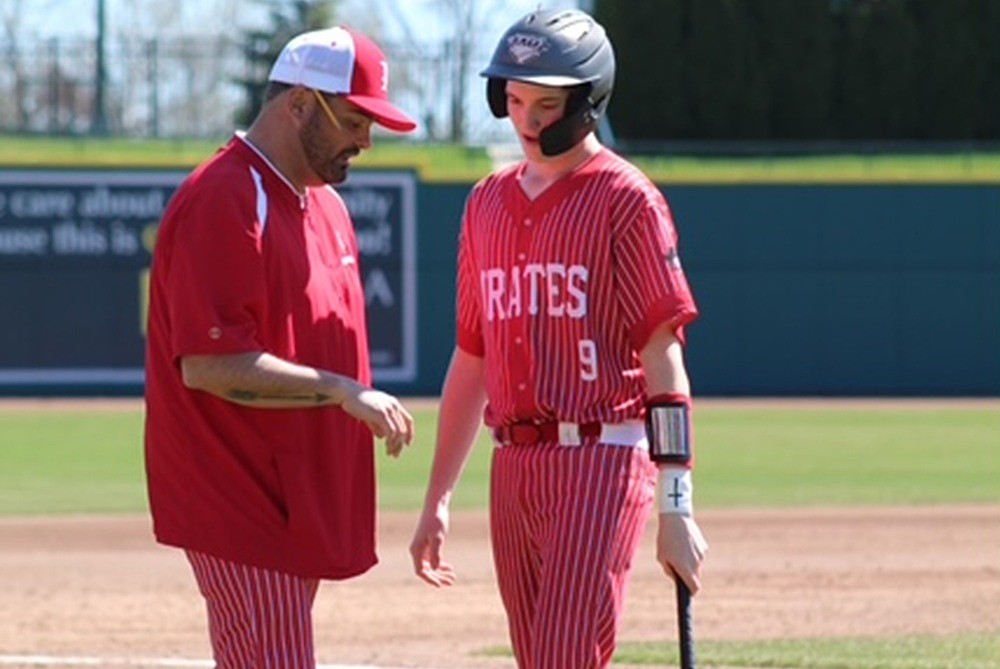
Peck Bands Together to Honor Welch's Memory as Pirates Return to Diamond
By
Paul Costanzo
Special for MHSAA.com
April 15, 2026
Bill Kerr didn’t need to spend much time back at the Little League fields in Peck before his childhood friend James Welch caught his ear.
 Not in conversation, but from the dugout, doing one of the things he loved most – coaching kids.
“When I got back to Peck 10 years ago, he was coaching Little League. We started talking about how we could get him in front of more kids and doing more,” said Kerr, the Peck superintendent. “I always joked that I was recruiting him. I’ve been around coaches forever, evaluated coaches forever, and you could just hear it, even at the Little League fields. You could hear his message and how strong it was.”
Kerr brought Welch on board at Peck, first as the baseball coach and eventually as athletic director, and over a few short years he made an out-sized impact on the kids he worked with and the community at large.
Welch died unexpectedly on Nov. 6, 2025, but that impact is still being felt today on the baseball diamond and beyond.
“He was always so authentic and positive with (students),” Kerr said. “In this day and age, a lot of adults are kind of hesitant to kind of address some of the things that don’t apply on the field. He and I talked a lot about making them good people and leaders rather than worry about what type of athlete they were. That was the most important thing to him, with his baseball players, he wanted to make sure they were good people.”
The Peck gymnasium was required to host all the people who showed up for Welch’s memorial service, and school was canceled the day after his passing.
His players were there, however.
“The next day we had school off, but the school was open because staff had to report,” said Jen Kluger, Welch’s friend and assistant coach. “All the boys came in. We all sat in James’ office and talked and cried. We were just together.”
Kluger, who began working in Peck in 2023, was surprised at how much the community came together in the days after Welch’s passing.
“It happened on a Thursday, and that Sunday we had a booster meeting because the funeral was going to be at the school and the boosters were going to handle everything,” Kluger said. “Normally, we have five or six people show up, and on that day, I don’t even know how many people were there. I was blown away. Jessica Royle is the booster president and we were texting a couple days later, I was like, ‘I am blown away by all these people that just showed up.’ She was like, ‘That’s Peck. That’s what they do.’”
While the entire community was mourning Welch, it was also there to support his family – his wife Shane and son Grady, who is a junior at Peck.
 “I would say it definitely helped,” Grady said. “I felt like I wasn’t alone in grieving. Everyone in the whole community knew him, knew everything about him and what he stood for.”
The Welch family was part of the Peck community long before James began working at the school. He was a star athlete for the Pirates during the 1990s, playing football, basketball and baseball. He was part of the 1995 Peck football team that advanced to the Semifinals, and the 1994 baseball team that advanced to the Quarterfinals.
That 1994 team was inducted into the Peck High School Hall of Fame – something Welch worked with Kerr to establish – shortly after his passing.
“He was like one of those five-tool guys,” said Kerr, who graduated from Peck a year before Welch. “His best sport was football, but he was a very good baseball player.”
Now, while weather has not allowed them to get onto the field much for practice let alone play a game, Welch’s players are together again for the start of baseball season. Kluger has taken over the program as coach, which was announced in December.
“The day before we went on Christmas break, I called them all down to the gym, and I couldn’t say anything until the board approved it, so I had to sit on it for three weeks,” Kluger said. “I sat them all down, and I didn’t know how they were going to react. They didn’t seem upset about it. I got some hugs, got some claps, got some high fives.”
Not only were the players not upset, it’s the move they wanted as they had to move into a world without their coach.
“It definitely helped a lot,” Grady Welch said. “She knew how my dad ran practices, everyone knows her and she’s a nice person. It definitely helps to transition into baseball season knowing that things aren’t going to change.”
Of course, for Grady, it’s much more than simply not having a coach. He admits that the beginning of the season has been difficult – as does Kluger – but his teammates have been there to lift him up when he needs it. Many of them have been his teammates, and played for his father, since T-ball.
“I always have my space if I do need to take space,” Grady said. “But we’ve always been a group that’s been together all the time. We have a very good friendship between all of us.”
To honor James Welch, Kerr said supporters are working to create a scholarship in his name, and that his former high school number will be hung on the outfield fence at Peck.
Welch wore No. 9, as his father’s favorite player was Roger Maris. That number has been worn the past two years by Grady, who switched to it in middle school because of his dad.
Stepping onto the field in a game for the first time – which would be Thursday if weather permits – is certain to be an emotional moment for Kluger, Grady, his teammates and everyone in attendance. But it will also be the next step in honoring Welch by being together and playing the sport he loved.
“There’s a few that are going to struggle (emotionally),” Kluger said. “But I think at this point, they all want to be on the field and want to play.”
 Paul Costanzo served as a sportswriter at The Port Huron Times Herald from 2006-15, including three years as lead sportswriter, and prior to that as sports editor at the Hillsdale Daily News from 2005-06. He can be reached at [email protected] with story ideas for Genesee, Lapeer, St. Clair, Sanilac, Huron, Tuscola, Saginaw, Bay, Arenac, Midland and Gladwin counties.
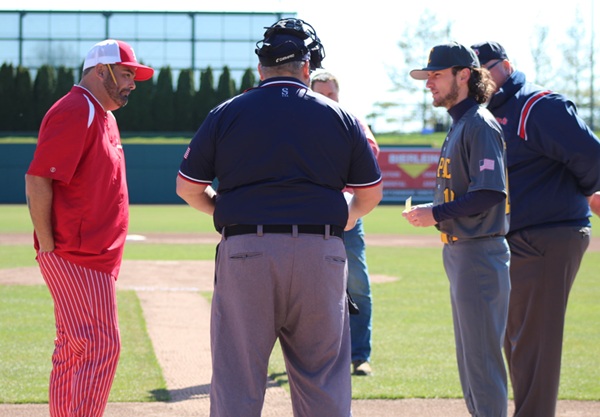
PHOTOS (Top) Peck baseball coach James Welch, left, talks with son Grady during a game from a recent season. (Middle) Welch, far left, stands at the plate for a pregame conference before taking on Capac. (Photos provided by Jen Kluger.)