

Eventually, the sun will shine ...
April 25, 2013
By Geoff Kimmerly
Second Half editor
 We all believe that, right?
Rain – and snow for some – has been the buzzword of this spring sports season. Just about every newspaper is writing about it and every athletic director, coach, player and parent is dreading it on a now-daily basis.
But eventually, we expect the weather to clear up and teams to play catch-up. To that end, there are limitations teams in some sports face when attempting to make up their games – but also opportunities to take advantage of while trying to fill out their regular-season schedules.
- Girls soccer and girls and boys lacrosse teams may play only three games during a week, Monday through Sunday. A weekend tournament – which generally includes 2 to 3 shortened games – counts as only one in this equation.
- Baseball and softball teams can play as many games as they want in a week, but no more than two on a school day – and baseball pitchers must not pitch for two days following their 30th out in a week.
- For tennis, an individual may not play more than three matches in one day – unless she or he is playing in a league championship tournament featuring more than eight schools for which a fourth match would decide the championship. That player also could not have played more than six sets that day heading into that fourth and final match.
- Golf and Track and Field do not have weekly contest limitations. Track and field athletes can compete in only four events per day.
As expected, a number of teams – especially for baseball and softball – are scheduling to smash in as many contests as possible into the next four weeks. Postseason play for tennis and lacrosse begins May 16 – three weeks from today.
But teams do have options.
One rarely used but anticipated to be used more this spring is an opportunity to continue playing regular-season contests through the final day of the MHSAA tournament in that sport. For example, a baseball team can continue making up games through June 15, the day of the MHSAA Finals in Battle Creek. A tennis team can play regular-season matches through June 1, etc.
Also, the MHSAA Executive Committee approved Thursday to allow for this spring two additional multi-team tournament dates for soccer and lacrosse, which will give those teams an opportunity to get in a few more games. That means soccer teams will be allowed to play in four multi-team tournaments instead of two, boys lacrosse four instead of two and girls lacrosse five instead of three.
Teams will have to do some juggling, no doubt, and all other tournament stipulations still apply (games generally are shortened so more can be played, etc.). But with a little creativity, teams could at least get in a few of their make-up games in this way.
Also, the Executive Committee approved a motion to waive the four-contest MHSAA tournament entry requirement for all Upper Peninsula schools in all sports this spring. As of the weekend, snow still covered parts of the U.P.
Gaps shrinking
Much has been discussed about minimums for all four MHSAA classes for 2013-14, and how they are the lowest student totals in at least a decade.
It’s true. The floor in Class A is 893 (down from 911 this school year), Class B starts at 429 (down from 449), Class C at 207 (down from 217) and Class D at 206 (down from 216).
However, there is a better way to crunch the numbers: Consider the shrinking gaps between the largest and smallest schools in each class.
For 2013-14, the gap in Class A is 1,888 students – 261 students fewer than 2007-08 and nearly 900 students fewer than in 2005-06. The gaps between largest and smallest in Classes B, C and D also are trending smaller – which means each class actually includes schools more similar in size, instead of a perceived other way around.
SAC 2013-14 on the way
We’re thankful for a valuable group of students who help us throughout the school year – our 16-member Student Advisory Council, made up of eight seniors and eight juniors from all over the state who are charged with providing feedback on issues impacting educational athletics from a student’s perspective, while also assisting at MHSAA championships and with special projects like the “Battle of the Fans.”
Selecting the next class to join is a highlight of every spring – but hardly an easy process.
A six-member selection committee, myself included, considered 62 sophomore applicants today from all over the Lower and Upper Peninsulas, representing all four of our classes and nearly every sport we sponsor.
Every candidate is impressive for a variety of reasons. That’s what makes this difficult – we could pick any number of combinations to make up our new SAC class, and no doubt leaders galore will emerge from another impressive group.
But there are only eight spots on the council. And we’ll announce who received them later next week.
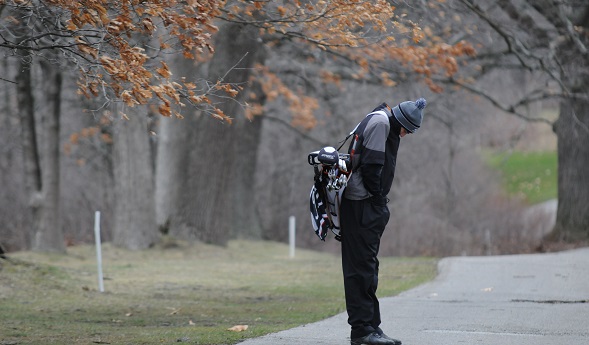
PHOTO: A golfer attempts to keep warm during a round on a dreary day earlier this season. (Click to see more at HighSchoolSportsScene.com.)
Rep Council Wrap-Up: Fall 2021
By
Geoff Kimmerly
MHSAA.com senior editor
December 9, 2021
The authorization to use digital ticketing for Winter and Spring postseason events, an extension of the waiver for previous academic credit record and an adjustment to regular-season multi-media video regulations were the most notable actions taken by the Representative Council of the Michigan High School Athletic Association during its Fall Meeting on Dec. 3 in East Lansing.
Generally, the Council takes only a few actions during its Fall Meeting, with topics often introduced for additional consideration and action during its meetings in winter and spring. This Fall Meeting saw the Council take only a few actions, while the majority of discussion centered on topics expected to receive more specific consideration at MHSAA sport committee meetings this winter.
The Council approved the continued use of the GoFan digital ticketing system for the MHSAA’s Winter and Spring Tournament events. The MHSAA first began using GoFan digital ticketing during the 2020-21 school year to comply with state contact tracing requirements due to COVID-19, and continued with digital ticketing via that service this fall. Tickets from GoFan are purchased on a phone or other “smart” device, eliminating the exchange of cash and other contact at an event site.
Also due to COVID, and the related challenges of remote learning, the MHSAA had suspended its previous academic credit record rule requiring high school students to pass at least 66 percent of a full credit load during the previous academic term (semester or trimester) in order to be eligible for athletic activity. Middle school and junior high athletes must pass at least 50 percent of a full credit load. Based on member school feedback and input, the Council voted to continue suspension of this rule through the rest of the 2021-22 school year, but reinstate the regulation beginning Aug. 1, 2022. The MHSAA’s previous academic credit record rule serves as a minimum standard; school districts may mandate higher academic requirements for eligibility.
The Council also approved an adjustment to the MHSAA’s video broadcast rules for regular-season events. Previously, those broadcasts could only be delivered to audiences through the National Federation of State High School Associations (NFHS) Network, or via a school-controlled webpage or social media page. The Council approved a change to provide an opportunity for schools, for regular-season events only, to allow MHSAA Tournament-credentialed media to broadcast their home events live, as long as a school is a member of the NFHS Network – which includes more than 520 of the MHSAA’s 750 member high schools. Postseason rights continue to belong to the MHSAA and its media partners.
A number of remaining discussions focused on results from this fall’s Update Meeting survey completed by administrators during the MHSAA’s annual presentations across the state. The Council considered survey data on a number of questions including whether the 11 and 8-Player Football Playoffs should be expanded to include nearly all schools. The Council also discussed questions on sports physicals, classification for postseason tournaments, sports-related summer transportation and contact days for coaches from teams not in season to work with their athletes, among other topics.
The Fall Meeting saw the addition of Ann Arbor Greenhills athletic director Meg Seng and Westland John Glenn athletic director Jason Malloy to the 19-person Council. Seng was appointed to a two-year term, and Malloy was appointed to finish the two-year term of former Romulus Summit Academy North athletic director William McCoy, who became part of the MHSAA staff in July. Also, Kris Isom, athletic director at Adrian Madison High School, was appointed to a second two-year term.
The Council reelected Scott Grimes, deputy superintendent for Grand Haven Area Public Schools, as its president; and Vic Michaels, director of physical education and athletics for the Archdiocese of Detroit, as secretary-treasurer. Novi High School principal Nicole Carter was elected Council vice president. (Grimes will become Grand Haven Schools’ superintendent Jan. 1.)
The Representative Council is the legislative body of the MHSAA. All but five members are elected by member schools. Four members are appointed by the Council to facilitate representation of females and minorities, and the 19th position is occupied by the Superintendent of Public Instruction or designee.
The MHSAA is a private, not-for-profit corporation of voluntary membership by more than 1,500 public and private senior high schools and junior high/middle schools which exists to develop common rules for athletic eligibility and competition. No government funds or tax dollars support the MHSAA, which was the first such association nationally to not accept membership dues or tournament entry fees from schools. Member schools which enforce these rules are permitted to participate in MHSAA tournaments, which attract more than 1.4 million spectators each year.