

Get Prepped for a Fantastic Finale
May 24, 2013
By Geoff Kimmerly
Second Half editor
We love this time of year. And not just because school is nearly out for summer.
There’s little argument that the week ahead is the most exciting of each MHSAA school year. And you’ll want to set your bookmarks for MHSAA.com and Second Half for updated results and coverage not just next week – but through the rest of this spring season.
 The MHSAA.com Score Center is our home for scores from all District softball, baseball and soccer games, which begin Tuesday. You also can view real-time brackets for every District by going to the “Sports” page for each, and updated brackets for lacrosse by visiting our girls and boys pages for that sport as well.
In the Lower Peninsula, we’ll have same day or next morning results as golf Districts are played, and first-day results from next weekend’s Girls Tennis Finals on May 31 – followed by final results at the conclusion of play June 1. We’ll post Finals results for Upper Peninsula golf and tennis as we receive them Wednesday and Thursday, and then results for all seven Lower and Upper Peninsula Track and Field Finals as they come in June 1.
But results are only the start. As we have during the fall and winter, Second Half will provide coverage including photos from every MHSAA Final – beginning with Wednesday’s Upper Peninsula Girls and Boys Golf and Boys Tennis Finals. Keep an eye on Second Half throughout the week, or follow the Second Half feed on the cover page of MHSAA.com.
Transfer rule clarification
We released Monday the actions our Representative Council took earlier this month at its Spring Meeting, including an addition to the athletics-related portion of our transfer rule. Based on some questions we’ve received and read, here’s some further explanation of what will be installed for 2014-15:
The longer period of ineligibility for athletes who transfer because of athletics is not new. This has previously existed for cases in which a school could prove that it lost a student to another school purely for sports-related reasons.
What’s new is what must be proven and by whom for the longer ineligibility period to take effect. Now, a school that lost a student does not have to file a report with the MHSAA for the case to be considered. As long as one of a set of offending activities can be verified – including practicing, competing or training with a member of the new school’s coaching staff during summer or non-school sports activities or seasons – that student will have to sit 180 days instead of the usual period of roughly a semester. The 15 exemptions that allow a student to be eligible immediately – like making a full move to a new district or a student’s school closing – may still apply.
So, to conclude: The longer athletics-related ineligibility period is not new, just how athletics-related transfers are considered and reported. Click to read the full release.
Kickoff is coming
And that means we’re collecting varsity football schedules.
In fact, we have most of them thanks to our athletic directors, their secretaries, coaches and many others who chip in to help us keep complete and accurate information throughout the season.
But there are still plenty of steps in getting ready for August – and a huge one is locking down correct leagues for our teams this season, especially as schools continue to switch things up.
Check out your school’s schedule page by click on the “Schools” button in the menu bar at the top of MHSAA.com and searching for your school. Once on the school page, click the blue “Boys” button next to football. The schedule will appear in the middle of the page, with standings to the left.
See an error in a schedule or the standings? Email me at [email protected]. I thank you in advance.
Kramer’s words of wisdom
Long before Roy Kramer served as athletic director at Vanderbilt University, commissioner of the Southeastern Conference and creator of the Bowl Championship Series (BCS) for Division I college football, he coached multiple sports at East Lansing High School.
He recently was named winner of this year’s Duffy Daugherty Award, given in honor of the former Michigan State University coach to a valued coach or contributor to college football. The award, presented in East Lansing, is among those recognized by the College Football Hall of Fame.
Kramer finished his acceptance speech with a stirring endorsement of the sport that brought the crowd of more than 300 to its feet. If you’re a fan, former or current player or coach, see below.
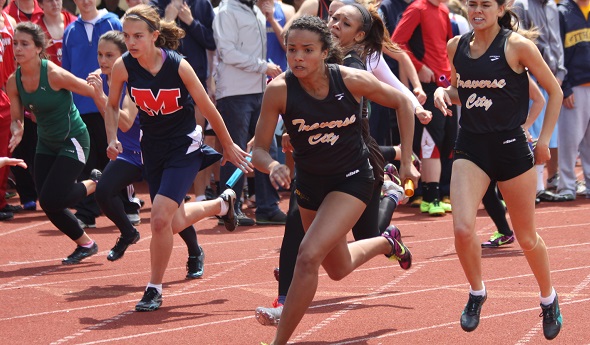
PHOTO: Athletes race toward the finish of a relay during this spring's Alma College Invitational. (Click to see more at HighSchoolsSportsScene.com.)
Off to Superb Start, Three Rivers Eager to Build on Program-Best Run
By
Scott Hassinger
Special for MHSAA.com
April 14, 2026
THREE RIVERS – The Three Rivers varsity baseball team reached historic heights last spring with an experienced group of seniors and talented underclassmen in Scott Muffley's return to the third-base coaching box.
 Three Rivers caught fire during the 2025 postseason and finished 25-15 overall, winning Division 2 District and Regional championships before falling 10-0 in its Division 2 Quarterfinal to eventual champion Ada Forest Hills Eastern. The Regional title was the program's first.
Muffley, a Three Rivers alumnus and long-time marketing teacher at the high school, begins his second season of this second tenure after previously guiding the Wildcats to a District title in 2010. He later enjoyed a successful stint as Schoolcraft's head baseball coach before resigning to follow the careers of his daughter Josie in Division I softball at Florida State and son Jordyn in minor league baseball.
Even though he graduated eight seniors, Muffley returns six starters, including senior starting first and third baseman Mason Awe.
"We got really hot towards the end of last season. We played our hearts out with great team baseball,” Awe said. “When everyone started listening to Coach Muffley near the end of the year, that's when we began hitting and playing very well. Our pitching and hitting are really strong again.”
Hitting, speed on the basepaths and defense will be Three Rivers' biggest team strengths. Awe was selected second-team all-state as a junior after batting .462 with 12 extra-base hits, 23 RBI, 26 runs scored and 12 stolen bases.
He had multiple college baseball scholarship offers but instead will attend Kalamazoo College and play football, hoping to compete for the starting quarterback job this fall.
Other key returnees for the Wildcats this season include junior pitcher and utility player Aiden Williams, junior catcher Tate Rohrer, senior centerfielder Brady Penny, senior pitcher and third baseman Gabriel Young, junior shortstop and pitcher Drake Dibble and senior outfielder Carson Bowley.
"Mason is going to be my utility guy. He can play anywhere in the infield and has a strong stick in our lineup," Muffley said.
"Tate will have to be a strong horse for us again behind the plate," Muffley added.
Dibble, a three-sport athlete, will be counted on heavily to make a lot of plays at shortstop.
"We had great team players last year. Our goal is to win more hardware and win our (group’s) first conference title. That hasn't been done in a very long time,” Dibble said. “The biggest thing is we just have to play for one another."
Sophomores Rylan Corte and Tyson Rohrer are making a big impact. Corte is a middle infielder, while Tyson Rohrer is a left-handed pitcher and roams the outfield.
"Rylan has a phenomenal glove and is very smooth," said Muffley, who added that Corte and Dibble already have executed a half-dozen double plays.
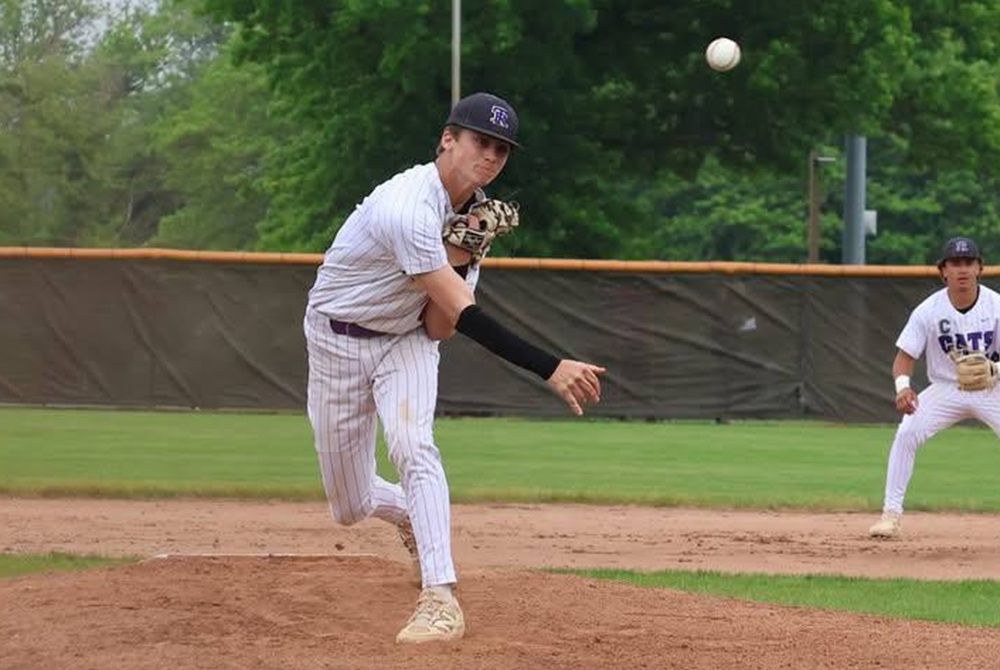
Williams returns as Three Rivers' ace on the pitcher's mound, where he compiled a 6-2 record with a 1.69 ERA as a sophomore with 49 strikeouts over 49 2/3 innings pitched.
Corte, Dibble, Tyson Rohrer, Penny, Cole Dunmier, Nowak and Young will shoulder a few innings on the mound as well.
 "It was tough as a pitcher my sophomore year in a conference as strong as ours, but I got solid experience. I took this year off from football and put 30 pounds on, and I have increased my fastball by six miles per hour," said Williams, who has verbally committed to play at Glen Oaks Community College in two years. His future plans are to study education and become a coach.
"Team chemistry is definitely a key. We had a lot of tough losses early last season, and once we came together as a team we all had one goal, to keep winning."
Despite graduating a significant class a year ago, Three Rivers hasn't missed a beat this spring getting off to an 8-0-1 start. That strong beginning includes league sweeps of Otsego and Sturgis.
The Wildcats are 4-0 in the Wolverine Conference entering today’s home doubleheader against Plainwell. They are shooting for the school's first league title since 1974.
When Muffley got an opportunity to return to the program before last season, he jumped at it.
"I had the itching to get back into coaching, When (athletic director) Matt Stofer asked me to come back, it was just perfect timing,” Muffley said. “I saw the group of individuals we had coming up. I knew there was a lot of talent there. The only thing we had to do was get them to buy into a system, and it took time.
“Things went very well for us last season once we did that. It involves not only the ability to play the game, but mental toughness, self-visualization, goal setting, positive and negative self-talk, being a good teammate and the ability to be coachable.
"What we have are a lot of good quality players who are interchangeable with plenty of arms, especially our younger kids. We just have to put everything together. Baseball is a mental game, 70 percent failure and 30 percent success. It's a learning process that many of these kids don't see until the next level. We're teaching that aspect to them now."
Penny, a four-year varsity player, serves as Three Rivers' leadoff hitter followed by Williams in the No. 2 slot, Young or Tyson Rohrer hitting third and Awe as the clean-up hitter.
Dibble, Tate Rohrer, Corte, Ethan Moreland and junior Alex Nowak also have provided plenty of punch at the plate during the early portion of the schedule. Three Rivers' goal at the plate is to hit .330. The Wildcats batted .326 a year ago, and that was a big reason for much of their success. They were a base-hitting team with just six home runs in 2025.
"Our achievements last season were big and helped put Three Rivers baseball on the map. I think we have a good squad. We want to win another District, Regional and keep working from there," said Penny, who anchors the Wildcats' starting outfield.
"Brady has blazing speed; the kid makes some unbelievable catches out there and tracks things down well. At the plate he can lay down a bunt and beat plays out," Muffley said.
When not pitching, Tyson Rohrer will play first, left field or right field. Bowley, junior Ethan Moreland and junior Lincoln Burkey also will log time in the Wildcats' outfield.
"My role as a senior is to keep everyone humble and to play for one another and be a real team, build chemistry and teach the younger guys to listen. If you can do all those things, you will succeed," Bowley said.
Sophomore JT Wilds, a pitcher and infielder, will split time between the junior varsity and varsity squads throughout the season, along with Cooper Goff (c, of).
Muffley's coaching staff consists of Derek Adams – one of Muffley's former players – along with Steve Dibble, Jerry Burgess and Chris Kearney.
"Our coaching staff is phenomenal. We all share the same philosophy and have the same level of passion for the game,” Muffley said. “They have all been a Godsend. We all get along and believe in playing the game the right way."
 Scott Hassinger is a contributing sportswriter for Leader Publications and previously served as the sports editor for the Three Rivers Commercial-News from 1994-2022. He can be reached at [email protected] with story ideas for Berrien, Cass, St. Joseph and Branch counties.
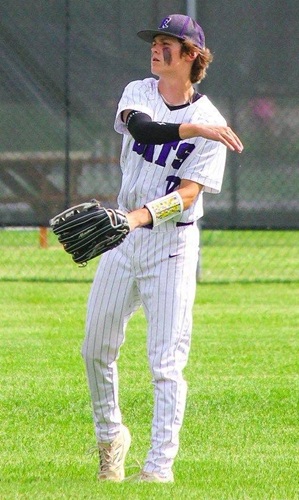
PHOTOS (Top) Three Rivers’ Aiden Williams delivers a pitch to the plate last season during a tournament game. (Middle) Brady Penny throws the ball back into the infield after making a catch in center field. (Photos courtesy of the Three Rivers athletic department.)