

Lee Takes Key Steps in Heart Safety with AED Purchase, CPR Training for All Athletes
By
Steve Vedder
Special for MHSAA.com
December 30, 2025
WYOMING – Tom DeGennaro never felt the typical dizziness, lightheadedness or nausea associated with the attack before he simply fell over in his Wyoming Lee classroom seven years ago.
His students moved quickly to help him, but within minutes, DeGennaro, one day past his 53rd birthday, was dead.
"Literally dead on the floor," DeGennaro said. "Just nothing there."
DeGennaro suffered an aneurysm, a bleeding of the brain which caused a subarachnoid hemorrhage or ventricular fibrillation which led to cardiac arrest. Fortunately, paramedics swiftly arrived at the school and with the help of an automated external defibrillator (AED), shocked DeGennaro back to life. Six months later DeGennaro, a former football and track coach at four West Michigan high schools, awoke from a coma.
"I was talking to the kids, then I just flopped over and started convulsing," DeGennaro said of his only recollection of the event.
It was an incident which stuck with Wyoming Lee cross country and track coach Greg Popma, who had coached under DeGennaro at Lee for many years. The more Popma saw overweight and obviously out-of-shape spectators huffing and puffing to make it to different points of a three-mile cross country course, the more it bothered him that real tragedy at a meet was only a heartbeat away.
So Popma did something about it.
With the help of a grant from the American Heart Association, Popma organized the purchase of an AED to be kept at all Legends sporting events. Sure, all Wyoming Lee school buildings already had an AED, but Popma worried that in a medical emergency such as a heart attack, minutes counted. Popma wasn't completely sold on the idea that an AED could be rushed to a nearby cross country course, softball field or tennis court in time to fend off disaster. Now an AED is kept at the ready disposal of a Wyoming Lee trainer.
Popma admits the odds of ever needing an AED at a cross country meet or any other sporting event are low. But he isn't willing to just accept low odds.
Instead of letting a near-tragedy to his coaching partner and friend just slide into memory, Popma chose to act.
"It made me think a little that something like that could happen at any time," Popma said of DeGennaro's experience. "It's not only about the kids, but about parents and others who probably shouldn't be running or going from place to place at a cross country meet. We needed to have something there."
While MHSAA guidelines require all head coaches at member high schools and middle schools to be CPR certified (with that certification usually including AED training), Popma took the training a step farther. With the help of Wyoming Lee teacher Mike Donovan, all athletes from 15 Lee teams have been trained and certified in the usage of CPR.
Popma said he's seen AEDs at countless cross country and track meets over 25 years of coaching. Most are easily within reach at the organizational tent at meets. And while he's never witnessed a heart attack at an event, Popma knows of a father dying at a Legends baseball game, and he's also old enough to remember 28-year-old Detroit Lions receiver Chuck Hughes dying on the field at Tiger Stadium in 1971 due to a heart attack.
To do nothing and hope for the best is not a plan, Popma said.
"I hope people understand, what good is it if you don't have an AED?" he said. "Obviously you can't have 100 percent certainty if you don't make the attempt. The response has been positive. Coaches think it's a good idea. It's like, 'Oh, I never thought of that.'"
DeGennaro is recovered from his heart attack, but in the last seven years figures he's been shocked over 90 times by the implantable cardioverter defibrillator (ICD) in his chest. DeGennaro is honored that his experience sparked safety improvements at Wyoming Lee.
"Love it," he said. "Even at professional events these things can happen. AEDs need to be at every place, every sporting event and not just for the kids. For the adults, too.
"Nothing is 100 percent. You bring band-aids to games and never get cut, right? There needs to be preparation for something like a heart attack. I have two goals in life now. Spreading the word of Christ and getting people to learn about CPR."
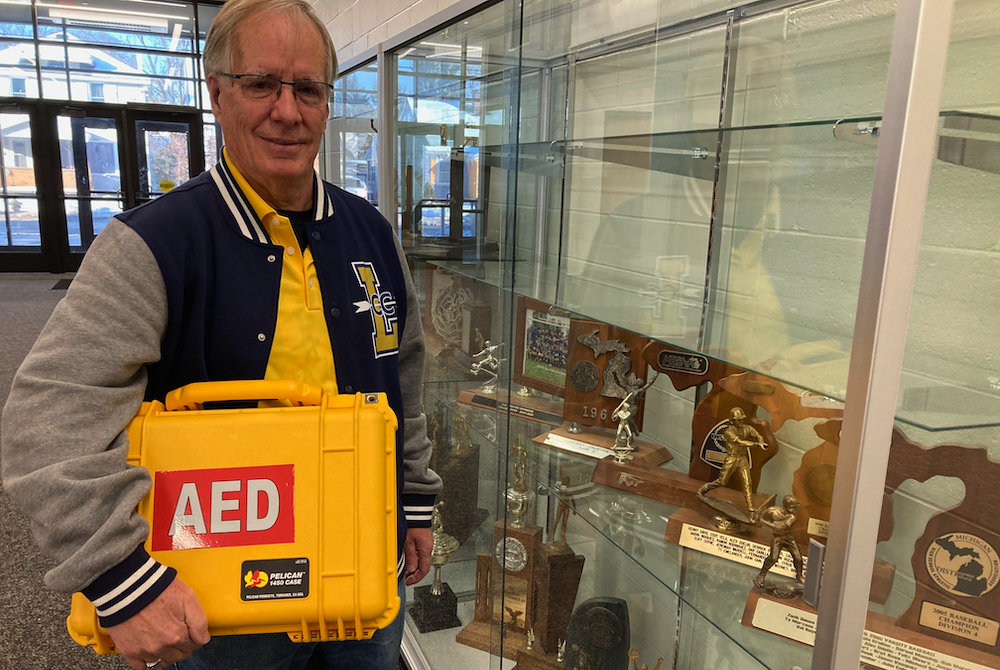
PHOTO Wyoming Lee cross country/track coach Greg Popma carries his school’s portable AED that is brought to school sporting events. (Photo by Steve Vedder.)

MHSAA Provides Heat Management Reminders in Advance of 2024 Fall Practices
By
Geoff Kimmerly
MHSAA.com senior editor
August 1, 2024
A stretch of hot and humid days downstate to finish July provided another reminder of why acclimatization to weather conditions is essential as teams at Michigan High School Athletic Association schools prepare for their first fall practices this month.
Each year, the MHSAA provides information to its member schools to help them prepare for hot weather practice and game conditions during the late summer and early fall. Practices for all Fall 2024 sports – cross country, football, Lower Peninsula girls golf, boys soccer, Lower Peninsula girls swimming & diving, Lower Peninsula boys and Upper Peninsula girls tennis, and volleyball – may begin Monday, Aug. 12.
The “Health & Safety” page of the MHSAA Website has links to several information sources, including the MHSAA preseason publication Heat Ways, which is available for download and includes valuable information on heat management in addition to requirements and resources regarding head injuries, sudden cardiac arrest and emergency action plans. Emergency action plans specific to sport and venue are a new requirement for schools beginning this fall season.
The first days of formal practices in hot weather should be more for heat acclimatization than the conditioning of athletes, and practices in such conditions need planning to become longer and more strenuous over a gradual progression of time. Schools also must consider moving practices to different locations or different times of day, or change practice plans to include different activities depending on the conditions. Furthermore, football practice rules allow for only helmets to be worn during the first two days, only shoulder pads to be added on the third and fourth days, and full pads to not be worn until the fifth day of team practice.
The MHSAA advises student-athletes to make sure to hydrate all day long – beginning before practice, continuing during and also after practice is done. Water and properly-formulated sports drinks are the best choices for hydration.
A number of member schools follow the MHSAA’s Model Policy for Managing Heat & Humidity, which while not mandated for member schools was adopted as a rule for MHSAA postseason competition in 2013. The plan directs schools to begin monitoring the heat index at the activity site once the air temperature reaches 80 degrees, and provides recommendations when the heat index reaches certain points, including ceasing activities when it rises above 104 degrees. (When the temperature is below 80 degrees, there is no combination of heat and humidity that will result in a need to curtail activity.) The model heat & humidity policy is outlined in a number of places on the MHSAA Website, including as part of Heat Ways.