

Lee Takes Key Steps in Heart Safety with AED Purchase, CPR Training for All Athletes
By
Steve Vedder
Special for MHSAA.com
December 30, 2025
WYOMING – Tom DeGennaro never felt the typical dizziness, lightheadedness or nausea associated with the attack before he simply fell over in his Wyoming Lee classroom seven years ago.
His students moved quickly to help him, but within minutes, DeGennaro, one day past his 53rd birthday, was dead.
"Literally dead on the floor," DeGennaro said. "Just nothing there."
DeGennaro suffered an aneurysm, a bleeding of the brain which caused a subarachnoid hemorrhage or ventricular fibrillation which led to cardiac arrest. Fortunately, paramedics swiftly arrived at the school and with the help of an automated external defibrillator (AED), shocked DeGennaro back to life. Six months later DeGennaro, a former football and track coach at four West Michigan high schools, awoke from a coma.
"I was talking to the kids, then I just flopped over and started convulsing," DeGennaro said of his only recollection of the event.
It was an incident which stuck with Wyoming Lee cross country and track coach Greg Popma, who had coached under DeGennaro at Lee for many years. The more Popma saw overweight and obviously out-of-shape spectators huffing and puffing to make it to different points of a three-mile cross country course, the more it bothered him that real tragedy at a meet was only a heartbeat away.
So Popma did something about it.
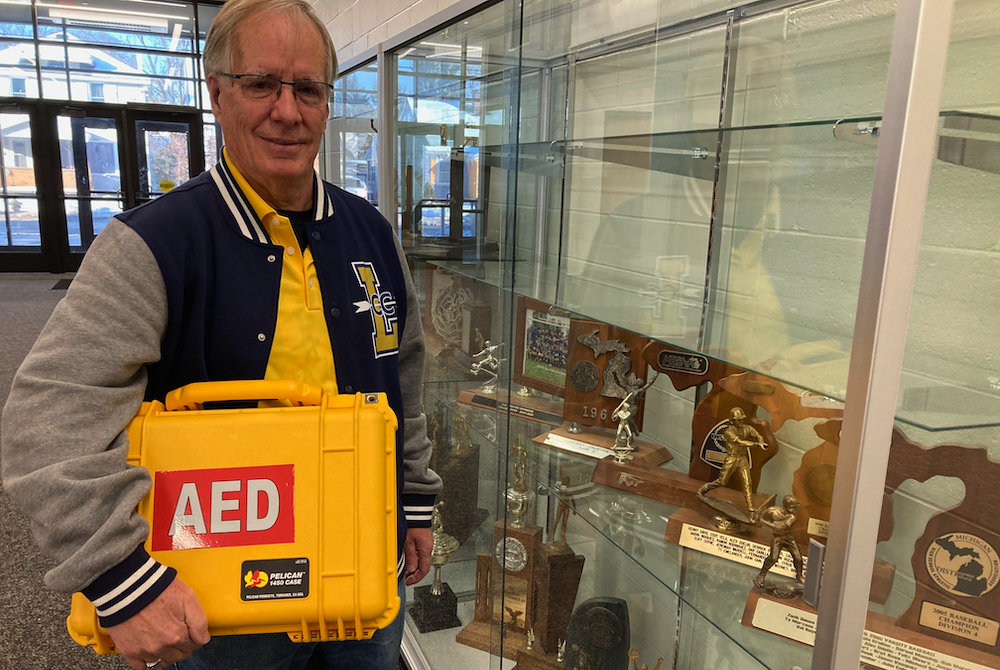
With the help of a grant from the American Heart Association, Popma organized the purchase of an AED to be kept at all Legends sporting events. Sure, all Wyoming Lee school buildings already had an AED, but Popma worried that in a medical emergency such as a heart attack, minutes counted. Popma wasn't completely sold on the idea that an AED could be rushed to a nearby cross country course, softball field or tennis court in time to fend off disaster. Now an AED is kept at the ready disposal of a Wyoming Lee trainer.
Popma admits the odds of ever needing an AED at a cross country meet or any other sporting event are low. But he isn't willing to just accept low odds.
Instead of letting a near-tragedy to his coaching partner and friend just slide into memory, Popma chose to act.
"It made me think a little that something like that could happen at any time," Popma said of DeGennaro's experience. "It's not only about the kids, but about parents and others who probably shouldn't be running or going from place to place at a cross country meet. We needed to have something there."
While MHSAA guidelines require all head coaches at member high schools and middle schools to be CPR certified (with that certification usually including AED training), Popma took the training a step farther. With the help of Wyoming Lee teacher Mike Donovan, all athletes from 15 Lee teams have been trained and certified in the usage of CPR.
Popma said he's seen AEDs at countless cross country and track meets over 25 years of coaching. Most are easily within reach at the organizational tent at meets. And while he's never witnessed a heart attack at an event, Popma knows of a father dying at a Legends baseball game, and he's also old enough to remember 28-year-old Detroit Lions receiver Chuck Hughes dying on the field at Tiger Stadium in 1971 due to a heart attack.
To do nothing and hope for the best is not a plan, Popma said.
"I hope people understand, what good is it if you don't have an AED?" he said. "Obviously you can't have 100 percent certainty if you don't make the attempt. The response has been positive. Coaches think it's a good idea. It's like, 'Oh, I never thought of that.'"
DeGennaro is recovered from his heart attack, but in the last seven years figures he's been shocked over 90 times by the implantable cardioverter defibrillator (ICD) in his chest. DeGennaro is honored that his experience sparked safety improvements at Wyoming Lee.
"Love it," he said. "Even at professional events these things can happen. AEDs need to be at every place, every sporting event and not just for the kids. For the adults, too.
"Nothing is 100 percent. You bring band-aids to games and never get cut, right? There needs to be preparation for something like a heart attack. I have two goals in life now. Spreading the word of Christ and getting people to learn about CPR."
PHOTO Wyoming Lee cross country/track coach Greg Popma carries his school’s portable AED that is brought to school sporting events. (Photo by Steve Vedder.)

How To Stay Hydrated: 7 Tips For An Active Summer
By
Nick Parkinson, M.Ed., AT, ATC, TSAC-F
Henry Ford Health
June 4, 2024
Not only is water an essential nutrient, it makes up your entire being. We’re 40 to 70 percent water, depending on fitness level and age. And while staying hydrated is always important, it may become more challenging as the weather heats up. Hard-working muscles generate more heat when they’re surrounded by hot air, making it harder for your body to maintain a normal temperature.
 Even a 1 to 2 percent loss of body weight from water can compromise your performance and impact your body’s ability to cool itself. The heart pumps harder, circulation slows and muscles fatigue more quickly. If the loss creeps up to 3 or 4 percent, you’ll be at increased risk of developing heat-related illness and injury, including cramps, heat exhaustion and heat stroke.
Even when you’re not active, your body loses more than a quart of water every day through urine, perspiration, sweat and breath, according to the National Institutes of Health. And most days, it’s more than 2.5 quarts.
The goal, of course, is to replace what’s lost. And with a little planning and preparation, you can during any outdoor activity, no matter what the thermometer says. Here’s how:
- Drink before you’re thirsty. Need to quench your thirst? Chances are you’re already dehydrated. Your best defense against dehydration is drinking water on a consistent basis so you never reach the point of thirst.
- Take frequent water breaks. While you might not want to disrupt your workout for a water break, taking time out for some much-needed liquid nourishment will pay off in the long run. Drink 8 to 10 ounces of water (about one full glass) before starting any activity. Once the games begin, drink another 7 to 10 ounces every 20 to 30 minutes.
- Track your intake. Many people don’t know how much water they should drink daily—or even how much water they’re typically downing. If you’re sipping on a 16-ounce bottle, drink eight of them each day—and even more if you’re exercising heavily.
- Consider an electrolyte drink. Working out for more than an hour? Consider sipping a sports drink—or nibbling on some pretzels or a banana to restore lost electrolytes (minerals in the blood that regulate bodily systems). Your body loses important electrolytes like sodium, potassium and chloride when you sweat. A good sports drink can help you replenish them. Coconut water is a great choice, but there are a slew of healthy, low-sugar options on the market.
- Munch on water-rich produce. Water-packed snacks, including melon, berries, bell peppers and grapes, are all good options. A bonus: All of these foods boast a decent hit of electrolytes, too!
- Step on the scale. Weigh yourself before and after a workout. If the scale shows a loss, replenish it with water (gulp 20 to 24 ounces of water for every pound lost). If you’ve lost 3 percent or more of your body weight, chances are you’re severely dehydrated.
- Watch your urine stream. It may seem gross, but checking your pee is probably the best way to determine whether you’re dehydrated. If it looks like watered down, colored lemonade, you’re probably in the clear. But if it’s a deep yellow or light orange, you’re probably not drinking enough fluids.
Keep in mind that heat exhaustion happens quickly—especially during summer activities. It can easily turn into heat stroke, a dangerous condition that can lead to organ damage, seizures, coma and even death. If you feel dehydrated, dizzy or overheated, get out of the sun, sip some water (slowly) and apply cooling compresses to your head, neck and chest. If your symptoms don’t improve quickly, get to a doctor or call 9-1-1.
Nick Parkinson, M.Ed., AT, ATC, TSAC-F, is the supervisor of athletic training and sports performance at Henry Ford Health. Learn more about Nick.
To find a sports medicine provider at Henry Ford Health, visit henryford.com/athletes or call 313-651-1969.