

Lee Takes Key Steps in Heart Safety with AED Purchase, CPR Training for All Athletes
By
Steve Vedder
Special for MHSAA.com
December 30, 2025
WYOMING – Tom DeGennaro never felt the typical dizziness, lightheadedness or nausea associated with the attack before he simply fell over in his Wyoming Lee classroom seven years ago.
His students moved quickly to help him, but within minutes, DeGennaro, one day past his 53rd birthday, was dead.
"Literally dead on the floor," DeGennaro said. "Just nothing there."
DeGennaro suffered an aneurysm, a bleeding of the brain which caused a subarachnoid hemorrhage or ventricular fibrillation which led to cardiac arrest. Fortunately, paramedics swiftly arrived at the school and with the help of an automated external defibrillator (AED), shocked DeGennaro back to life. Six months later DeGennaro, a former football and track coach at four West Michigan high schools, awoke from a coma.
"I was talking to the kids, then I just flopped over and started convulsing," DeGennaro said of his only recollection of the event.
It was an incident which stuck with Wyoming Lee cross country and track coach Greg Popma, who had coached under DeGennaro at Lee for many years. The more Popma saw overweight and obviously out-of-shape spectators huffing and puffing to make it to different points of a three-mile cross country course, the more it bothered him that real tragedy at a meet was only a heartbeat away.
So Popma did something about it.
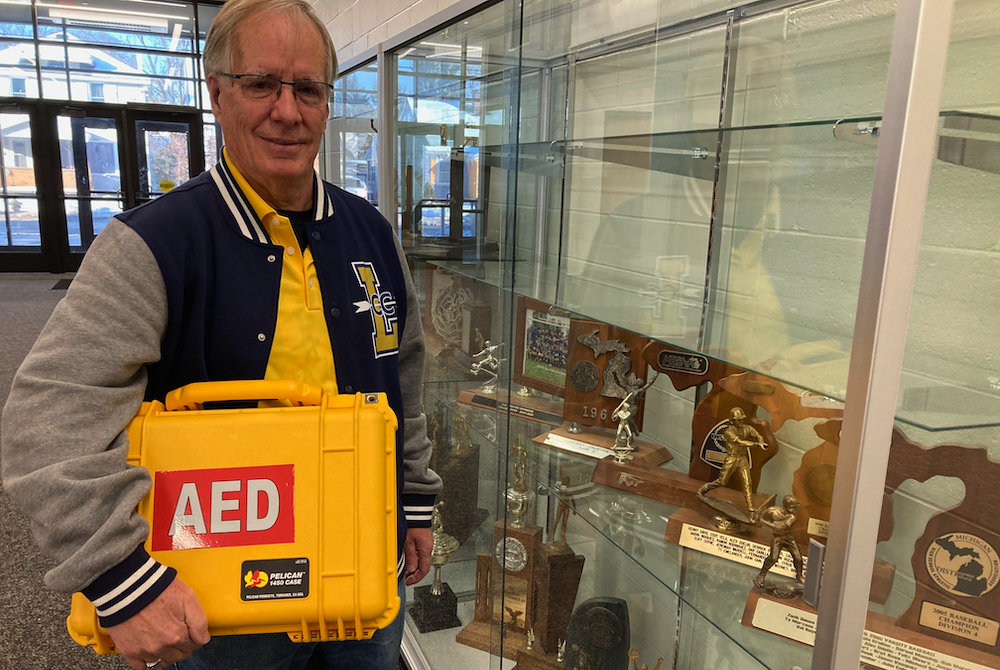
With the help of a grant from the American Heart Association, Popma organized the purchase of an AED to be kept at all Legends sporting events. Sure, all Wyoming Lee school buildings already had an AED, but Popma worried that in a medical emergency such as a heart attack, minutes counted. Popma wasn't completely sold on the idea that an AED could be rushed to a nearby cross country course, softball field or tennis court in time to fend off disaster. Now an AED is kept at the ready disposal of a Wyoming Lee trainer.
Popma admits the odds of ever needing an AED at a cross country meet or any other sporting event are low. But he isn't willing to just accept low odds.
Instead of letting a near-tragedy to his coaching partner and friend just slide into memory, Popma chose to act.
"It made me think a little that something like that could happen at any time," Popma said of DeGennaro's experience. "It's not only about the kids, but about parents and others who probably shouldn't be running or going from place to place at a cross country meet. We needed to have something there."
While MHSAA guidelines require all head coaches at member high schools and middle schools to be CPR certified (with that certification usually including AED training), Popma took the training a step farther. With the help of Wyoming Lee teacher Mike Donovan, all athletes from 15 Lee teams have been trained and certified in the usage of CPR.
Popma said he's seen AEDs at countless cross country and track meets over 25 years of coaching. Most are easily within reach at the organizational tent at meets. And while he's never witnessed a heart attack at an event, Popma knows of a father dying at a Legends baseball game, and he's also old enough to remember 28-year-old Detroit Lions receiver Chuck Hughes dying on the field at Tiger Stadium in 1971 due to a heart attack.
To do nothing and hope for the best is not a plan, Popma said.
"I hope people understand, what good is it if you don't have an AED?" he said. "Obviously you can't have 100 percent certainty if you don't make the attempt. The response has been positive. Coaches think it's a good idea. It's like, 'Oh, I never thought of that.'"
DeGennaro is recovered from his heart attack, but in the last seven years figures he's been shocked over 90 times by the implantable cardioverter defibrillator (ICD) in his chest. DeGennaro is honored that his experience sparked safety improvements at Wyoming Lee.
"Love it," he said. "Even at professional events these things can happen. AEDs need to be at every place, every sporting event and not just for the kids. For the adults, too.
"Nothing is 100 percent. You bring band-aids to games and never get cut, right? There needs to be preparation for something like a heart attack. I have two goals in life now. Spreading the word of Christ and getting people to learn about CPR."
PHOTO Wyoming Lee cross country/track coach Greg Popma carries his school’s portable AED that is brought to school sporting events. (Photo by Steve Vedder.)
The Dangers of Returning to a Sport Too Soon After an Injury
September 12, 2023
 When you've been hit with an injury, it's natural to want to get back to your regular activities as soon as possible. In fact, it's not uncommon for athletes to sidestep doctors' orders and return to the field or the court before an injury has healed.
"It doesn’t matter how much you train, or how much you prepare, injuries are going to happen, especially if you're an athlete," says Jamie Schwab, an athletic trainer at Henry Ford Health System. "But the real trouble arises when athletes try to play through their pain without allowing sufficient time for recovery."
Risks Of Returning Too Soon After Injury
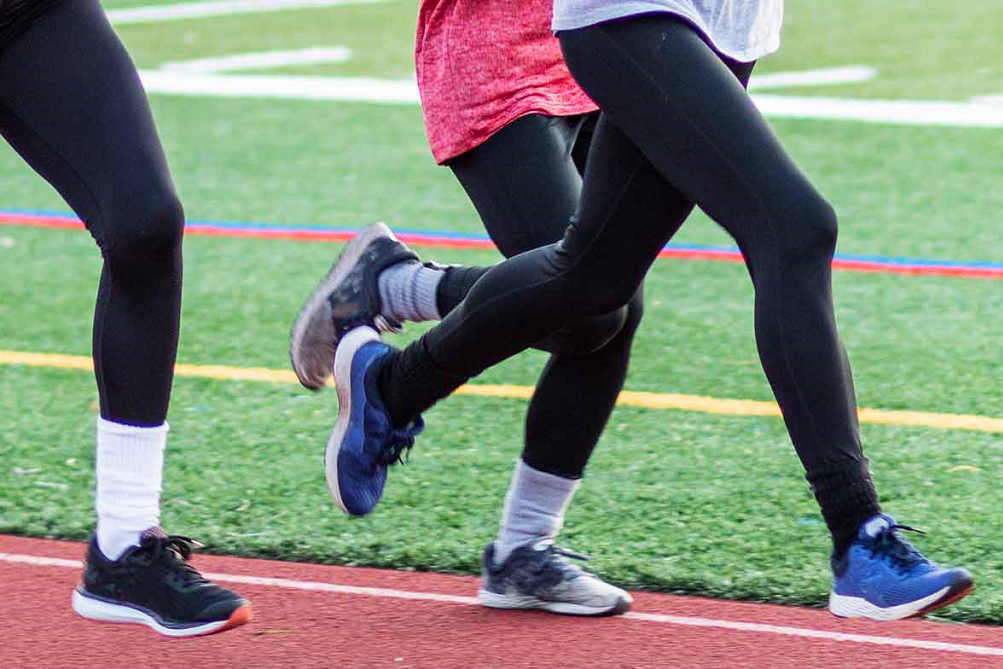
If you sprain your ankle during a cross country run, it can be tempting to finish the race. Unfortunately, hiding your pain and powering through the activity can actually make matters worse.
"If you continue to work out after suffering from an injury, you run the risk of furthering that injury," Schwab says. So what began as a minor ankle sprain can evolve into a major sprain that sidelines you for weeks.
Returning to play after surgery demands extra precautions. "Athletes are a lot more susceptible to re-injury after returning from surgery, especially if they don't complete the entire 9-month or year-long rehabilitation protocol," Schwab says. In some cases, you can exacerbate an injury to such a degree that you'll never be able to participate in the same capacity.
A Safe Return To Play
The road back to play after an injury is a long and winding one. Before you can even consider returning to exercise, you need to reduce swelling, get pain under control and get your range of motion back to almost normal.
"The recovery process takes time," Schwab says. "But if you stick with it, and you take it seriously, it's going to be a whole lot easier for you to return to the playing field in a timely manner."
Once you get pain and swelling under control, you can focus on agility and weight exercises that will help you regain strength and slowly return to baseline. The key tenets for a safer return to play:
► Be honest about your abilities: "So many athletes are afraid to tell the truth," Schwab says. "But if you're hurting and you're not competing at your full potential, you're letting your team down and yourself down, too." Even worse, you could increase your risk of further injury.
► Focus on building strength: Strength training is critical. It can help you become faster, stronger and more agile on the field. It can also help you recover more quickly after an injury.
► Listen to your body: If something doesn't feel right, pay attention to it. Talk to your athletic trainer or a physical therapist to get to the bottom of what's bugging you and put a plan in place to address it.
Boosting Performance Over The Long Haul
Unfortunately, not every coach and athletic trainer stresses the importance of a maintenance program. In fact, focused training and maintenance exercises are key to preventing injuries in the first place.
"The rehabilitation exercises you begin doing on day one after injury need to be maintained at least three to four times each week, indefinitely," Schwab says. "If you follow that regimen, all of your muscular nagging strains will no longer be a problem because your body is constantly adapting to the stresses. It's conditioned, it's strong, it can withstand the constant changes in direction."
Most importantly, don't be afraid to try complementary strategies. Practice using a foam roller, try cupping to release tension in the muscles and enhance blood flow and consider getting a monthly massage.
Jamie Schwab, AT, ATC, SCAT, CSCS, is an athletic trainer with Henry Ford Sports Medicine and works with student athletes at Edsel Ford High School. She is a National Strength and Conditioning Association-certified strength and conditioning specialist.
To find a sports medicine doctor or athletic trainer at Henry Ford, visit henryford.com/sports.