

Lee Takes Key Steps in Heart Safety with AED Purchase, CPR Training for All Athletes
By
Steve Vedder
Special for MHSAA.com
December 30, 2025
WYOMING – Tom DeGennaro never felt the typical dizziness, lightheadedness or nausea associated with the attack before he simply fell over in his Wyoming Lee classroom seven years ago.
His students moved quickly to help him, but within minutes, DeGennaro, one day past his 53rd birthday, was dead.
"Literally dead on the floor," DeGennaro said. "Just nothing there."
DeGennaro suffered an aneurysm, a bleeding of the brain which caused a subarachnoid hemorrhage or ventricular fibrillation which led to cardiac arrest. Fortunately, paramedics swiftly arrived at the school and with the help of an automated external defibrillator (AED), shocked DeGennaro back to life. Six months later DeGennaro, a former football and track coach at four West Michigan high schools, awoke from a coma.
"I was talking to the kids, then I just flopped over and started convulsing," DeGennaro said of his only recollection of the event.
It was an incident which stuck with Wyoming Lee cross country and track coach Greg Popma, who had coached under DeGennaro at Lee for many years. The more Popma saw overweight and obviously out-of-shape spectators huffing and puffing to make it to different points of a three-mile cross country course, the more it bothered him that real tragedy at a meet was only a heartbeat away.
So Popma did something about it.
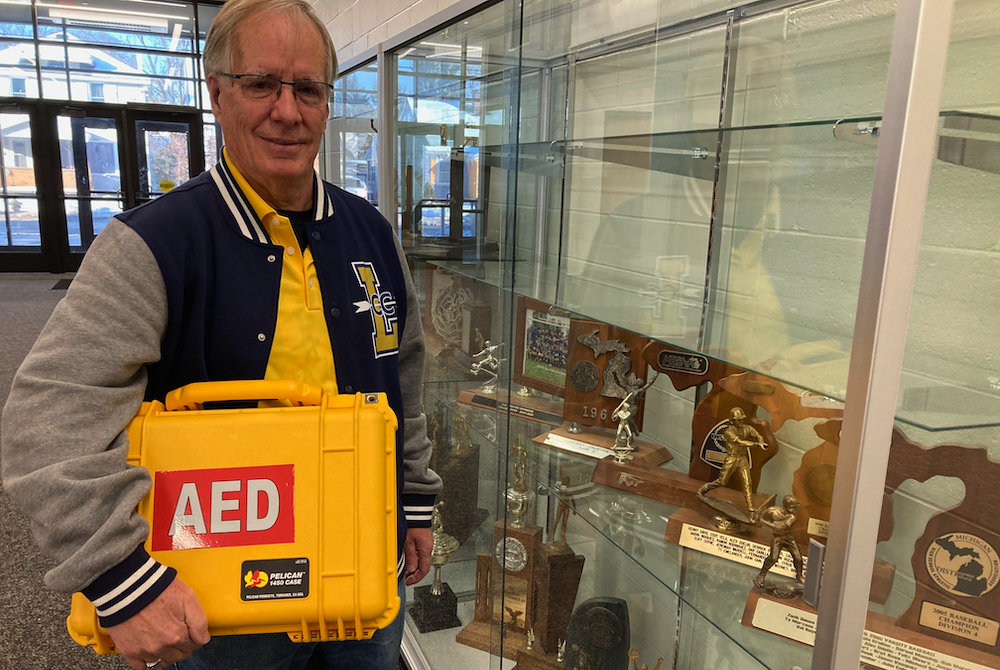
With the help of a grant from the American Heart Association, Popma organized the purchase of an AED to be kept at all Legends sporting events. Sure, all Wyoming Lee school buildings already had an AED, but Popma worried that in a medical emergency such as a heart attack, minutes counted. Popma wasn't completely sold on the idea that an AED could be rushed to a nearby cross country course, softball field or tennis court in time to fend off disaster. Now an AED is kept at the ready disposal of a Wyoming Lee trainer.
Popma admits the odds of ever needing an AED at a cross country meet or any other sporting event are low. But he isn't willing to just accept low odds.
Instead of letting a near-tragedy to his coaching partner and friend just slide into memory, Popma chose to act.
"It made me think a little that something like that could happen at any time," Popma said of DeGennaro's experience. "It's not only about the kids, but about parents and others who probably shouldn't be running or going from place to place at a cross country meet. We needed to have something there."
While MHSAA guidelines require all head coaches at member high schools and middle schools to be CPR certified (with that certification usually including AED training), Popma took the training a step farther. With the help of Wyoming Lee teacher Mike Donovan, all athletes from 15 Lee teams have been trained and certified in the usage of CPR.
Popma said he's seen AEDs at countless cross country and track meets over 25 years of coaching. Most are easily within reach at the organizational tent at meets. And while he's never witnessed a heart attack at an event, Popma knows of a father dying at a Legends baseball game, and he's also old enough to remember 28-year-old Detroit Lions receiver Chuck Hughes dying on the field at Tiger Stadium in 1971 due to a heart attack.
To do nothing and hope for the best is not a plan, Popma said.
"I hope people understand, what good is it if you don't have an AED?" he said. "Obviously you can't have 100 percent certainty if you don't make the attempt. The response has been positive. Coaches think it's a good idea. It's like, 'Oh, I never thought of that.'"
DeGennaro is recovered from his heart attack, but in the last seven years figures he's been shocked over 90 times by the implantable cardioverter defibrillator (ICD) in his chest. DeGennaro is honored that his experience sparked safety improvements at Wyoming Lee.
"Love it," he said. "Even at professional events these things can happen. AEDs need to be at every place, every sporting event and not just for the kids. For the adults, too.
"Nothing is 100 percent. You bring band-aids to games and never get cut, right? There needs to be preparation for something like a heart attack. I have two goals in life now. Spreading the word of Christ and getting people to learn about CPR."
PHOTO Wyoming Lee cross country/track coach Greg Popma carries his school’s portable AED that is brought to school sporting events. (Photo by Steve Vedder.)
Summer Is Peak Time For Outdoor Sports Injuries
June 6, 2023
Summertime is the ideal time for outdoor activities like boating, swimming, barbecues and picnicking. It’s also ripe for sports injuries, says Nancy White, M.D., a Henry Ford Health sports medicine physician.
 “We encourage people of all ages to get outside and take advantage of all the activities available during the summer. It’s very important, though, that people keep safety top of mind to reduce their risk of injury,” Dr. White says.
Dr. White counts these as the five most common injuries:
- Sprains and strains
- Fractures
- Trampoline injuries
- Bike injuries
- Overuse injuries
“Trampoline injuries are mostly caused by jumping, either by an awkward landing or colliding with someone,” Dr. White says. “Overuse injuries happen when someone overextends themselves in a particular activity, whether it’s attending multiple sports camps or simply exercising outdoors.”
Dr. White recommends these three tips for reducing your risk of injury:
- Stay hydrated. Replenish your fluid intake with frequent water breaks.
- Perform warm-up exercises before your run or your game.
- Wear protective gear. Whether bike riding, rollerblading or skateboarding, a helmet and protective pads are a must. Obey traffic laws and store your phone away.
For soft-tissue injuries strains and sprains, Dr. White says the R.I.C.E. method is an immediate at-home treatment you can apply to reduce swelling and pain. It stands for Rest, Ice, Compression and Elevation. Over-the-counter anti-inflammatory medicine, such as ibuprofen (like Advil) or acetaminophen (like Tylenol), can help too.
If the pain worsens to the point that it interferes with your usual activities or sleep, make an appointment with your doctor or a sports medicine doctor.
Seek medical attention immediately if your pain was caused by a particularly forceful impact, you suspect a broken bone, or if the injury is accompanied by:
- Significant swelling
- Redness
- Tenderness and warmth around the joint
- Significant pain
- Fever
For injuries that don’t improve and require medical attention, visit henryford.com/sports and request an appointment with a Henry Ford sports medicine doctor.
Dr. Nancy White is a sports medicine doctor seeing patients at Henry Ford Medical Center-Columbus in Novi and at the William Clay Ford Center for Athletic Medicine in midtown Detroit.