


Stretching Done Right: Easy Tips To Stay Limber
By
Christina Chapski, Ed.D., AT, ATC
Henry Ford Health
November 7, 2023
Stretching is more than just a workout suggestion – it's a vital way to avoid injury and get the most out of your activity. You wouldn’t take your car on a long drive without making sure it’s in tip-top shape, right? So before you work up a sweat, work up a stretch.
 One important thing to keep in mind is that dynamic stretching is best. It uses momentum to propel your muscles into an extended range of motion. Unlike static stretching, where you remain in an almost still position, a dynamic warm up is the best way to get your blood flowing and your heart rate pumping.
To get your muscles primed for activity, high knees, "butt kicks" and side shuffling are more effective than standing quad stretches. If you are doing an upright quad stretch, it's best to lean back a little to get the full benefit, since your quads originate from above the hip. Also, remember to always grab the ankle and not the toe.
Here are some other helpful hints on how to warm up the right way:
- For hamstrings: The hamstring muscle attaches to your bones below the knee at the back of the leg, so you want to avoid bending them (which ultimately shortens the muscle you’re trying to stretch). When bending at your back, make sure to keep your spine straight like a table to elongate those muscles. Keep your chin up. If you bend down to touch your toes, there’s no need to hover closer than six inches above the ground – unless you’re able to comfortably do so.
- For pectoral muscles: "Door stretches” offer the best stretch. Simply place your arms out on either side of you as if you were making a “T” with your body. Then, bend your arms up at your elbows so they each form a 90-degree angle. In this position, put your arms on either side of a door frame, with your body within the frame’s opening and walk forward slowly to open up the chest.
- For triceps: Make a gesture like you’re scratching your upper back and be sure to keep your elbows in for maximum benefit.
- For the torso: The iron cross stretch involves putting your arms out at your sides like a “T” and then rotating at your waist side to side. You can also drop down toward the floor and reach for your toes, one side at a time.
Other great tips to add to your stretching repertoire include:
- Don’t forget to keep breathing throughout your stretch. It will help keep your muscle tissue oxygenated.
- Hold each stretch for 10 to 20 seconds, aiming for three repetitions of each. If you prefer, you can split up your stretching throughout the day, or use props like foam rollers to help ease tension in your muscles and break up knots.
- Listen to your body while stretching. Slight pain is acceptable, but if your muscles start shaking, it's a warning for you to stop.
- Don't give up. Stretching progress can be slow, so comparing your progress to that of others will only discourage you. Pay attention to your own progress. Seeing your body become more flexible when you previously weren’t limber will help keep you motivated and is the ultimate reward.
To find a sports medicine doctor or athletic trainer at Henry Ford, visit henryford.com/athletes. Christina Chapski, Ed.D., AT, ATC, is the director of athletic training and community outreach at Henry Ford Health. Read more of Chapski's articles.
MHSAA Provides Heat & Hydration Reminders with 2026 Fall Practices Soon to Begin
By
Geoff Kimmerly
MHSAA.com senior editor
August 3, 2026
Multiple regions across Michigan approached record-high temperatures this summer, just another reminder of the importance of adhering to hot-weather precautions as schools and families prepare for the start of fall sports practices and competitions this month at Michigan High School Athletic Association member schools.
Each year, the MHSAA provides information to its member schools to help them prepare for hot-weather practice and game conditions during the late summer and early fall. Practices for all Fall 2026 sports – cross country, field hockey, football, Lower Peninsula girls golf, boys soccer, Lower Peninsula girls swimming & diving, Lower Peninsula boys and Upper Peninsula girls tennis, and girls volleyball – may begin Monday, Aug. 10.
The “Health & Safety” page of MHSAA.com has links to several information sources, including the MHSAA preseason publication Heat Ways, which is available for download and includes valuable information on heat management in addition to requirements and resources regarding head injuries, sudden cardiac arrest and emergency action plans.
Heat Ways also again includes a statement on air quality and its potential effects on activity, given conditions across the state especially over the last month resulting from wildfires and smoke they have created.
The first days of formal practices in hot weather should be more for heat acclimatization and instruction than the conditioning of athletes, and practices in such conditions need planning to become longer and more strenuous over a gradual progression of time. Schools also must consider moving practices to different locations or different times of day, or changing practice plans to include different activities depending on the conditions. Furthermore, football practice rules allow for only helmets to be worn during the first two days, only shoulder pads to be added on the third and fourth days, and full pads to not be worn until the fifth day of team practice.
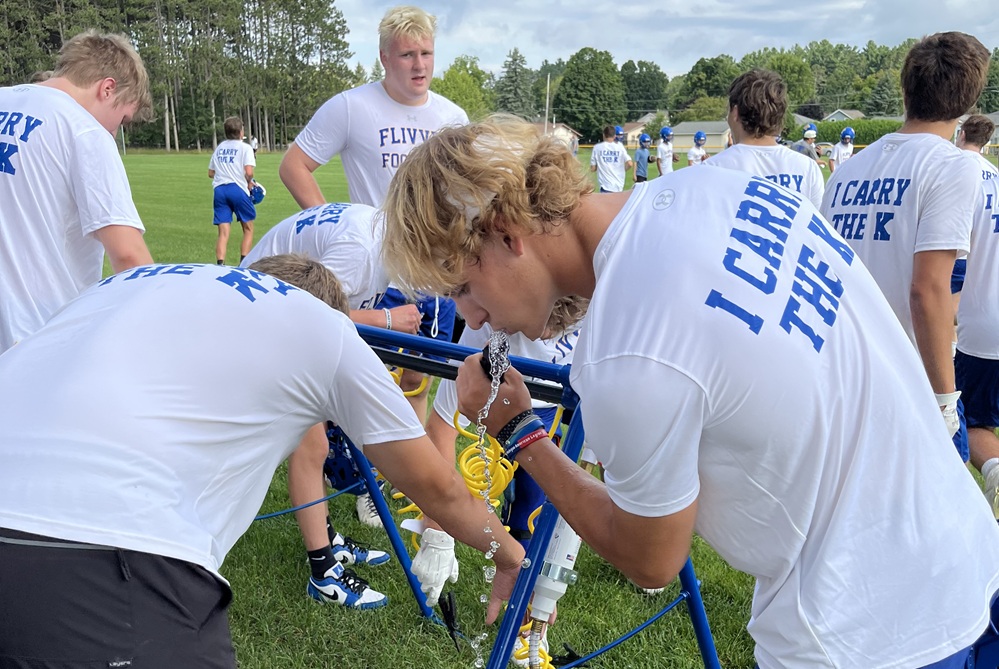
The MHSAA advises student-athletes to make sure to hydrate all day long – beginning before practice, continuing during and also after practice is done. Water and properly-formulated sports drinks are the best choices for hydration. The National Federation of State High School Associations (NFHS) advises that a 6-to-8 percent carbohydrate formulation is the maximum that should be utilized in a sports drink, while fruit juices with greater than 8-percent carbohydrate content and carbonated soda can both result in a bloated feeling and abdominal cramping.
A number of member schools follow the MHSAA’s Model Policy for Managing Heat & Humidity, which while not mandated for member schools was adopted as a rule for MHSAA postseason competition in 2013. The plan directs schools to begin monitoring the heat index at the activity site once the air temperature reaches 80 degrees and provides recommendations when the heat index reaches certain points, including ceasing activities when it rises above 104 degrees. (When the temperature is below 80 degrees, there is no combination of heat and humidity that will result in a need to curtail activity.)
The model heat & humidity policy is outlined in a number of places on the MHSAA Website, including as part of Heat Ways and the football-focused Safety Blitz preseason guide.
PHOTO Kingsford football players hydrate during last season's first day of practice. (Photo by Keith Dunlap.)