


Howell Puts Heart Into Memorial Meet
August 29, 2013
By Geoff Kimmerly
Second Half editor
An online tribute to Mackenzie Watts describes how she “made the people and world around her better.”
The Howell swimming and diving community continues to work so that her memory makes those who come after her safer as well.
 Watts died in 2005 after suffering a cardiac arrhythmia. She was a 15-year-old sophomore and key cog on her high school team.
This past weekend, for the sixth straight season, the Highlanders hosted the Kenzie Classic, an invitational that served as a fundraiser for the Howell program and annual Mackenzie Watts scholarship – plus served to promote heart screenings by local National Diagnostic Services in their “HeartMobile” parked outside the pool.
NDS, which also has held screening events at Northville, Canton and Middleville Thornapple Kellogg schools among others, screened 20 students during this Kenzie Classic, said Wellness Director Heidi Enders.
Tests are ultrasound-based and non-invasive, and include an EKG to examine the heart’s electrical system for arrhythmias and an echocardiogram to examine the heart’s structure in case there is a thickening of the muscle (known as hyperthrophic cardiomyopathy). Adults were charged $199 and students $75, with discounted rates for adults in groups and children.
Click to check out coverage of the event from the Livingston County Daily Press & Argus.
Records Revamp
While tracking down 660 football schedules (give or take a few) took up most of the summer, there still was time for a few additions to the MHSAA record book – with more to come.
Track and field fans will notice records from retired yardage events (pre-1982 or earlier depending on the MHSAA class) have been added to the online records here for boys and here for girls.
Cross country fans should check out our lists of top MHSAA Finals times for every division and every class, plus overall top 10 lists for both boys and girls since the race was set to five kilometers in 1980. Click here for girls and here for boys.
Also added or updated were team championship counts for both cross countries, volleyball and girls golf. Click to check out girls golf here and volleyball here.
Fond Football Memories
It has been 30 years since former Genesee all-state running back Don Robinson became the fourth player in Genesee County history to run for more than 300 yards in one game – which he did in gaining 317 on Sept. 23, 1983.
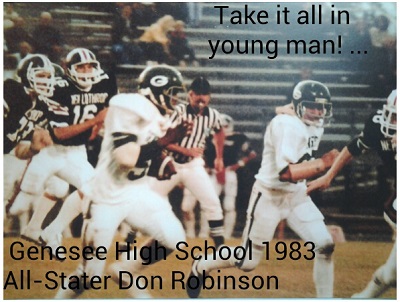 High school football and those memories remain close to his heart even after going on to play at Eastern Michigan University, a stint in the U.S. Navy and a move to Georgia.
He’s paid attention over the years as that “300 club” has grown to 22 players including current New Orleans Saints back Mark Ingram, Jr., and the University of Michigan’s Thomas Rawls.
He’s also a regular reader of Second Half, and asked to send along some words of wisdom to those who will be taking the field to begin the season this weekend:
“When you run out onto the field this season, do me a favor. At least once, pause.
“Look around you. Look at the lights in the sky. See the faces of those that have come to see you play. Listen to the band and the cheerleaders. Look into the eyes of your teammates ...
“Take it all in. When you’re older and miss this amazing game that you are playing, you’ll be glad you did.”
PHOTOS: (Top) A swimmer takes the lead during a race at Saturday's Kenzie Klassic at Howell High School. (Photo courtesy of Howell High School.) (Middle) Genesee graduate Don Robinson runs the ball during the 1983 season. (Photo courtesy of Don Robinson.)

Today in the MHSAA: 5/19/26
By
Geoff Kimmerly
MHSAA.com senior editor
May 19, 2026
1. BOYS GOLF Holland Christian came back from a double-digit deficit to claim the Ottawa-Kent Conference Black Tournament championship – Holland Sentinel
2. BOYS GOLF McBain Northern Michigan Christian – No. 2 in Lower Peninsula Division 4 – won the Highland Conference Tournament, with Blair DeZeeuw carding two eagles in finishing first individually – Traverse City Record-Eagle
3. GIRLS SOCCER Division 1 No. 7 Hartland handed Division 2 No. 5 DeWitt its only loss this season, 1-0 – Livingston Daily Press & Argus
4. BOYS GOLF LPD2 No. 10 Macomb Lutheran North broke Warren De La Salle Collegiate’s three-year winning streak at the Macomb County Tournament, but the Pilots’ Julian Sinishtaj was the individual medalist – Macomb Daily
5. GIRLS TENNIS Bay City Western claimed six flights in winning the Bay County Championship – Bay City Times
6. SOFTBALL Division 3 top-ranked Evart swept McBain to finish its Highland Conference schedule undefeated – Cadillac News
7. BOYS LACROSSE Temperance Bedford opened its Division 2 Regional with a big win over Monroe St. Mary Catholic Central – Monroe News
8. BASEBALL Division 1 No. 5 Bay City Western downed Flint Powers Catholic in the first game of a Saginaw Valley League championship series – Bay City Times
9. GIRLS SOCCER Melanie Kolnitys had three goals in Midland Dow’s Senior Night win over Division 3 No. 8 Frankenmuth – Midland Daily News
10. GIRLS SOCCER Bay City John Glenn downed Saginaw Heritage – WNEM